
[论文解读] Secure Computation Offloading in Blockchain based IoT Networks with Deep Reinforcement Learning
本文提出了一种基于区块链保护的深度强化学习(DRL)计算卸载框架,用于移动边缘-云物联网网络,联合优化卸载决策、边缘资源分配、带宽以及智能合约使用,以最小化延迟、能耗和成本。所提出的 ADRLO 方案采用双双重Q网络,在真实和仿真环境中均优于基线方法。
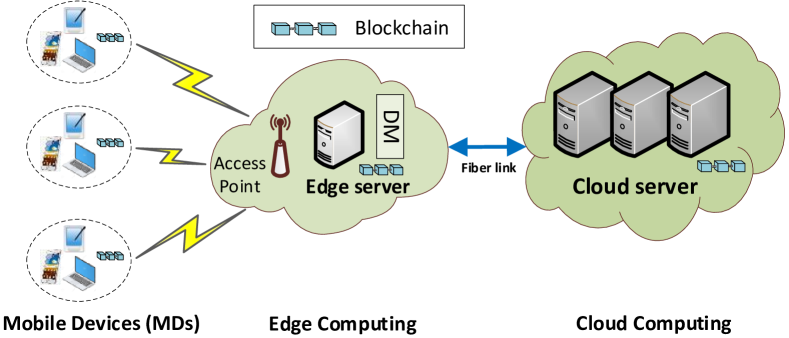
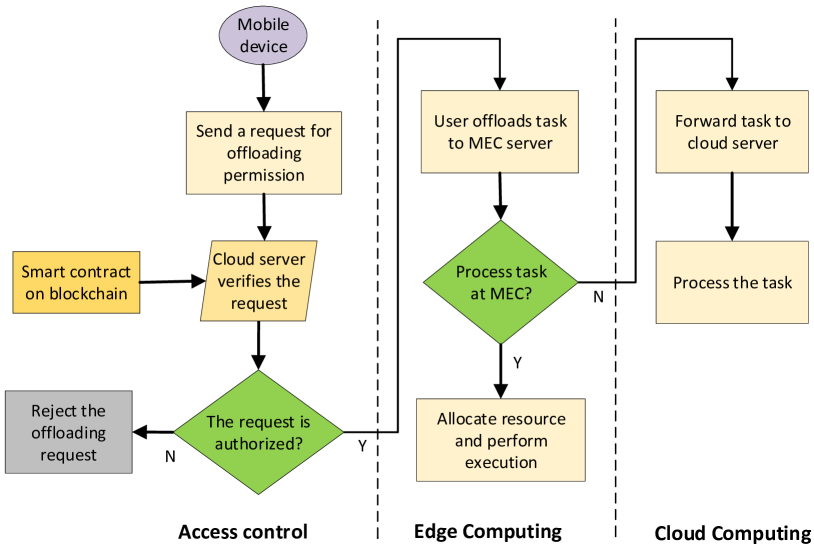
For current and future Internet of Things (IoT) networks, mobile edge-cloud computation offloading (MECCO) has been regarded as a promising means to support delay-sensitive IoT applications. However, offloading mobile tasks to the cloud is vulnerable to security issues due to malicious mobile devices (MDs). How to implement offloading to alleviate computation burdens at MDs while guaranteeing high security in mobile edge cloud is a challenging problem. In this paper, we investigate simultaneously the security and computation offloading problems in a multi-user MECCO system with blockchain. First, to improve the offloading security, we propose a trustworthy access control using blockchain, which can protect cloud resources against illegal offloading behaviours. Then, to tackle the computation management of authorized MDs, we formulate a computation offloading problem by jointly optimizing the offloading decisions, the allocation of computing resource and radio bandwidth, and smart contract usage. This optimization problem aims to minimize the long-term system costs of latency, energy consumption and smart contract fee among all MDs. To solve the proposed offloading problem, we develop an advanced deep reinforcement learning algorithm using a double-dueling Q-network. Evaluation results from real experiments and numerical simulations demonstrate the significant advantages of our scheme over existing approaches.
研究动机与目标
- 为解决物联网网络中因不可信移动设备(MDs)导致的移动边缘-云计算卸载(MECCO)安全漏洞问题。
- 设计一种可信的去中心化访问控制机制,利用区块链和智能合约,防止未经授权的卸载并保护云资源。
- 在多用户MECCO系统中,联合优化卸载决策、边缘资源分配、无线频带分配以及智能合约使用。
- 最小化所有MDs的长期系统成本,包括计算延迟、能耗以及智能合约费用。
提出的方法
- 提出一种基于区块链的访问控制机制,利用智能合约在卸载前对MDs进行身份认证和授权,确保信任与完整性。
- 构建联合优化问题,以最小化总系统成本,涵盖卸载决策、边缘资源分配、带宽分配以及智能合约使用。
- 设计一种先进的DRL算法,采用双双重深度Q网络(DDQN)来学习高维状态-动作空间中的最优卸载策略。
- 采用双双重Q网络架构,通过解耦价值与优势估计,提升学习的稳定性和收敛性。
- 利用真实物联网数据和仿真环境训练并评估DRL智能体,以应对动态、多用户的MECCO环境。
- 将所提出的ADLRO方案与基线方法进行对比:一种不考虑边缘资源分配,另一种不考虑带宽分配,以验证资源感知优化的有效性。
实验结果
研究问题
- RQ1如何利用区块链和智能合约建立可信的去中心化访问控制机制,以保障物联网网络中计算卸载的安全性?
- RQ2在多用户MECCO环境中,如何制定最优联合策略,以最小化卸载决策、边缘资源分配、带宽分配以及智能合约使用带来的总系统成本?
- RQ3在动态且高维的约束条件下,采用双双重Q网络架构的深度强化学习智能体在学习最优卸载策略方面表现如何?
- RQ4与传统优化方法及基线DRL方法相比,所提出的基于DRL的方案在多大程度上降低了系统成本(延迟、能耗、智能合约费用)?
主要发现
- 所提出的ADLRO方案通过联合优化卸载决策、边缘资源和带宽分配,在所有MDs中实现了最低的总卸载成本。
- 与不考虑边缘或带宽优化的基线方案相比,ADLRO方案显著降低了总卸载成本,如图11所示。
- 在不同MD数量下,ADLRO方案的智能合约成本始终低于DRLO基线,这是由于优化的学习策略减少了冗余的合约执行。
- ADLRO基于DRL的算法在60个MD的情况下,每次卸载实例的平均执行延迟为5.891秒,分别比RL和穷举搜索基线快5倍和14倍。
- 双双重Q网络架构在高维状态-动作空间中实现了稳定且高效的训练,克服了基于表格的Q学习面临的维度灾难问题。
- 所提出的方案在智能卸载、先进DRL设计、智能合约集成以及基于区块链的卸载服务方面,优于现有工作,如表III所总结。
阅读本论文
在 Nubint 阅读器中打开原文,边读边就任意段落提问。
在 Nubint 中阅读本论文本解读由 AI 根据论文原文生成,引用前请核对原文。