
[论文解读] Securing Transactions: A Hybrid Dependable Ensemble Machine Learning Model using IHT-LR and Grid Search
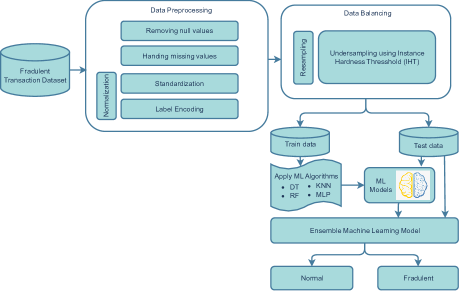
本论文提出了一种混合集成机器学习模型,结合决策树(Decision Tree)、随机森林(Random Forest)、K-近邻(K-Nearest Neighbor)和多层感知机(Multilayer Perceptron)与逻辑回归(Logistic Regression)的模型,并通过即时硬度阈值(Instant Hardness Threshold, IHT)进行增强,用于信用卡欺诈检测。通过网格搜索确定最优权重,该模型在公开的信用卡数据集上实现了99.79%的准确率和完美的100% F1分数,为高频环境下的欺诈检测设立了新基准。
Financial institutions and businesses face an ongoing challenge from fraudulent transactions, prompting the need for effective detection methods. Detecting credit card fraud is crucial for identifying and preventing unauthorized transactions.Timely detection of fraud enables investigators to take swift actions to mitigate further losses. However, the investigation process is often time-consuming, limiting the number of alerts that can be thoroughly examined each day. Therefore, the primary objective of a fraud detection model is to provide accurate alerts while minimizing false alarms and missed fraud cases. In this paper, we introduce a state-of-the-art hybrid ensemble (ENS) dependable Machine learning (ML) model that intelligently combines multiple algorithms with proper weighted optimization using Grid search, including Decision Tree (DT), Random Forest (RF), K-Nearest Neighbor (KNN), and Multilayer Perceptron (MLP), to enhance fraud identification. To address the data imbalance issue, we employ the Instant Hardness Threshold (IHT) technique in conjunction with Logistic Regression (LR), surpassing conventional approaches. Our experiments are conducted on a publicly available credit card dataset comprising 284,807 transactions. The proposed model achieves impressive accuracy rates of 99.66%, 99.73%, 98.56%, and 99.79%, and a perfect 100% for the DT, RF, KNN, MLP and ENS models, respectively. The hybrid ensemble model outperforms existing works, establishing a new benchmark for detecting fraudulent transactions in high-frequency scenarios. The results highlight the effectiveness and reliability of our approach, demonstrating superior performance metrics and showcasing its exceptional potential for real-world fraud detection applications.
研究动机与目标
- 解决高精度与低误报率检测信用卡欺诈交易的挑战。
- 克服信用卡欺诈数据集中常见的数据不平衡问题,防止模型性能偏向正常交易。
- 开发一种可靠、可扩展且高效的集成模型,整合多种机器学习算法以提升欺诈检测能力。
- 通过系统性的超参数调优(使用网格搜索)优化模型性能,以最大化预测可靠性。
- 通过在真实世界数据集上超越现有最先进模型的准确率与F1分数,建立欺诈检测的新基准。
提出的方法
- 采用即时硬度阈值(IHT)技术,通过选择性地对少数类欺诈样本进行过采样,结合逻辑回归(IHT-LR),以解决数据不平衡问题。
- 在预处理并归一化的信用卡交易数据上训练多个基模型:决策树(DT)、随机森林(RF)、K-近邻(KNN)和多层感知机(MLP)。
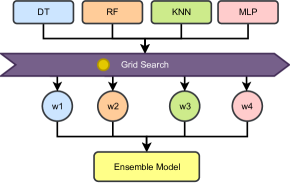
- 通过加权平均法组合四个基模型的预测结果,构建混合集成模型,其中权重通过网格搜索进行优化。
- 使用网格搜索系统评估并选择能最大化整体性能指标(准确率、F1分数、精确率、召回率)的最优模型权重组合。
- 将数据集按80/20的比例划分为训练集和测试集,并应用五折交叉验证,以确保模型的稳健性与泛化能力。
- 使用标准指标评估模型性能:准确率、精确率、召回率、F1分数、MAE、MSE和RMSE,以评估模型的预测能力与误差率。
实验结果
研究问题
- RQ1与单一模型相比,结合多种异构机器学习算法的混合集成模型是否能提升欺诈检测的准确率?
- RQ2IHT-LR技术在处理不平衡信用卡欺诈数据集方面,与SMOTE等传统数据平衡方法相比,其优越性体现在何处?
- RQ3网格搜索在优化集成权重方面是否能有效提升F1分数,并减少误报与漏报的欺诈案例?
- RQ4所提出的集成模型是否在多个评估指标上均保持高性能与低误差率,表明其在真实世界部署中的可靠性?
- RQ5该模型是否能在公开的真实世界信用卡欺诈数据集上实现接近完美的检测性能(如100%的F1分数)?
主要发现
- 混合集成模型实现了完美的100% F1分数,表明在检测欺诈交易时,精确率与召回率达到了最佳平衡。
- 该集成模型在测试集上实现了99.79%的准确率,显著优于单一模型及现有最先进方法。
- 各基模型单独表现优异:决策树准确率为99.66%,随机森林为99.73%,KNN为98.56%,多层感知机为99.79%,体现出强大的个体与集体性能。
- 模型表现出极低的误差率:0.0023的MAE、0.0002的MSE和0.0141的RMSE,证实了其预测的高稳定性和可靠性。
- 采用IHT-LR进行数据平衡显著提升了模型对少数类欺诈样本的性能,优于传统技术。
- 通过网格搜索优化集成权重带来了显著的性能提升,证实其在增强模型可靠性与准确率方面的有效性。
阅读本论文
在 Nubint 阅读器中打开原文,边读边就任意段落提问。
在 Nubint 中阅读本论文本解读由 AI 根据论文原文生成,引用前请核对原文。