
[论文解读] Security of discrete-modulated continuous-variable quantum key distribution
本文提出了一种基于四组相干态与本态检测的离散调制连续变量量子密钥分发(CVQKD)协议的有限尺寸安全证明,利用熵累积定理,实现了对相干攻击的安全性保障。在100公里传输距离下,其渐近密钥率可达每轮0.1至10⁻⁴比特,并在数十公里距离下,经过10¹²轮通信后可生成约10 Gbits的保密密钥,参数设定符合实际条件。
Continuous variable quantum key distribution with discrete modulation has the potential to provide information-theoretic security using widely available optical elements and existing telecom infrastructure. While their implementation is significantly simpler than that for protocols based on Gaussian modulation, proving their finite-size security against coherent attacks poses a challenge. In this work we prove finite-size security against coherent attacks for a discrete-modulated quantum key distribution protocol involving four coherent states and heterodyne detection. To do so, and contrary to most of the existing schemes, we first discretize all the continuous variables generated during the protocol. This allows us to use the entropy accumulation theorem, a tool that has previously been used in the setting of discrete variables, to construct the finite-size security proof. We then compute the corresponding finite-key rates through semi-definite programming and under a photon-number cutoff. Our analysis provides asymptotic rates in the range of $0.1-10^{-4}$ bits per round for distances up to hundred kilometres, while in the finite case and for realistic parameters, we get of the order of $10$ Gbits of secret key after $n\sim10^{11}$ rounds and distances of few tens of kilometres.
研究动机与目标
- 为离散调制的连续变量量子密钥分发协议在不依赖高斯极值性假设下,建立有限尺寸下的安全性,以应对相干攻击。
- 克服在离散调制下高斯态最优性不成立的挑战,从而无需依赖该假设来证明安全性。
- 通过证明仅使用四组相干态的协议安全性,实现使用标准电信组件的CVQKD实际部署。
- 在有限资源条件下,推导长距离量子密钥分发的现实密钥率。
提出的方法
- 作者应用熵累积定理(EAT),将渐近安全性边界升级为有限尺寸下的安全证明。
- 采用四组相干态进行离散调制,并结合本态检测,完全离散化信息处理,避免依赖连续变量假设。
- 引入光子数截断以模拟实际实验约束,且在该假设下对渐近密钥率进行上界约束。
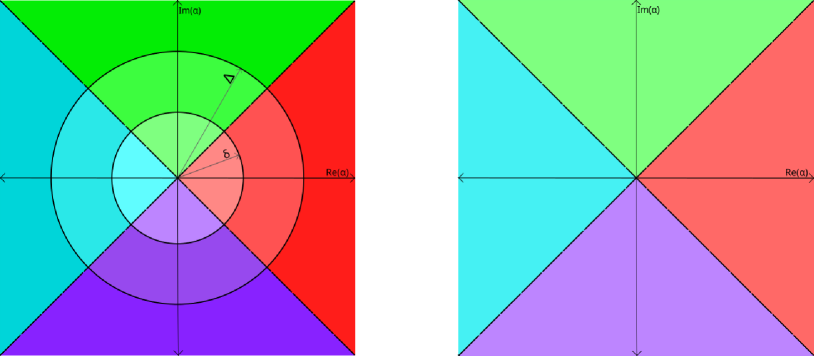
- 通过纯化距离与最大熵界控制实际态与理想态之间的偏差,确保安全性位于ε-球内。
- 利用霍夫丁不等式控制高光子数结果出现的概率,从而实现对熵估计误差的控制。
- 推导出条件最大熵界,以处理协议结果被限制在部分结果子集的情形,确保在统计波动下的鲁棒性。
实验结果
研究问题
- RQ1是否能严格证明离散调制CVQKD协议在不依赖高斯态最优性假设下的有限尺寸安全性?
- RQ2在实际光子数约束下,四态离散调制CVQKD协议的可实现渐近密钥率是多少?
- RQ3在有限尺寸情形下,密钥率如何随轮次数变化?对于实际参数,可实现的总保密密钥长度是多少?
- RQ4尽管缺乏高斯结构,熵累积定理是否能有效应用于具有离散调制的连续变量协议?
- RQ5实验缺陷(如光子数截断与有限统计)对最终密钥率与安全性有何影响?
主要发现
- 该离散调制CVQKD协议在100公里传输距离下的渐近密钥率范围为每轮0.1至10⁻⁴比特。
- 在实际参数设定下,当n = 10¹²轮时,协议在数十公里距离下可生成约10 Gbits的保密密钥。
- 该安全证明对相干攻击有效,利用熵累积定理处理有限尺寸效应,且不依赖德·芬蒂或后选择技术。
- 在实际光子数截断假设下,密钥率受到约束,确保分析结果反映实验限制。
- 通过控制实际态与理想态之间的纯化距离实现安全性,误差界由霍夫丁不等式推导得出。
- 推导出与√n成比例的条件最大熵界,即使在统计波动下也能实现紧密的有限尺寸估计。
阅读本论文
在 Nubint 阅读器中打开原文,边读边就任意段落提问。
在 Nubint 中阅读本论文本解读由 AI 根据论文原文生成,引用前请核对原文。