
[论文解读] Self-Supervised Multimodal Learning: A Survey
本综述全面概述了自监督多模态学习(SSML),解决了无标签表示学习、多模态融合以及非对齐数据等核心挑战。综述涵盖了自监督目标、架构、对齐策略及现实世界应用,突出显示了统一趋势、涌现能力以及多模态人工智能中自监督定义的演变。
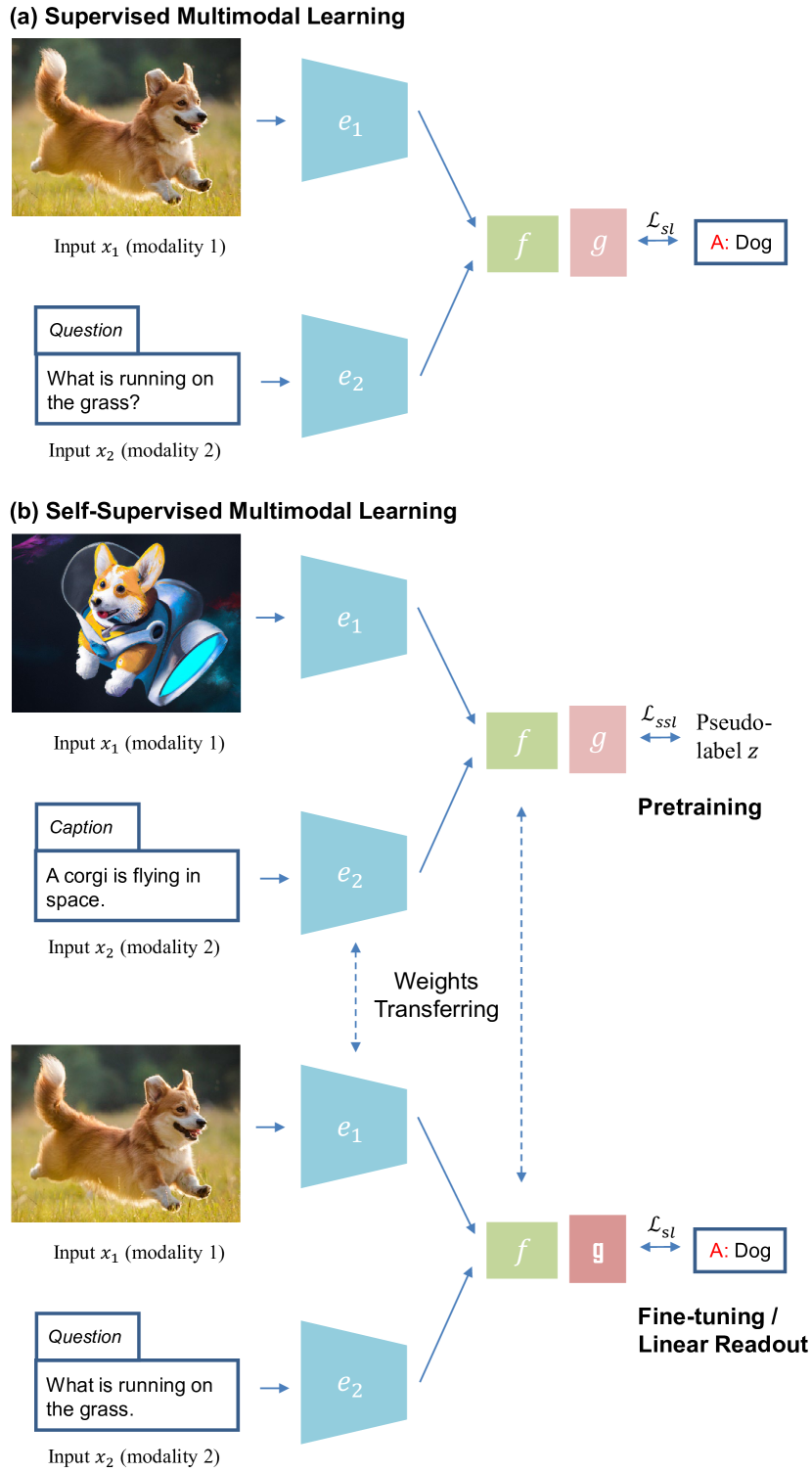
Multimodal learning, which aims to understand and analyze information from multiple modalities, has achieved substantial progress in the supervised regime in recent years. However, the heavy dependence on data paired with expensive human annotations impedes scaling up models. Meanwhile, given the availability of large-scale unannotated data in the wild, self-supervised learning has become an attractive strategy to alleviate the annotation bottleneck. Building on these two directions, self-supervised multimodal learning (SSML) provides ways to learn from raw multimodal data. In this survey, we provide a comprehensive review of the state-of-the-art in SSML, in which we elucidate three major challenges intrinsic to self-supervised learning with multimodal data: (1) learning representations from multimodal data without labels, (2) fusion of different modalities, and (3) learning with unaligned data. We then detail existing solutions to these challenges. Specifically, we consider (1) objectives for learning from multimodal unlabeled data via self-supervision, (2) model architectures from the perspective of different multimodal fusion strategies, and (3) pair-free learning strategies for coarse-grained and fine-grained alignment. We also review real-world applications of SSML algorithms in diverse fields such as healthcare, remote sensing, and machine translation. Finally, we discuss challenges and future directions for SSML. A collection of related resources can be found at: https://github.com/ys-zong/awesome-self-supervised-multimodal-learning.
研究动机与目标
- 通过利用未配对、无标签数据的自监督学习(SSL),解决多模态学习中的标注瓶颈问题。
- 识别并分析SSML中的三个核心挑战:无标签表示学习、有效的多模态融合,以及从非对齐数据中学习。
- 回顾自监督目标、融合架构及跨粗粒度与细粒度层级的无配对对齐策略的最先进方法。
- 考察SSML在医疗健康、遥感及机器翻译中的现实世界应用,并讨论其伦理与社会影响。
- 探索新兴趋势,如架构统一、大规模模型中的涌现能力,以及多模态情境下自监督定义的演变。
提出的方法
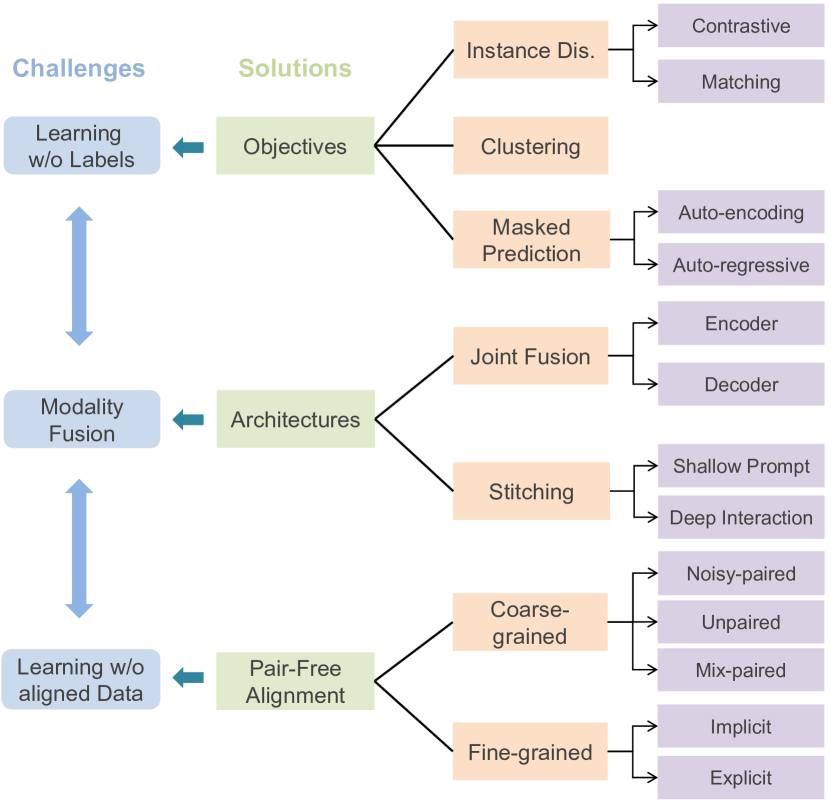
- 将自监督目标分类为实例判别、聚类和掩码预测,包含混合方法。
- 将多模态融合策略分类为早期融合(联合编码器)、晚期融合(独立编码器与后期交互)以及模型拼接(通过SSL连接预训练单模态模型)。
- 回顾粗粒度对齐的无配对学习技术,涵盖噪声配对、混合配对及完全无配对数据场景。
- 考察细粒度对齐方法,其在无需显式边界框或词级监督的情况下推导隐式或显式对齐。
- 分析解码器设计及其对表示质量与下游任务性能的影响。
- 提出SSML挑战与解决方案的分类体系,整合视觉-语言预训练、生物医学及自主系统领域的洞见。
实验结果
研究问题
- RQ1如何通过自监督方法从原始、无标注数据中有效学习多模态表示?
- RQ2自监督多模态学习中最有效的架构与融合策略是什么?
- RQ3当模态在粗粒度或细粒度层级上非对齐时,模型如何学习到鲁棒表示?
- RQ4哪些关键自监督目标能够在无需人工标注配对的情况下实现优异性能?
- RQ5涌现能力与架构统一如何塑造自监督多模态模型的未来?
主要发现
- 自监督多模态学习通过利用视频-音频对或图像-标题对等自由获取的共现数据,显著减少了对昂贵人工标注的依赖。
- 架构统一——如使用共享编码器或统一目标——使得跨多样化数据类型的多模态模型更具可扩展性与泛化能力。
- 大规模SSML模型中出现的涌现能力(如零样本识别或推理)仅在特定模型规模下显现,表明多模态表示学习中存在阈值效应。
- 针对非对齐数据的无配对学习策略(如使用噪声鲁棒目标的对比学习)可在无需显式配对的情况下实现有效对齐。
- SSML模型中的偏见可能源于数据、架构或目标,凸显了在多模态系统中系统性检测与缓解偏见的必要性。
- 自监督的定义正在演变,尤其是在大语言模型生成输出的背景下,引发了关于此类信号是否真正属于自监督的疑问。
阅读本论文
在 Nubint 阅读器中打开原文,边读边就任意段落提问。
在 Nubint 中阅读本论文本解读由 AI 根据论文原文生成,引用前请核对原文。