
[论文解读] Self-testing composite measurements and bound entangled state in a single quantum network
本文提出了一种统一的量子网络框架,用于在三量子比特系统中自检验三类复合投影测量:一类源自真正纠缠的GHZ类态,一类源自无纠缠非局域性(NLWE)的乘积态,以及一类源自不可延拓乘积基(UPB)的混合测量。该方案首次通过UPB基测量间接认证了束缚纠缠态,展示了超越标准贝尔场景的新型基于网络的混合纠缠态认证方法。
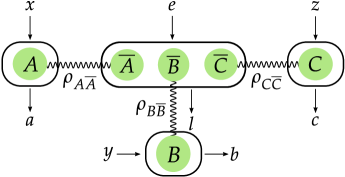
Within the quantum networks scenario we introduce a single scheme allowing to certify three different types of composite projective measurements acting on a three-qubit Hilbert space: one constructed from genuinely entangled GHZ-like states, one constructed from fully product vectors that exhibit the phenomenon of nonlocality without entanglement (NLWE), and a hybrid measurement obtained from an unextendible product basis (UPB). Noticeably, we certify a basis exhibiting NLWE in the smallest dimension capable of supporting this phenomenon. On the other hand, the possibility of certification of a measurement obtained from a UPB has an interesting implication that one can also self-test a bound entangled state in the considered quantum network. Such a possibility does not seem to exist in the standard Bell scenario. Furthermore, we also analyse the robustness of our scheme towards experimental errors.
研究动机与目标
- 解决多量子比特系统中复合量子测量自检验缺乏通用方案的问题。
- 在单一实验设置中认证三种不同类型的投影测量——纠缠态、NLWE态与基于UPB的混合态。
- 首次在基于网络的场景中实现对束缚纠缠态的自检验,该目标在标准贝尔场景中无法实现。
- 在支持NLWE的最小维度(三量子比特)中实现认证,相较于先前工作提升了效率。
提出的方法
- 构建一个包含共享纠缠态和针对三种不同测量类型量身定制的测量设置的量子网络。
- 在三量子比特希尔伯特空间中使用UPB来定义一种混合测量,结合乘积态与正交纠缠子空间上的投影算符。
- 基于贝尔型不等式与测量统计量应用自检验协议,以认证测量算符的结构。
- 利用态的对称性与正交性,通过半正定规划与态重建推导对测量算符的约束。
- 利用酉变换与迹运算,将观测到的相关性与目标量子态及测量关联起来。
- 证明观测到的统计量唯一确定了测量算符与测量后态,包括来自UPB的束缚纠缠态。
实验结果
研究问题
- RQ1能否通过单一量子网络协议在三量子比特系统中自检验三类不同的复合投影测量?
- RQ2是否可能在基于网络的场景中,通过源自不可延拓乘积基(UPB)的测量自检验束缚纠缠态?
- RQ3能否在最小可能维度(三量子比特)中,使用统一框架认证无纠缠非局域性(NLWE)?
- RQ4与标准贝尔场景中的自检验相比,基于网络的自检验方案在态与测量认证方面有何不同?
主要发现
- 本文实现了在三量子比特系统中基于UPB的测量的首次自检验,且为网络场景中的首次认证。
- 首次通过基于UPB的测量实现了对束缚纠缠态的间接自检验,该方法在标准贝尔场景中不可行。
- 该方案在最小维度(三量子比特)中认证了无纠缠非局域性(NLWE)基,证实了该现象在最小可能希尔伯特空间中的存在。
- 与先前工作相比,该协议所需测量次数更少,显著提升了实验可行性与效率。
- 证明了在特定测量结果后,测量后态为束缚纠缠态(来自UPB)与最大纠缠态的张量积,从而确认了认证态的结构。
阅读本论文
在 Nubint 阅读器中打开原文,边读边就任意段落提问。
在 Nubint 中阅读本论文本解读由 AI 根据论文原文生成,引用前请核对原文。