
[论文解读] Semantic Information Marketing in The Metaverse: A Learning-Based Contract Theory Framework
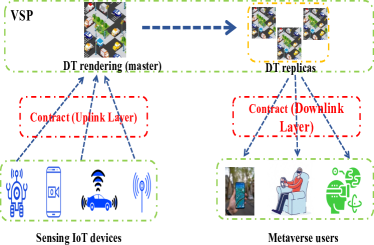
该论文提出了一种基于学习的合同理论框架,利用多智能体强化学习(MARL)为元宇宙中的虚拟服务提供商(VSP)设计诚实、激励相容的合同。通过利用语义信息提取减少数据传输,该框架使VSP能够最优地为物联网设备定价数据包,并向用户提供数字孪生体,实现高利润的同时个体理性(IR)和激励相容(IC)违规极少——在未见过的类型分布上表现出强大的泛化能力。
In this paper, we address the problem of designing incentive mechanisms by a virtual service provider (VSP) to hire sensing IoT devices to sell their sensing data to help creating and rendering the digital copy of the physical world in the Metaverse. Due to the limited bandwidth, we propose to use semantic extraction algorithms to reduce the delivered data by the sensing IoT devices. Nevertheless, mechanisms to hire sensing IoT devices to share their data with the VSP and then deliver the constructed digital twin to the Metaverse users are vulnerable to adverse selection problem. The adverse selection problem, which is caused by information asymmetry between the system entities, becomes harder to solve when the private information of the different entities are multi-dimensional. We propose a novel iterative contract design and use a new variant of multi-agent reinforcement learning (MARL) to solve the modelled multi-dimensional contract problem. To demonstrate the effectiveness of our algorithm, we conduct extensive simulations and measure several key performance metrics of the contract for the Metaverse. Our results show that our designed iterative contract is able to incentivize the participants to interact truthfully, which maximizes the profit of the VSP with minimal individual rationality (IR) and incentive compatibility (IC) violation rates. Furthermore, the proposed learning-based iterative contract framework has limited access to the private information of the participants, which is to the best of our knowledge, the first of its kind in addressing the problem of adverse selection in incentive mechanisms.
研究动机与目标
- 解决由于VSP与感知型物联网设备或元宇宙用户之间存在信息不对称,导致在元宇宙数字孪生体创建过程中出现的逆向选择问题。
- 在多维私有信息环境下设计一种确保个体理性(IR)和激励相容(IC)的激励机制。
- 通过使用语义信息提取而非原始数据传输,减少通信开销。
- 开发一种基于学习的迭代合同框架,最大限度减少对参与者完整私有信息的依赖。
- 评估框架在参与者类型分布发生偏移时的鲁棒性和泛化能力。
提出的方法
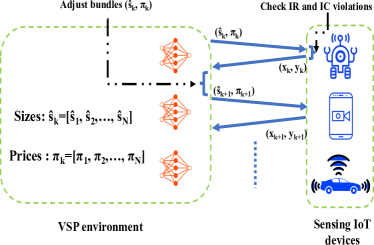
- VSP使用一种新颖的迭代合同设计,通过与每个参与者(物联网设备或用户)交互,利用多智能体强化学习(MARL)框架学习最优定价组合。
- 开发了一种多智能体近端策略梯度深度强化学习(MA-PDDQL)的新变体,将合同建模为具有多个智能体的序列决策过程。
- VSP为每个参与者训练独立的深度强化学习(DRL)智能体,以在最大化收入的同时最小化IR和IC违规率。
- 在物联网设备上应用语义提取算法,将原始传感器数据压缩为有意义的语义信息后再进行传输。
- 框架在联合类型(语义质量、新鲜度和能力)的均匀分布上进行训练,并在分布偏移的测试条件下评估泛化能力。
- 优化问题(P1)中的目标函数在最大化VSP收入与控制IR和IC违规约束之间实现平衡。
实验结果
研究问题
- RQ1VSP如何设计一种激励机制,即使在存在多维私有信息的情况下,也能确保物联网设备和元宇宙用户如实报告?
- RQ2信息不对称对元宇宙中数字孪生体创建性能有何影响,如何缓解?
- RQ3基于学习的合同框架能否泛化到与训练分布不同的参与者类型分布?
- RQ4所提出的基于MARL的合同在最小化IR和IC违规的同时,最大化VSP利润方面有多高效?
- RQ5语义数据压缩在多大程度上提升了元宇宙数字孪生生态系统中的系统效率?
主要发现
- 所提出的基于学习的迭代合同在所有测试场景中均实现了高VSP利润,且IR和IC违规率均低于5%。
- 该框架在未见过的类型分布上表现出良好泛化能力:在低类型权重分布上测试时,VSP的收入仅略有下降,且IR/IC违规率保持较低水平。
- 在低类型权重测试分布下,低类型物联网设备的效用略有提升,而高类型设备的效用则有所下降——表明模型在不损害核心约束的前提下实现了自适应调整。
- 语义信息提取的使用显著减少了数据传输量,提升了数字孪生体交付的系统可扩展性和及时性。
- 基于MARL的框架成功学习到最优定价组合,而无需掌握参与者私有类型信息的完整知识,因此对信息不对称具有鲁棒性。
- 即使测试时参与者类型的分布与训练分布不同,该框架仍保持强劲性能,证明了其适应性和泛化能力。
阅读本论文
在 Nubint 阅读器中打开原文,边读边就任意段落提问。
在 Nubint 中阅读本论文本解读由 AI 根据论文原文生成,引用前请核对原文。