
[论文解读] SemEval-2023 Task 10: Explainable Detection of Online Sexism
本文介绍 EDOS,一个用于可解释在线性别歧视检测的三任务分层分类法,一个覆盖多平台的2万标签数据集,以及基线/参与者结果,突出表现差距和可解释性挑战。
Online sexism is a widespread and harmful phenomenon. Automated tools can assist the detection of sexism at scale. Binary detection, however, disregards the diversity of sexist content, and fails to provide clear explanations for why something is sexist. To address this issue, we introduce SemEval Task 10 on the Explainable Detection of Online Sexism (EDOS). We make three main contributions: i) a novel hierarchical taxonomy of sexist content, which includes granular vectors of sexism to aid explainability; ii) a new dataset of 20,000 social media comments with fine-grained labels, along with larger unlabelled datasets for model adaptation; and iii) baseline models as well as an analysis of the methods, results and errors for participant submissions to our task.
研究动机与目标
- 提出一个用于可解释性性别歧视检测的分层分类法(二元、类别和细粒度向量)。
- 从 Reddit 和 Gab 构建一个多样且标注良好的数据集,拥有专家标注者。
- 提供强基线并分析参与者方法以识别挑战和标注错误类型。
- 在三层级任务上评估系统,以评估准确性和可解释性。
提出的方法
- 设计一个三层级分类法:任务 A(二元性别歧视)、任务 B(4 个类别)、任务 C(11 个细粒度向量)。
- 使用六种多样化采样技术从 Reddit 和 Gab 收集并抽样 2 万条带标签的评论;并辅以 200 万条未标注的在域数据。
- 由 19 位专家女性标注者进行标注;用裁决解决分歧;在低一致性情形下使用专家标注者。
- 将数据分割为训练/开发/测试集(70/10/20),并发布未标注数据以用于持续的预训练基线。
- 提供七个基线(包括 TF-IDF+XGBoost、DistilBERT、DeBERTa 变体),并报告任务 A–C 的宏 F1;便于在 CodaLab 上提交参与者结果。
- 进行错误分析(混淆矩阵、人工检查),以理解错误分类和标注挑战。
实验结果
研究问题
- RQ1分层分类法是否能在可解释性方面超越二元标签,从而改进自动化性别歧视检测?
- RQ2在多样化社交平台上,任务 A(二元)、任务 B(类别)和任务 C(向量)的性能和错误特征是什么?
- RQ3在域内未标注数据上的持续预训练如何影响各任务的性能?
- RQ4在标注微妙性别歧视向量时,常见的错误模式和标注挑战有哪些?
主要发现
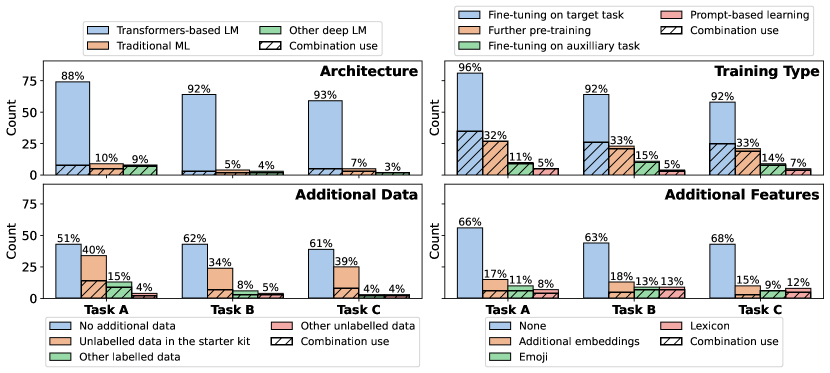
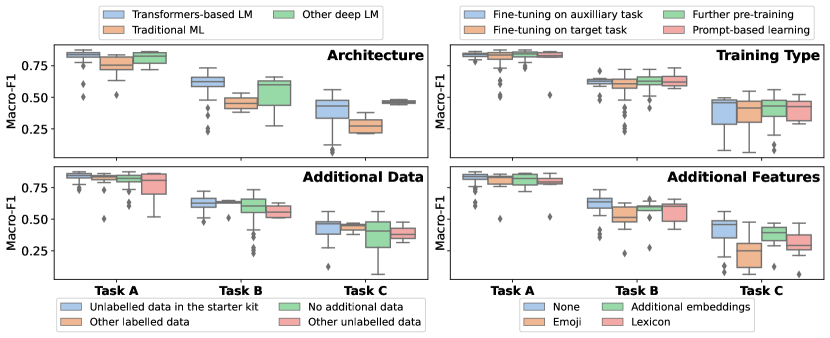
- 任务 A 基线(DeBERTa-v3)实现了最高宏 F1,约 0.8235;任务 B/C 相对更困难(基线为 0.5926 和 0.3171)。
- 集成方法和在未标注的域内数据上持续预训练在参与者系统中获得了最优结果。
- 基于 Transformer 的架构主导提交,RoBERTa/DeBERTa 变体和基于提示的模型表现最佳;额外特征很少提升性能。
- 错误分析显示任务 A 的假阴性多于假阳性,敌意和贬损是造成多数误分类的因素。
- 细粒度任务(B 和 C)仍有较大提升空间;基线的宏 F1 约在 0.32 左右,某些任务的顶尖系统约 0.55–0.60。
- 标注质量和上下文含义仍是关键挑战,存在一些人工标注分歧和灰色区域案例。
阅读本论文
在 Nubint 阅读器中打开原文,边读边就任意段落提问。
在 Nubint 中阅读本论文本解读由 AI 根据论文原文生成,引用前请核对原文。