
[论文解读] Simplified and Generalized Masked Diffusion for Discrete Data
该论文提出了一种简化且通用的离散数据掩码扩散框架,将变分目标重新表述为时间加权的交叉熵损失积分,从而实现高效训练和最先进性能。在文本和图像建模任务中均取得最先进结果,优于以往的离散扩散模型,在似然和零样本迁移性能方面表现更优,CIFAR-10 和 ImageNet 64×64 上的比特数分别为 2.78 和 3.42 bits/dim。
Masked (or absorbing) diffusion is actively explored as an alternative to autoregressive models for generative modeling of discrete data. However, existing work in this area has been hindered by unnecessarily complex model formulations and unclear relationships between different perspectives, leading to suboptimal parameterization, training objectives, and ad hoc adjustments to counteract these issues. In this work, we aim to provide a simple and general framework that unlocks the full potential of masked diffusion models. We show that the continuous-time variational objective of masked diffusion models is a simple weighted integral of cross-entropy losses. Our framework also enables training generalized masked diffusion models with state-dependent masking schedules. When evaluated by perplexity, our models trained on OpenWebText surpass prior diffusion language models at GPT-2 scale and demonstrate superior performance on 4 out of 5 zero-shot language modeling tasks. Furthermore, our models vastly outperform previous discrete diffusion models on pixel-level image modeling, achieving 2.75 (CIFAR-10) and 3.40 (ImageNet 64x64) bits per dimension that are better than autoregressive models of similar sizes. Our code is available at https://github.com/google-deepmind/md4.
研究动机与目标
- 解决现有离散数据掩码扩散模型的复杂性与设计不佳问题。
- 统一并澄清不同连续时间形式化方法在掩码扩散中的关系。
- 通过合理的变分公式化,简化训练目标并提升模型性能。
- 为广义掩码扩散模型实现状态依赖的掩码调度。
- 在离散序列与图像建模基准上实现最先进性能。
提出的方法
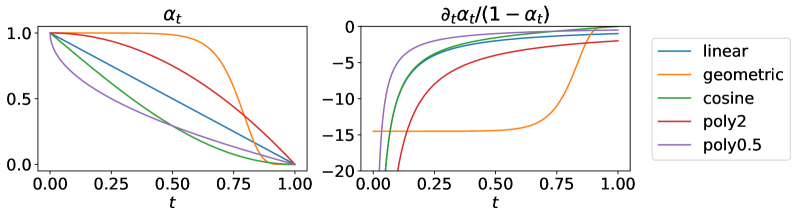
- 将掩码扩散的证据下界(ELBO)重新表述为时间加权的交叉熵损失积分。
- 利用时间反演框架推导离散掩码过程的连续时间极限。
- 引入信噪比参数化方法,保留与连续空间扩散相似的不变性特性。
- 提出一种具有状态依赖掩码调度的广义掩码扩散模型,以提升建模灵活性。
- 采用连续时间前向过程,其转移矩阵以概率方式将状态掩码至吸收态。
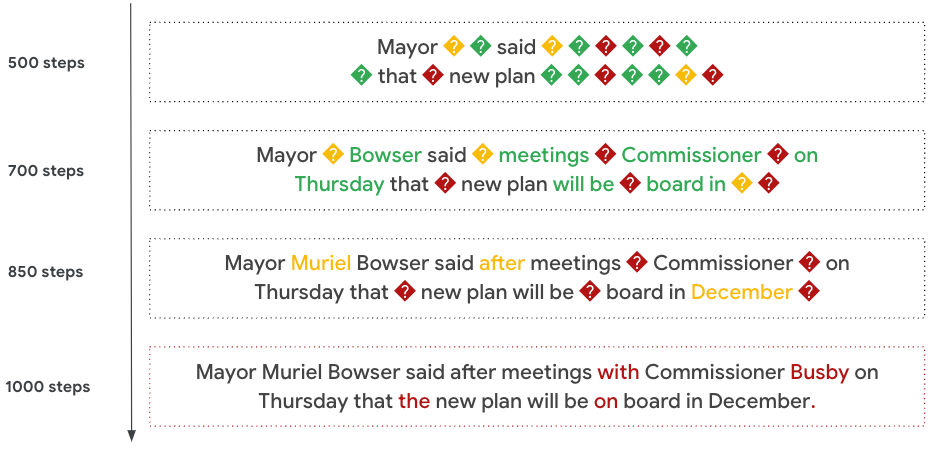
- 采用时间反演的生成过程,通过从掩码状态去噪来建模数据分布。
实验结果
研究问题
- RQ1如何简化并提升掩码扩散模型变分目标的可解释性?
- RQ2文献中不同连续时间形式化方法在掩码扩散中的关系是什么?
- RQ3统一且简化的训练目标能否提升离散数据生成任务的性能?
- RQ4状态依赖掩码如何提升离散扩散模型的建模能力与似然性能?
- RQ5掩码扩散能否在文本和图像任务上实现与自回归模型相当的最先进性能?
主要发现
- 掩码扩散的ELBO等价于时间加权的交叉熵损失积分,简化了训练与解释。
- 所提框架统一了先前方法,并识别出如高方差和前后向过程不一致等问题。
- 在GPT-2规模的文本建模中,模型在困惑度和零样本性能方面均优于以往的离散扩散模型。
- 在CIFAR-10和ImageNet 64×64上,模型分别达到2.78和3.42 bits/dim,与同等规模的自回归模型相当或更优。
- 具有状态依赖掩码的广义掩码扩散模型进一步提升了测试似然,证明了自适应调度的优势。
- 该方法实现了高效训练,降低了复杂度,并在多种离散数据类型上提升了采样质量。
阅读本论文
在 Nubint 阅读器中打开原文,边读边就任意段落提问。
在 Nubint 中阅读本论文本解读由 AI 根据论文原文生成,引用前请核对原文。