
[论文解读] skrl: Modular and Flexible Library for Reinforcement Learning
skrl 是一个开源、模块化且透明的 Python 强化学习库,支持 OpenAI Gym、DeepMind、NVIDIA Isaac Gym 和 Omniverse Isaac Gym 环境。它支持多个智能体同时训练,资源范围可自定义——可共享或隔离——在高达 1,024 个环境上实现基于 GPU 的高效训练,性能与 established 库如 stable-baselines3 和 RLlib 相当。
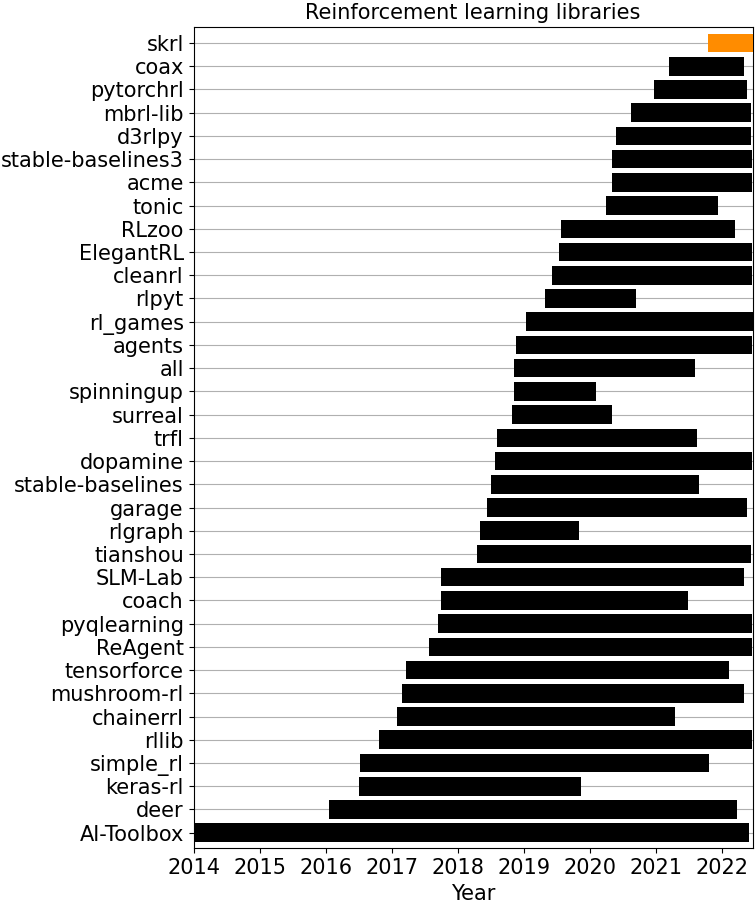
skrl is an open-source modular library for reinforcement learning written in Python and designed with a focus on readability, simplicity, and transparency of algorithm implementations. In addition to supporting environments that use the traditional interfaces from OpenAI Gym and DeepMind, it provides the facility to load, configure, and operate NVIDIA Isaac Gym and NVIDIA Omniverse Isaac Gym environments. Furthermore, it enables the simultaneous training of several agents with customizable scopes (subsets of environments among all available ones), which may or may not share resources, in the same run. The library's documentation can be found at https://skrl.readthedocs.io and its source code is available on GitHub at https://github.com/Toni-SM/skrl.
研究动机与目标
- 解决缺乏模块化、可读性强且透明的强化学习库的问题,这些库能够支持现代 GPU 加速模拟器(如 Isaac Gym 和 Omniverse Isaac Gym)。
- 实现跨不同环境的多个智能体同时训练,支持可配置的资源共享或隔离。
- 通过强调代码可读性和算法透明性,降低强化学习研究的入门门槛。
- 提供统一且可扩展的 API,支持传统强化学习环境和高性能 GPU 模拟器。
- 通过结构良好、文档齐全的模块化代码结构,促进可复现性和教育用途。
提出的方法
- 该库围绕模块化组件构建,支持可互换的智能体、环境和训练算法,提升可重用性和可扩展性。
- 实现标准强化学习接口(OpenAI Gym、DeepMind),并通过 GPU 加速物理模拟原生支持 NVIDIA Isaac Gym 和 Omniverse Isaac Gym。
- 通过基于作用域的配置并行训练智能体,每个智能体在其可用环境子集上运行,支持共享或隔离内存与计算资源。
- 库使用 PyTorch 作为深度学习后端,提供清晰、可读的代码库,命名一致且抽象层级低,以增强透明性。
- 通过可配置的引擎管理训练流程,模块化地处理环境交互、奖励收集和策略更新。
- 实现支持单智能体和多智能体训练,智能体间可使用相同或不同的超参数。
实验结果
研究问题
- RQ1如何设计一个强化学习库,使其既能支持传统强化学习环境,又能支持现代高性能 GPU 模拟器(如 Isaac Gym 和 Omniverse Isaac Gym)?
- RQ2模块化和代码透明性在多大程度上能提升强化学习算法实现的可读性和可维护性?
- RQ3单次训练能否高效管理具有不同作用域和资源配置(包括共享或隔离内存)的多个智能体?
- RQ4skrl 在训练速度和最终性能方面与 established 库(如 stable-baselines3 和 RLlib)相比如何?
- RQ5在大规模环境中,内存共享对多智能体训练效率和性能稳定性有何影响?
主要发现
- 在 OpenAI Gym Pendulum-v0 环境中,skrl 达到了与 stable-baselines3 和 RLlib 相当的平均总奖励,训练吞吐量相似(例如,DDPG 每秒 135 个时间步)。
- 在 Isaac Gym 和 Omniverse Isaac Gym 环境中,skrl 的性能与 rl_pytorch 和 rl_games 相当,512 个 Cartpole 环境下达到每秒 105 个时间步,1024 个 Ant 环境下达到每秒 45 个时间步。
- 该库展示了高效的多智能体训练能力,成功在总共 512 个环境中并行管理三个智能体(DDPG、TD3、SAC),每个智能体处理约 170–172 个环境。
- 在同时训练中启用内存共享后,性能优于独立训练,且更加均衡,即使使用默认超参数也如此。
- 该库的模块化与透明化设计降低了学习门槛,提升了代码可维护性,支持教育和可复现研究。
- 实现已在多个环境上验证,包括 OpenAI Gym、Isaac Gym(预览版 2–4)和 Omniverse Isaac Gym,确认了广泛的兼容性和稳定性。
阅读本论文
在 Nubint 阅读器中打开原文,边读边就任意段落提问。
在 Nubint 中阅读本论文本解读由 AI 根据论文原文生成,引用前请核对原文。