
[论文解读] SkyMapper Southern Survey: Data Release 4
DR4 展示 SkyMapper Southern Survey 的扩展 26,000 deg^2 六波段数据发布,在约 7.5 年内产生 ~13 billion detections 对 ~700 million objects,部分区域深度达到 ~22 mag。
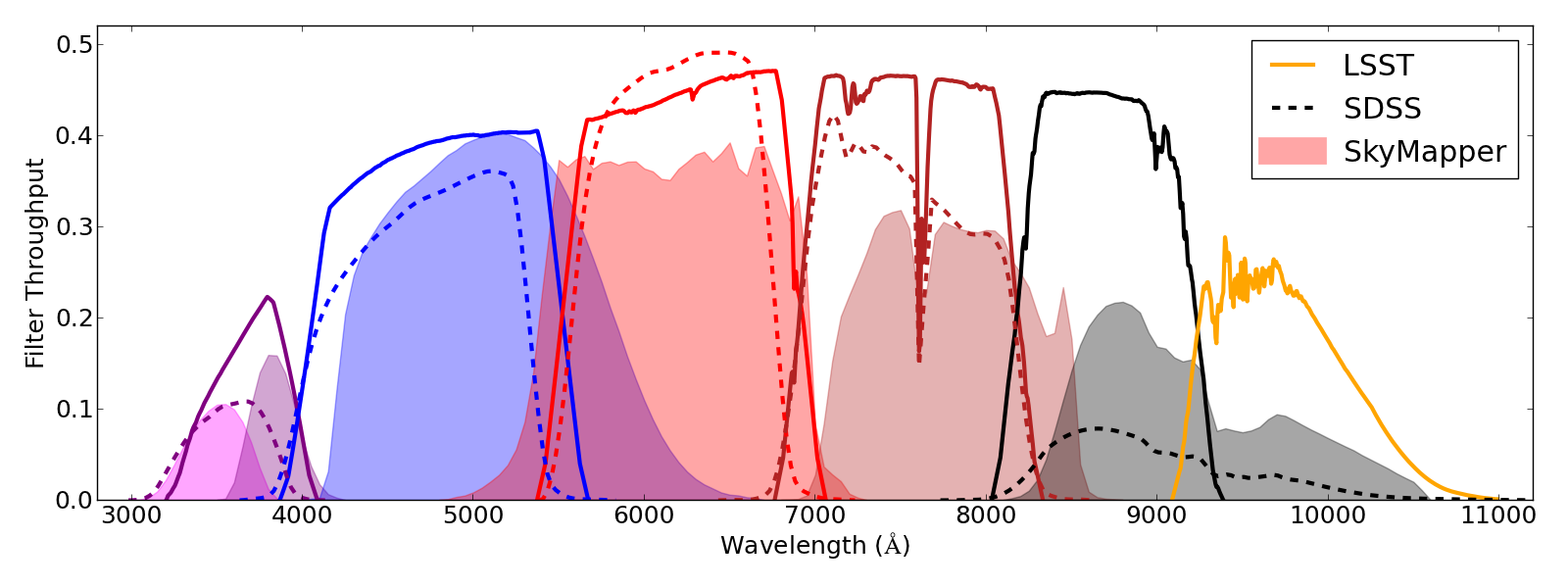
We present the fourth data release (DR4) of the SkyMapper Southern Survey (SMSS), the last major step in our hemispheric survey with six optical filters: u, v, g, r, i, z. SMSS DR4 covers 26,000 sq.deg from over 400,000 images acquired by the 1.3m SkyMapper telescope between 2014-03 and 2021-09. The 6-band sky coverage extends from the South Celestial Pole to Dec = +16deg, with some images reaching Dec ~ +28deg. In contrast to previous DRs, we include all good-quality images from the facility taken during that time span, not only those explicitly taken for the public Survey. From the image dataset, we produce a catalogue of nearly 13 billion detections made from ~700 million unique astrophysical objects. The typical 10sigma depths for each field range between 18.5 and 20.5 mag, depending on the filter, but certain sky regions include longer exposures that reach as deep as 22 mag in some filters. As with previous SMSS catalogues, we have cross-matched with a host of other imaging and spectroscopic datasets to facilitate additional science outcomes. SMSS DR4 is now available to the worldwide astronomical community.
研究动机与目标
- Explain the scope and improvements of the SkyMapper Southern Survey Data Release 4 (DR4).
- Describe the data volume, sky coverage, and depth achieved in DR4.
- Outline the data processing, calibration, and accessibility to the astronomical community.
- Highlight the archival and cross-matching strategies used to enable broad science cases.
提出的方法
- Describe the SkyMapper facility, its six-filter system (u,v,g,r,i,z), and the 1.3 m telescope instrumentation.
- Summarize data collection spanning 2014–2021 across 400,000 images and 26,000 deg^2.
- Explain data processing steps from image collection to astrometric/photometric calibration and catalog generation.
- Detail the construction of the final object catalog from detections and cross-matches with external datasets.
- Explain data access, formats, and plans for DR4 augmentation.
实验结果
研究问题
- RQ1What are the sky coverage, depth, and catalog size achieved in DR4 compared to prior releases?
- RQ2How were images selected, processed, and calibrated to produce a reliable 6-band photometric catalog?
- RQ3What are the key improvements in astrometry and photometry in DR4?
- RQ4How can the DR4 data be accessed and used for diverse scientific investigations?
- RQ5What cross-matching and archival strategies support broad scientific applications?
主要发现
- DR4 covers ~26,000 deg^2 from the South Celestial Pole to δ=+16°, with some images reaching δ~+28°.
- The dataset includes ~400,000 images and produces a catalogue of ~13 billion detections from ~700 million unique objects.
- Typical 10-σ depths range from 18.5 to 20.5 mag per field, with some regions reaching as deep as 22 mag in certain filters.
- DR4 continues the practice of cross-matching SkyMapper data with other imaging and spectroscopic datasets to enable broader science outcomes.
- DR4 represents the final major sky-hemisphere survey step and is publicly available to the worldwide community.
- The DR4 processing and cataloging incorporate improved astrometry and photometry, building on DR1–DR3 enhancements.
阅读本论文
在 Nubint 阅读器中打开原文,边读边就任意段落提问。
在 Nubint 中阅读本论文本解读由 AI 根据论文原文生成,引用前请核对原文。