
[论文解读] Small-Coupling Dynamic Cavity: a Bayesian mean-field framework for epidemic inference
本文提出了小耦合动态腔体(SCDC)方法,这是一种用于接触网络上流行病推断的贝叶斯平均场框架。该方法利用小耦合展开的动态腔方程,计算时变的感染边际概率,实现线性计算复杂度下的精确个体风险评估。SCDC在性能上可与信念传播(Belief Propagation)相媲美,同时可推广至SIR和SIRS等马尔可夫流行病模型。
We present the Small-Coupling Dynamic Cavity (SCDC) method, a novel generalized mean-field approximation for epidemic inference and risk assessment within a fully Bayesian framework. SCDC accounts for non-causal effects of observations and uses a graphical model representation of epidemic processes to derive self-consistent equations for edge probability marginals. A small-coupling expansion yields time-dependent cavity messages capturing individual infection probabilities and observational conditioning. With linear computational cost per iteration in the epidemic duration, SCDC is particularly efficient and valid even for recurrent epidemic processes, where standard methods are exponentially complex. Tested on synthetic networks, it matches Belief Propagation in accuracy and outperforms individual-based mean-field methods. Notably, despite being derived as a small-infectiousness expansion, SCDC maintains good accuracy even for relatively large infection probabilities. While convergence issues may arise on graphs with long-range correlations, SCDC reliably estimates risk. Future extensions include non-Markovian models and higher-order terms in the dynamic cavity framework.
研究动机与目标
- 开发一种可扩展且精确的复杂接触网络中个体层面流行病风险评估方法。
- 解决由于观测稀疏导致的非因果信息传播问题,该问题违反了标准的时间前向动力学。
- 将平均场近似推广至处理依赖观测的动力学,同时保持计算效率。
- 将动态腔方法的应用范围从时间前向、非重复过程扩展至SIS和SIRS等马尔可夫重复模型。
- 提供一种在准确性和效率之间取得平衡的框架,其性能优于启发式平均场方法,并接近信念传播性能,同时避免了信念传播的收敛问题。
提出的方法
- 将流行病动力学建模为接触网络上的图模型,将感染轨迹表示为边上的随机过程。
- 推导基于边的边际概率的动态腔方程,捕捉在排除特定邻居情况下的个体状态。
- 对观测重加权的腔方程应用小耦合展开,得到编码感染风险和观测影响的时变腔消息。
- 引入小自感染概率,以解决由观测引起的非因果效应带来的不一致性,尤其在观测密集的场景下。
- 采用时间转移矩阵形式高效计算腔消息,确保与流行病持续时间和接触数呈线性关系。
- 通过修改矩阵维度和元素,将框架适配至多状态模型(如SIR、SIRS),同时保持线性复杂度。
实验结果
研究问题
- RQ1如何设计一种贝叶斯平均场近似,以处理在流行病推断中由稀疏观测引起的非因果信息流?
- RQ2动态腔方程的小耦合展开能否为网络上的马尔可夫流行病过程提供准确且高效的推断?
- RQ3在接触图中存在长程相关性和环路的情况下,SCDC方法在多大程度上能保持准确性?
- RQ4SCDC在个体风险估计方面与信念传播和启发式平均场方法相比表现如何?
- RQ5小耦合展开中的二阶项起什么作用?能否利用它们在当前一阶近似的基础上进一步提升准确性?
主要发现
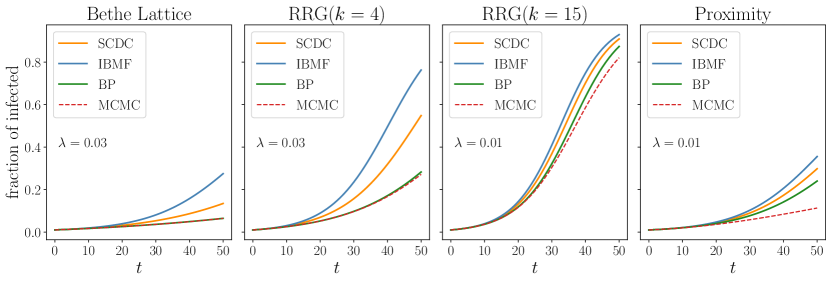
- SCDC方法在实现与信念传播相当的流行病风险估计精度的同时,保持了线性计算复杂度,尤其在时间前向动力学下表现优异。
- 在无观测条件下,SCDC退化为广义平均场近似,其性能优于标准个体基平均场(IBMF)方法,尤其在低传染性与高连通性场景下。
- 引入小自感染概率能有效解决由重复或密集观测引发的收敛性和一致性问题。
- 即使在长程相关性导致环状网络中出现收敛问题时,估计的边际概率仍足够准确,可支持可靠的風險评估。
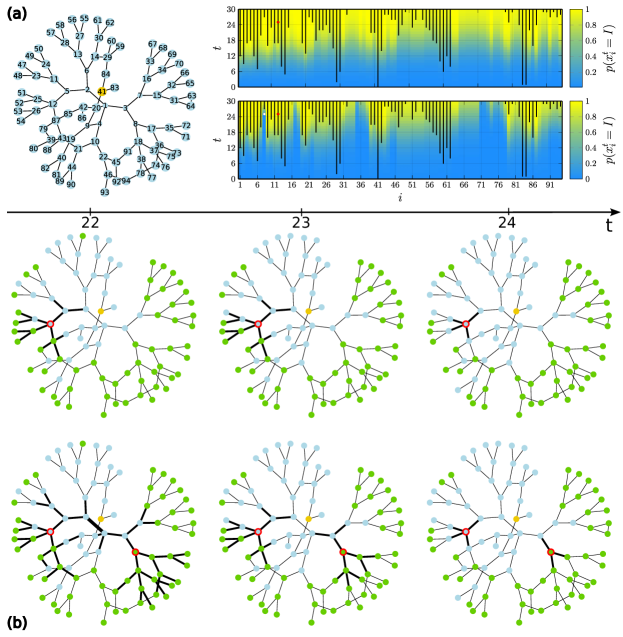
- 该方法可直接推广至SIRS等重复性马尔可夫模型,初步结果显示其具有强大的预测能力,且无需假设传染性较小。
- SCDC框架与流行病持续时间和网络规模均保持线性扩展,适用于大规模、实时的流行病推断应用。
阅读本论文
在 Nubint 阅读器中打开原文,边读边就任意段落提问。
在 Nubint 中阅读本论文本解读由 AI 根据论文原文生成,引用前请核对原文。