
[论文解读] Small Language Models: Survey, Measurements, and Insights
本论文对59个开源解码器式的小语言模型(100M–5B)进行综述,评估它们的架构、训练数据、算法、能力,以及在设备上的运行成本,以为边缘部署提供洞察。
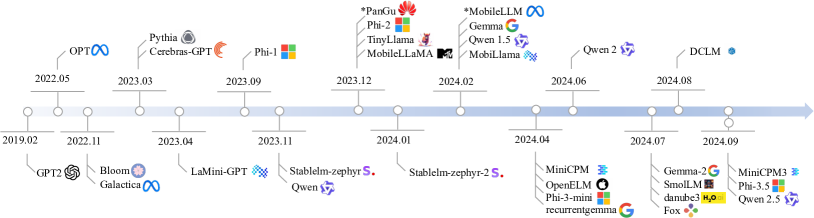
Small language models (SLMs), despite their widespread adoption in modern smart devices, have received significantly less academic attention compared to their large language model (LLM) counterparts, which are predominantly deployed in data centers and cloud environments. While researchers continue to improve the capabilities of LLMs in the pursuit of artificial general intelligence, SLM research aims to make machine intelligence more accessible, affordable, and efficient for everyday tasks. Focusing on transformer-based, decoder-only language models with 100M-5B parameters, we survey 70 state-of-the-art open-source SLMs, analyzing their technical innovations across three axes: architectures, training datasets, and training algorithms. In addition, we evaluate their capabilities in various domains, including commonsense reasoning, mathematics, in-context learning, and long context. To gain further insight into their on-device runtime costs, we benchmark their inference latency and memory footprints. Through in-depth analysis of our benchmarking data, we offer valuable insights to advance research in this field.
研究动机与目标
- 系统性地评审解码器式的开源小语言模型(100M–5B)及其发布配置。
- 分析所调研SLMs的架构、训练数据集和训练算法。
- 在常识推理、上下文学习、数学和编程方面基准能力。
- 评估设备端运行成本(延迟、内存、能耗)以指导边缘部署。
- 为未来的SLM研究和面向硬件的设计提供洞见与指南。
提出的方法
- 收集并将具有100M–5B参数的59个开源解码器式SLM进行分类。
- 在常识推理、问题解决、数学和上下文学习方面基准能力。
- 在边缘设备上使用通用推理引擎(llama.cpp)测量设备端运行成本(预填延迟、解码延迟、内存、能耗)。
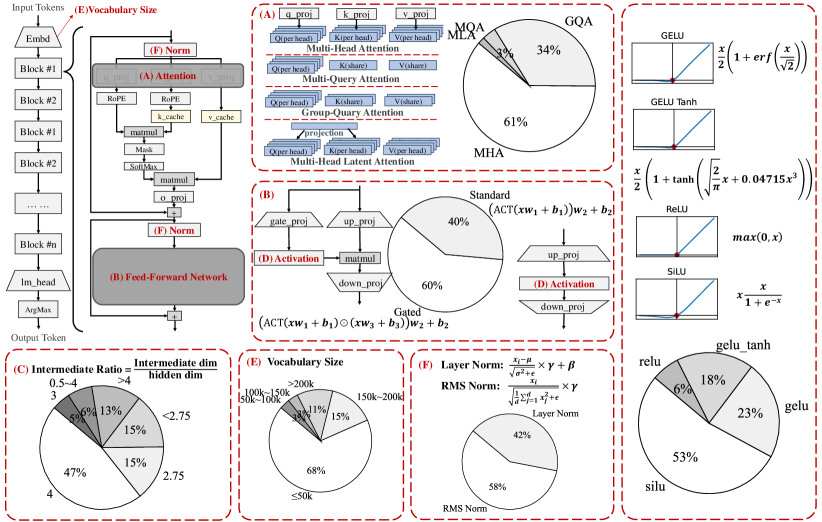
- 分析架构(注意力类型、FFN、激活、归一化、词汇表)以及训练数据的使用情况。
- 比较训练数据集和数据质量,包括基于模型的数据筛选。
- 提取关于数据质量、数据集选择以及SLM开发中的架构选择的洞见。
实验结果
研究问题
- RQ1SLMs中哪些架构选择是普遍存在的,这些选择如何影响设备端性能?
- RQ2开源训练数据集与数据质量如何影响SLM的能力,相较于闭源数据?
- RQ3SLMs在常识推理、问题解决和数学任务上的表现如何,模型大小和数据如何影响这种表现?
- RQ4在不同硬件和量化设置下,SLMs的设备端延迟、内存和能耗特征是什么?
主要发现
- SLMs在常识推理、问题解决和数学方面自2022年至2024年的性能有显著提升(大约分别为10.4%、13.5%、13.5%)。
- Phi家族在大多数任务上提供了最先进的结果,Phi-3-mini在某些情况下可与Llama 3.1 8B 相媲美,且Phi-3-mini在我们评估的模型中在数学方面处于领先。
- 像FineWeb-Edu和DCLM-baseline这样的开源数据集,采用模型筛选,在相对于闭源数据集的表现方面也达到了竞争力。
- 较大参数量通常与更好表现相关,但也存在异常(如Qwen 2);数据质量和训练数据选择往往比单纯模型大小更重要。
- 上下文学习通常对较大模型更有利,平均而言,5-shot提示约带来约2.1%的准确度提升,Gemma-2 展示了最大的增益。
- 在需要复杂推理或数学的任务上,开源模型与闭源模型之间仍存在差距,强调需要更高质量的推理数据集。
阅读本论文
在 Nubint 阅读器中打开原文,边读边就任意段落提问。
在 Nubint 中阅读本论文本解读由 AI 根据论文原文生成,引用前请核对原文。