
[论文解读] SN2023ixf in Messier 101: A Variable Red Supergiant as the Progenitor Candidate to a Type II Supernova
本研究通过预爆发的哈勃望远镜、斯皮策空间望远镜及地面望远镜成像,识别出M101星系中II型超新星SN 2023ixf的前身星为一颗具有大质量、 dusty(尘埃)的包层的变星红超巨星(RSG)。该源的光度为 log(L/L☉) = 4.74 ± 0.07,有效温度为3920 K,在8600 R☉处拥有质量约为5×10⁻⁵ M☉的尘埃包层,与约11 M☉的RSG前身星一致。该源在9年时间里表现出70%的光变幅度,可能由κ机制脉动引起。
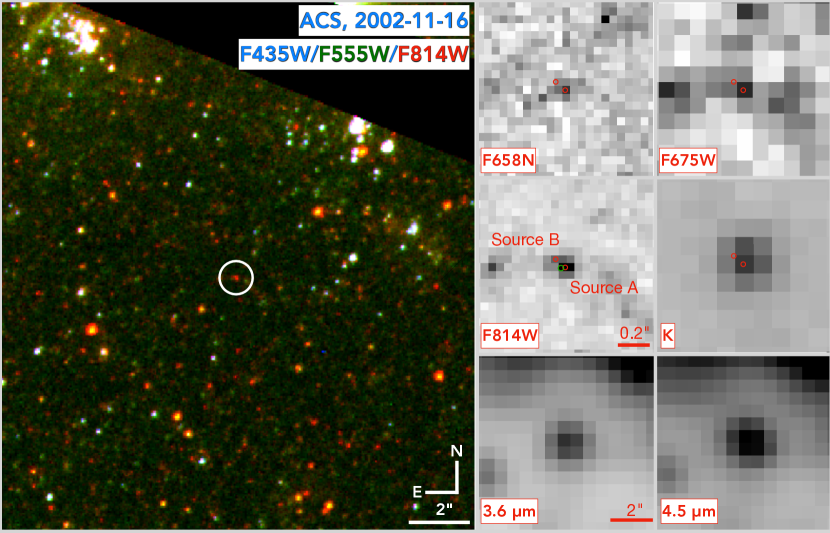
We present pre-explosion optical and infrared (IR) imaging at the site of the type II supernova (SN II) 2023ixf in Messier 101 at 6.9 Mpc. We astrometrically registered a ground-based image of SN 2023ixf to archival Hubble Space Telescope (HST), Spitzer Space Telescope (Spitzer), and ground-based near-IR images. A single point source is detected at a position consistent with the SN at wavelengths ranging from HST $R$-band to Spitzer 4.5 $μ$m. Fitting to blackbody and red supergiant (RSG) spectral-energy distributions (SEDs), we find that the source is anomalously cool with a significant mid-IR excess. We interpret this SED as reprocessed emission in a 8600 $R_{\odot}$ circumstellar shell of dusty material with a mass $\sim$5$ imes10^{-5} M_{\odot}$ surrounding a $\log(L/L_{\odot})=4.74\pm0.07$ and $T_{ m eff}=3920\substack{+200\\-160}$ K RSG. This luminosity is consistent with RSG models of initial mass 11 $M_{\odot}$, depending on assumptions of rotation and overshooting. In addition, the counterpart was significantly variable in pre-explosion Spitzer 3.6 $μ$m and 4.5 $μ$m imaging, exhibiting $\sim$70% variability in both bands correlated across 9 yr and 29 epochs of imaging. The variations appear to have a timescale of 2.8 yr, which is consistent with $κ$-mechanism pulsations observed in RSGs, albeit with a much larger amplitude than RSGs such as $α$ Orionis (Betelgeuse).
研究动机与目标
- 利用预爆发成像数据,识别M101星系中II型超新星SN 2023ixf的前身星。
- 通过研究大质量RSG(>20 M☉)在II型超新星中代表性不足的现象,解决“红超巨星难题”。
- 表征前身星的物理特性,包括光度、温度及包层环境。
- 探究前身星光变的性质及其对脉动不稳定性与质量损失的影响。
- 检验前身星的性质是否与RSG演化及核心塌缩超新星的理论模型一致。
提出的方法
- 对预爆发的地面望远镜、哈勃空间望远镜(HST)和斯皮策空间望远镜图像进行天体测量配准,以精确定位超新星位置。
- 使用黑体模型和RSG模型拟合光谱能量分布(SED),以推导前身星的有效温度和光度。
- 采用三维辐射转移方法,对中红外波段的超量辐射进行建模,解释为包层尘埃对恒星光的再辐射。
- 分析长达9年(29个历元)的斯皮策望远镜3.6 μm和4.5 μm光变曲线,测量光变幅度和特征 timescale(时间尺度)。
- 将前身星的光度和温度与理论RSG演化模型进行比较,以估算初始质量。
- 使用贝叶斯推断(emcee)方法,约束SED拟合和光变参数的不确定性。
实验结果
研究问题
- RQ1SN 2023ixf的前身星性质为何?其是否符合红超巨星的预期特征?
- RQ2为何前身星的SED中存在显著的中红外超量?这揭示了其包层环境的何种信息?
- RQ3前身星光变曲线中的长期光变特性与脉动不稳定性机制有何关联?
- RQ4前身星的初始质量是多少?其与II型超新星前身星的理论预期相比如何?
- RQ5前身星的光变与质量损失历史是否支持其为即将塌缩的大质量RSG的假设?
主要发现
- 在光学至中红外波段,SN 2023ixf位置处仅检测到一个点源,证实其为一颗明亮且低温的前身星。
- 前身星的光度为 log(L/L☉) = 4.74 ± 0.07,有效温度为3920 K,与红超巨星一致。
- 中红外超量最合理的解释是:恒星光在半径为8600 R☉、质量约为5×10⁻⁵ M☉的包层尘埃中被再辐射。
- 前身星在9年时间里,其斯皮策3.6 μm和4.5 μm波段的光变幅度达70%,特征时间尺度为2.8年。
- 该光变与κ机制脉动一致,但振幅远大于典型RSG(如参宿四)的振幅。
- 前身星的光度与温度与初始质量约11 M☉的RSG一致,具体结果取决于对旋转和非绝热对流的假设。

阅读本论文
在 Nubint 阅读器中打开原文,边读边就任意段落提问。
在 Nubint 中阅读本论文本解读由 AI 根据论文原文生成,引用前请核对原文。