
[论文解读] Solution of physics-based inverse problems using conditional generative adversarial networks with full gradient penalty
本论文提出了一种带有完整梯度惩罚(Full-GP)的条件Wasserstein GAN,用于解决基于物理的反问题,其中先验知识以样本形式给出,且前向模型为黑箱PDE系统。通过在判别器上对输入向量和测量向量均施加1-Lipschitz连续性约束,该方法确保了更强的收敛性保证和更高的采样精度,在合成问题和生物力学启发的反问题中,相较于先前的cWGAN,其后验估计表现更优。
The solution of probabilistic inverse problems for which the corresponding forward problem is constrained by physical principles is challenging. This is especially true if the dimension of the inferred vector is large and the prior information about it is in the form of a collection of samples. In this work, a novel deep learning based approach is developed and applied to solving these types of problems. The approach utilizes samples of the inferred vector drawn from the prior distribution and a physics-based forward model to generate training data for a conditional Wasserstein generative adversarial network (cWGAN). The cWGAN learns the probability distribution for the inferred vector conditioned on the measurement and produces samples from this distribution. The cWGAN developed in this work differs from earlier versions in that its critic is required to be 1-Lipschitz with respect to both the inferred and the measurement vectors and not just the former. This leads to a loss term with the full (and not partial) gradient penalty. It is shown that this rather simple change leads to a stronger notion of convergence for the conditional density learned by the cWGAN and a more robust and accurate sampling strategy. Through numerical examples it is shown that this change also translates to better accuracy when solving inverse problems. The numerical examples considered include illustrative problems where the true distribution and/or statistics are known, and a more complex inverse problem motivated by applications in biomechanics.
研究动机与目标
- 解决当先验信息仅以样本形式提供时,由物理PDE约束的高维概率反问题的挑战。
- 克服传统MCMC和BNN在高维设置下以及由于遗留代码导致导数计算不可行时的局限性。
- 开发一种深度学习框架,仅利用样本和黑箱前向模型,学习在给定噪声测量下被推断参数的后验分布。
- 通过更强的理论收敛性保证,提升反问题条件生成建模的鲁棒性和准确性。
- 在复杂反问题(如生物力学中出现的问题)中,实现准确的不确定性量化,采用样本高效且可微的训练策略。
提出的方法
- 使用先验分布和基于物理的前向模型,构建包含12,000对配对样本的训练数据集,包括被推断参数(x)和对应的噪声测量(y)。
- 训练一个条件Wasserstein GAN(cWGAN),其中生成器将噪声向量和测量向量映射为给定y时x的后验分布样本。
- 通过在判别器上对被推断向量x和测量向量y均施加1-Lipschitz约束,引入完整梯度惩罚(Full-GP),从而得到包含完整Hessian梯度惩罚的判别器损失。
- 采用一种采样策略,从以真实测量为中心的紧密高斯分布中生成测量值,以提高后验估计的准确性。
- 利用训练好的Full-GP cWGAN,从3,000个生成样本中估计后验统计量(均值和标准差)。
- 将该方法应用于两个测试案例:二维反向热传导问题和一个生物力学启发的反问题,即从波幅数据中估计视神经乳头剪切模量。
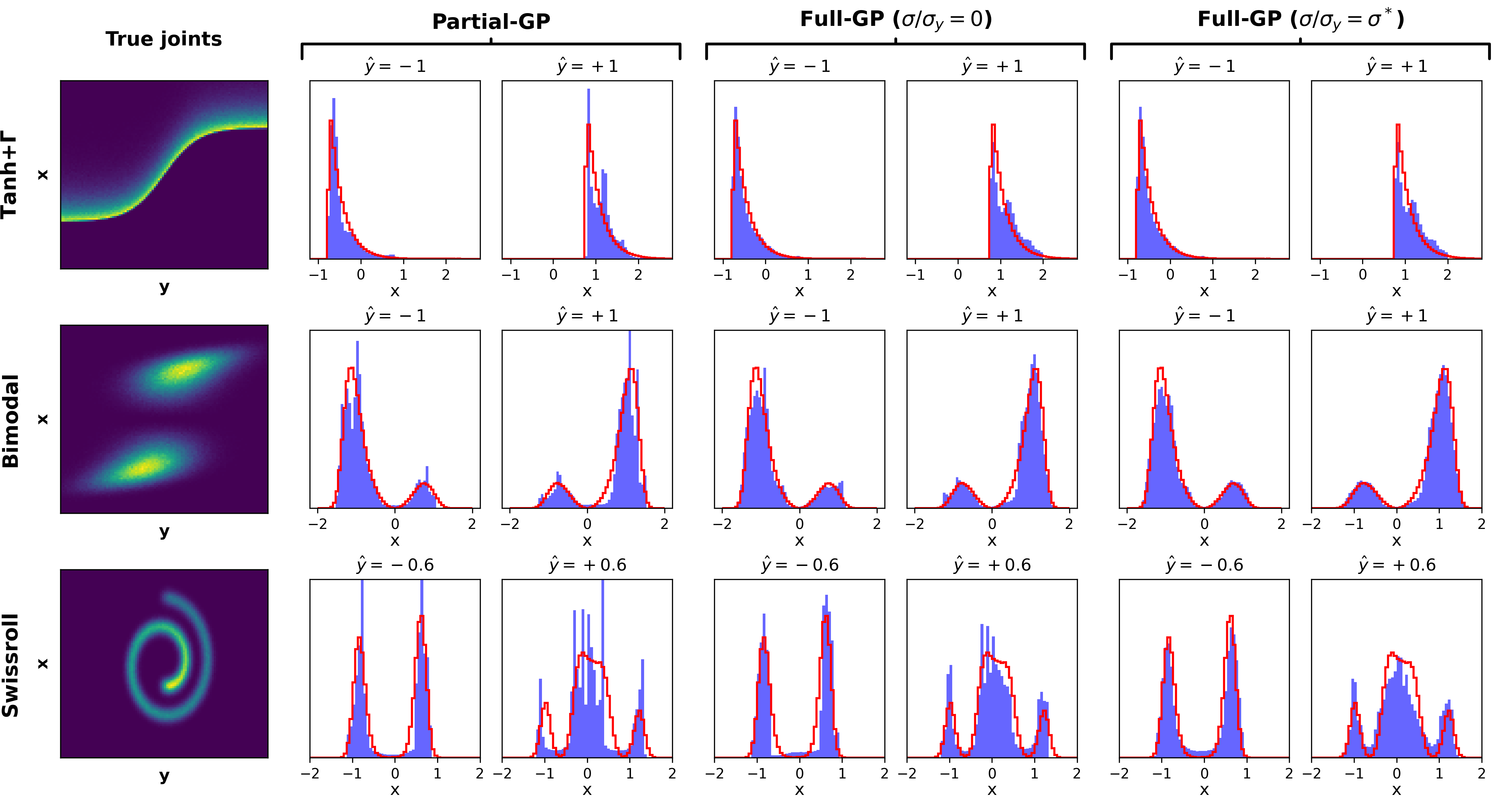
实验结果
研究问题
- RQ1与标准cWGAN相比,带有完整梯度惩罚的cWGAN是否能在基于物理的反问题中实现更强的理论收敛性,更接近真实后验分布?
- RQ2在高维反问题中,对判别器同时施加关于输入和测量向量的1-Lipschitz连续性约束,如何影响后验采样的准确性和鲁棒性?
- RQ3所提出的采样策略——从以真实测量为中心的高斯分布中生成测量值——在真实反问题中能在多大程度上提升后验估计?
- RQ4当应用于具有未知真实统计特性的复杂真实生物力学启发反问题时,Full-GP cWGAN相较于基线cWGAN的表现如何?
- RQ5该方法是否能有效量化高模糊区域(如边界或低信号区域)中被推断参数场的不确定性?
主要发现
- Full-GP cWGAN确保了学习到的条件分布弱收敛至真实后验分布,相较于仅对被推断向量施加Lipschitz连续性的先前cWGAN,具有理论上的改进。
- 该方法实现了更精确的后验均值估计,在生物力学启发的反问题中,对所有三个测试样本,其估计的剪切模量均与真实值高度吻合。
- 后验标准差估计能正确识别出高不确定性区域,如视神经乳头边缘,这些区域的预测可靠性较低。
- 当测量噪声水平升高(σ/σ_Y = 0.31)时,预测的后验标准差相应增加,反映出预期的不确定性上升,验证了模型在不确定性量化方面的可靠性。
- Full-GP cWGAN在采样精度和鲁棒性方面优于其前代模型,尤其在高维和复杂反问题中表现更优。
- 所提出的采样策略——使用来自紧密高斯分布的噪声注入测量值——进一步提升了性能,尤其在噪声较大或病态设置下。
阅读本论文
在 Nubint 阅读器中打开原文,边读边就任意段落提问。
在 Nubint 中阅读本论文本解读由 AI 根据论文原文生成,引用前请核对原文。