
[论文解读] Sorting multibay block stacking storage systems
本文提出了一种针对使用自主移动机器人(AMR)的多仓 block stacking 仓库中的多仓单元载荷预整理问题(MUPMP)的两阶段解决方案方法,同时优化移动次数和行驶时间。该方法在第二阶段引入了精确的约束规划(CP)模型,显著提升了求解质量,并实现了对包含多个仓和每仓最多四个出入方向的实际仓库配置的高效排序。
Autonomous mobile robots (AMRs) are increasingly used to automate operations in intralogistics. One crucial feature of AMRs is their availability, allowing them to operate 24/7. This work addresses the multibay unit load pre-marshalling problem, which extends pre-marshalling from a single bay to larger warehouse configurations with multiple bays. Pre-marshalling leverages off-peak time intervals to sort a block stacking warehouse in anticipation of future orders. These larger warehouse configurations require not only the minimization of the number of moves but also the consideration of distance or time when making sorting decisions. Our proposed solution for the multibay unit load pre-marshalling problem is based on our two-step approach that first determines the access direction for each stack and then finds a sequence of moves to sort the warehouse. In addition to adapting the existing approach that integrates a network flow model and an extended A* algorithm, we additionally present an exact constraint programming approach for the second stage of the problem-solving process. The results demonstrate that the presented solution approach effectively enhances the access time of unit loads and reduces the sorting effort for block stacking warehouses with multiple bays.
研究动机与目标
- 解决大型多仓 block stacking 仓库中使用 AMR 进行预整理的可扩展性与运行效率问题。
- 将单仓单元载荷预整理问题(UPMP)扩展至考虑仓间移动的多仓场景。
- 通过在排序决策中整合行驶距离,最小化总移动时间与访问延迟,提升 AMR 利用效率。
- 开发并评估第二阶段的精确约束规划(CP)方法,以确保最优移动序列。
- 发布基准数据集,以支持多仓仓库优化研究的可复现性与未来研究。
提出的方法
- 采用两阶段方法:首先确定每个堆垛的最优出入方向,然后生成移动序列以最小化总行驶时间。
- 在第一阶段使用网络流模型,基于取货优先级和空间约束分配出入方向。
- 在第二阶段采用扩展的 A* 算法进行启发式移动序列生成,考虑 AMR 行驶距离。
- 引入精确的约束规划(CP)模型作为 A* 启发式方法的替代方案,以计算最优移动序列。
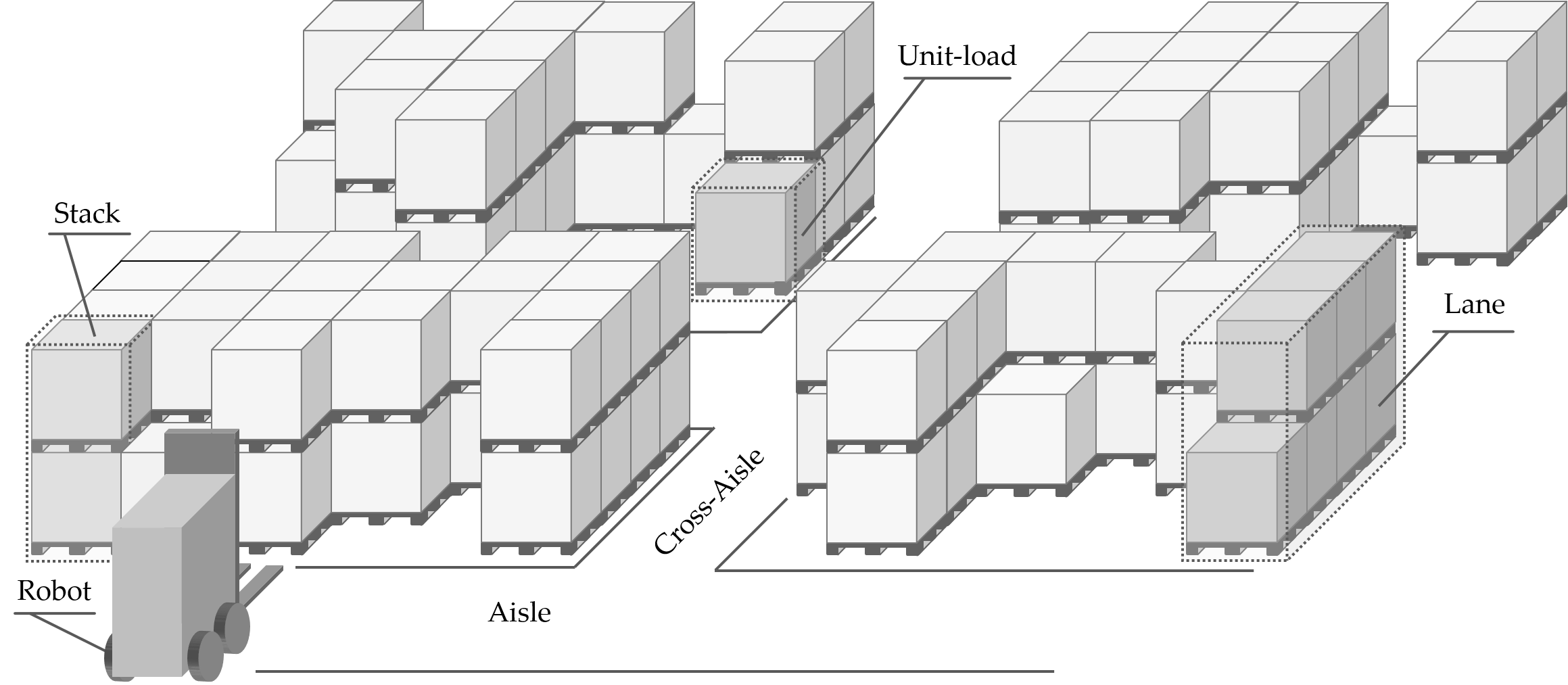
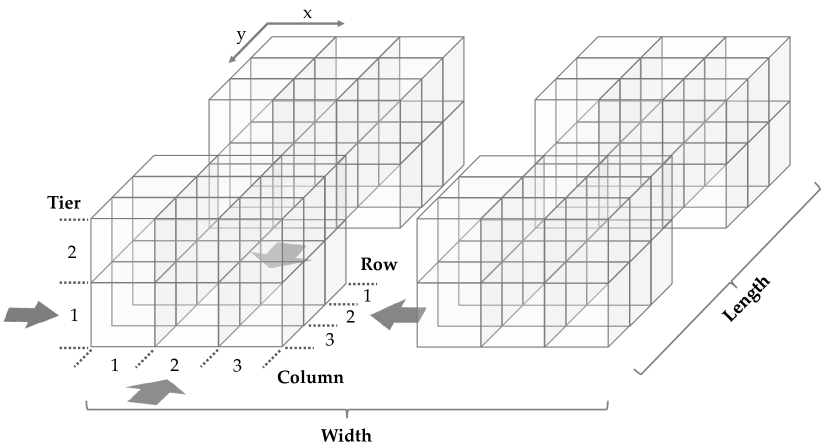
- 将仓库建模为由仓、通道和堆垛组成的网格结构,其中单元载荷被其下方更高优先级的载荷所阻挡。
- 引入 AMR 约束:单载荷容量、无法越过堆垛、通过过道在仓之间移动的时间。
实验结果
研究问题
- RQ1如何将单元载荷预整理问题从单仓有效扩展至多个互连仓且共享 AMR 车队的场景?
- RQ2与仅最小化移动次数相比,考虑仓间行驶时间在多大程度上能提升预整理效率?
- RQ3在移动序列阶段,精确约束规划方法是否能在求解质量上优于启发式方法?
- RQ4不同仓库配置(如仓大小、载荷密度、取货优先级分布)如何影响求解性能与可扩展性?
- RQ5在实际规模的 MUPMP 实例中,所提出的两阶段框架是否具有实际可行性?
主要发现
- 所提出的两阶段方法能有效减少多仓 block stacking 仓库中的访问时间与整理工作量,即使在高载荷密度下亦然。
- 精确约束规划(CP)模型在求解质量上始终优于启发式 A* 方法,尤其在高阻塞与高行驶复杂度的复杂实例中表现更优。
- 对于 5x5 和 6x6 仓配置、载荷密度为 80% 的情况,CP 模型在 3600 秒内求解了 90% 的实例,平均求解时间低于 3000 秒。
- 在 5x5-6x6 和 6x6-6x6 仓配置、载荷密度为 90% 的情况下,CP 模型在时间限制内求解了 5/10 个实例,表明其对大规模实例具备可扩展性。
- A* 启发式方法在小规模实例中计算速度更快,但相比 CP 求解出的解质量较差,尤其在高密度场景下更为明显。
- 作者发布了 MUPMP 的基准数据集,支持研究的可复现性,并为未来多仓仓库优化方法的比较提供基础。
阅读本论文
在 Nubint 阅读器中打开原文,边读边就任意段落提问。
在 Nubint 中阅读本论文本解读由 AI 根据论文原文生成,引用前请核对原文。