
[论文解读] Spanning the full range of neutron star properties within a microscopic description
本研究在包含非线性矢量介子相互作用的相对论性平均场模型中采用贝叶斯推断框架,系统地探索了中子星性质的全范围。根据非线性矢量耦合强度,识别出三种不同类别的方程态,关键结果表明:弱非线性耦合允许最大质量达2.75 M⊙,与GW190814中的次星体一致;且微扰QCD约束偏好具有强非线性矢量项或超子的模型。
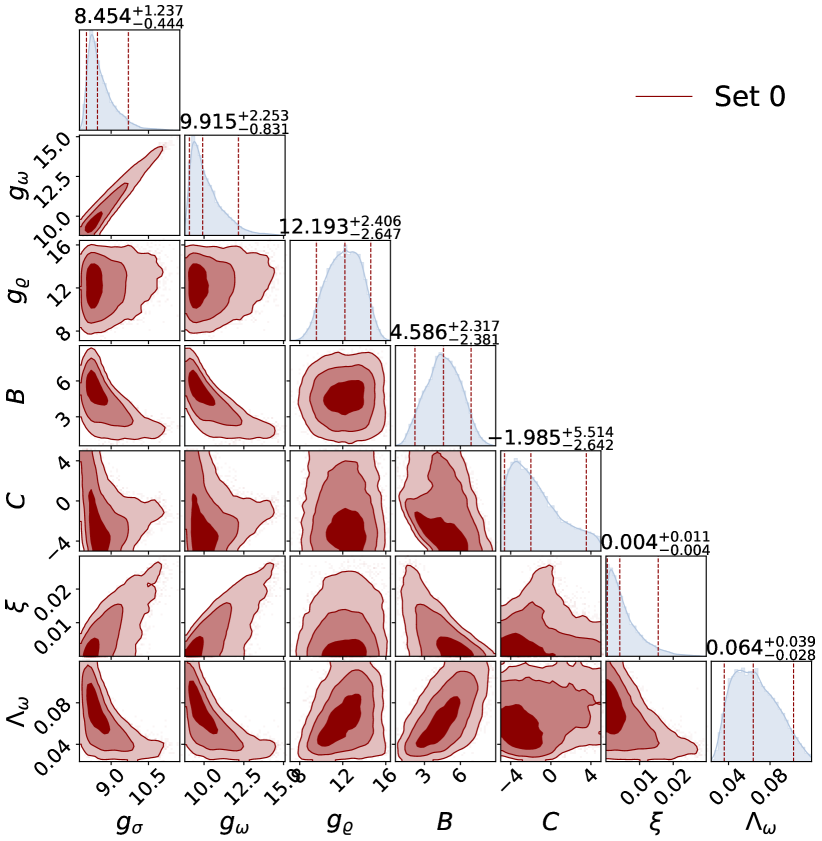
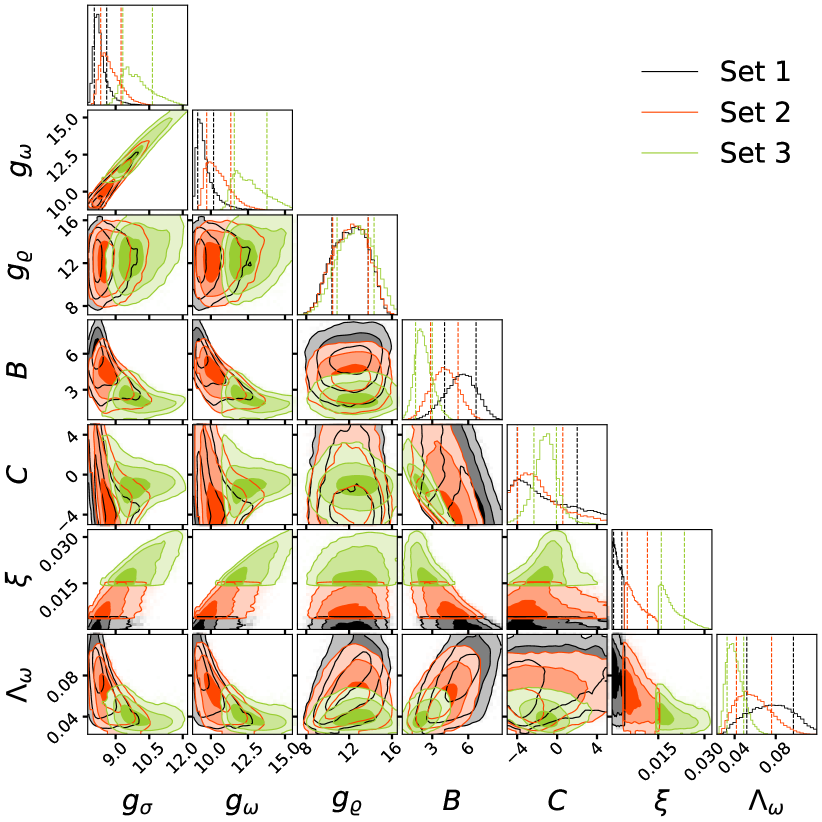
The high-density behavior of nuclear matter is analyzed within a relativistic mean-field description with non-linear meson interactions. To assess the model parameters and their output, a Bayesian inference technique is used. The Bayesian setup is limited only by a few nuclear saturation properties, the neutron star maximum mass larger than 2 M$_\odot$, and the low-density pure neutron matter equation of state (EOS) produced by an accurate N$^3$LO calculation in chiral effective field theory. Depending on the strength of the non-linear scalar vector field contribution, we have found three distinct classes of EOSs, each one correlated to different star properties distributions. If the non-linear vector field contribution is absent, the gravitational maximum mass and the sound velocity at high densities are the greatest. However, it also gives the smallest speed of sound at densities below three times saturation density. On the other hand, models with the strongest non-linear vector field contribution predict the largest radii and tidal deformabilities for 1.4 M$_\odot$ stars, together with the smallest mass for the onset of the nucleonic direct Urca processes and the smallest central baryonic densities for the maximum mass configuration. These models have the largest speed of sound below three times saturation density, but the smallest at high densities, in particular, above four times saturation density the speed of sound decreases approaching approximately $\sqrt{0.4}c$ at the center of the maximum mass star. On the contrary, a weak non-linear vector contribution gives a monotonically increasing speed of sound. A 2.75 M$_\odot$ NS maximum mass was obtained in the tail of the posterior with a weak non-linear vector field interaction. We found that pQCD favors models with a large non-linear vector field contribution or hyperons.
研究动机与目标
- 使用微观核多体模型系统地探索中子星性质的全范围。
- 评估非线性矢量介子相互作用对中子星方程态及可观测量性质的影响。
- 利用贝叶斯推断结合天体物理和核物理数据(包括GW170817、NICER和手征EFT约束)对模型参数进行约束。
- 评估所得方程态在高密度下与微扰QCD界限的相容性。
- 研究超子和非线性项在塑造速度-声速与最大质量构型中的作用。
提出的方法
- 使用包含标量与矢量介子自相互作用和交叉相互作用的相对论性平均场拉格朗日量来描述致密核物质。
- 应用贝叶斯推断,利用核饱和性质、2 M⊙的最大中子星质量,以及来自N3LO手征有效场论的低密度纯中子物质数据,对模型参数进行约束。
- 根据非线性矢量(ω⁴)相互作用项的强度,识别出三种不同的方程态类别。
- 计算1.4 M⊙和最大质量中子星的声速、质量-半径关系、潮汐形变性以及直接Urca过程的 onset。
- 在不同QCD标度参数X ∈ [1,4]下,评估方程态与微扰QCD约束的相容性。
- 引入超子贡献,以评估其对方程态软化效应及与观测和理论界限一致性的影响力。
实验结果
研究问题
- RQ1非线性矢量介子相互作用(ω⁴项)的强度如何影响方程态及中子星性质(如质量、半径和潮汐形变性)?
- RQ2该模型能否在满足天体物理和核物理约束的前提下再现2.75 M⊙的最大中子星质量?
- RQ3非线性矢量项对不同密度下声速的影响如何,特别是在四倍饱和密度附近及之上?
- RQ4超子和微扰QCD约束的引入如何影响不同方程态的可行性?
- RQ5哪些模型构型最能满足来自GW170817、NICER、手征EFT和pQCD的联合约束?
主要发现
- 零非线性矢量相互作用(ξ=0)的模型产生最高的最大中子星质量和最高密度下的声速,在最大质量星中心处声速可达约√0.4 c。
- 在后验分布的尾部,弱非线性矢量耦合可实现2.75 M⊙的最大质量,表明GW190814中的次星体可能是中子星。
- 强非线性矢量耦合的模型预测1.4 M⊙中子星具有最大半径和潮汐形变性,同时最大质量构型的中心重子密度最小。
- 强非线性矢量项的模型在四倍饱和密度以上声速下降,最大质量星中心处趋近于√0.4 c。
- 微扰QCD约束在弱非线性耦合模型(ξ < 0.004)中受到最严格的违反,其中多达40%的模型不满足X=4条件。
- 引入超子或强非线性矢量项可提高满足pQCD界限的可能性,尤其在X=1和X=4时,超子包含模型表现出近乎完全的合规性。
阅读本论文
在 Nubint 阅读器中打开原文,边读边就任意段落提问。
在 Nubint 中阅读本论文本解读由 AI 根据论文原文生成,引用前请核对原文。