
[论文解读] SparseFusion: Fusing Multi-Modal Sparse Representations for Multi-Sensor 3D Object Detection
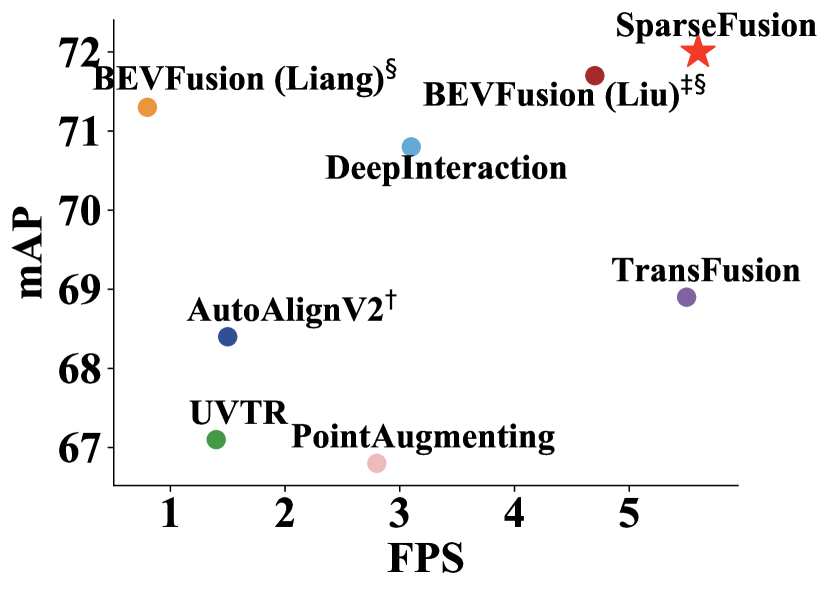
SparseFusion 提出了一种新颖的3D目标检测框架,通过在将相机候选区域转换到LiDAR坐标系后,利用轻量级自注意力模块融合来自LiDAR和相机模态的稀疏实例级特征。该方法通过避免密集表示并利用语义与几何跨模态迁移模块减轻负迁移,实现了在nuScenes数据集上的最先进性能,并具备最快的推理速度。
By identifying four important components of existing LiDAR-camera 3D object detection methods (LiDAR and camera candidates, transformation, and fusion outputs), we observe that all existing methods either find dense candidates or yield dense representations of scenes. However, given that objects occupy only a small part of a scene, finding dense candidates and generating dense representations is noisy and inefficient. We propose SparseFusion, a novel multi-sensor 3D detection method that exclusively uses sparse candidates and sparse representations. Specifically, SparseFusion utilizes the outputs of parallel detectors in the LiDAR and camera modalities as sparse candidates for fusion. We transform the camera candidates into the LiDAR coordinate space by disentangling the object representations. Then, we can fuse the multi-modality candidates in a unified 3D space by a lightweight self-attention module. To mitigate negative transfer between modalities, we propose novel semantic and geometric cross-modality transfer modules that are applied prior to the modality-specific detectors. SparseFusion achieves state-of-the-art performance on the nuScenes benchmark while also running at the fastest speed, even outperforming methods with stronger backbones. We perform extensive experiments to demonstrate the effectiveness and efficiency of our modules and overall method pipeline. Our code will be made publicly available at https://github.com/yichen928/SparseFusion.
研究动机与目标
- 为解决多传感器3D检测中密集表示带来的效率低下与噪声问题。
- 克服由于域差距导致的LiDAR与相机模态之间的负迁移问题。
- 开发一种仅在稀疏实例级特征上操作的融合策略,而非依赖密集场景表示。
- 通过避免计算量大的密集特征生成,仅融合相关稀疏实例特征,从而在不牺牲检测精度的前提下提升推理速度。
- 通过在nuScenes上的消融实验与基准测试,验证稀疏融合方法的有效性。
提出的方法
- SparseFusion 使用并行的3D目标检测器,独立地从LiDAR点云和相机图像中提取稀疏实例级特征。
- 通过解耦对象表示,将相机候选区域转换到LiDAR坐标系,实现统一的3D融合。
- 在共享的3D空间中,利用轻量级自注意力模块融合转换后的稀疏候选区域,完成最终检测。
- 在模态特定检测器之前应用语义与几何跨模态迁移模块,以减小域差距并降低负迁移。
- 通过仅融合相关稀疏实例特征,避免生成密集特征,从而提升效率并减少噪声。
- 将相机候选区域转换到LiDAR空间的视角变换对于准确的跨模态对齐与性能表现至关重要。
实验结果
研究问题
- RQ1是否可以有效融合来自LiDAR和相机模态的稀疏实例级特征,而无需依赖密集表示?
- RQ2与现有的密集到密集或稀疏到密集的融合策略相比,稀疏候选区域的融合在精度与速度方面表现如何?
- RQ3语义与几何跨模态迁移模块在多大程度上缓解了模态之间的负迁移?
- RQ4消除密集特征生成是否能在保持或提升检测性能的同时提高推理效率?
- RQ5融合机制的选择(如自注意力与MLP或最优传输)对最终检测精度有何影响?
主要发现
- SparseFusion 在nuScenes基准上实现了68.8%的NDS和66.4%的mAP,创下新的最先进性能记录。
- 其推理速度在所有方法中最快,甚至优于使用更强主干网络的模型。
- 消融实验表明,自注意力融合优于MLP、交叉注意力和最优传输基线方法。
- 将相机候选区域转换到LiDAR空间的视角变换使mAP提升0.8个百分点,NDS提升0.5个百分点。
- 几何与语义迁移模块显著提升了性能,其中语义迁移带来的增益最大。
- 顺序检测器流水线的表现不如并行检测器设计,验证了模态特定特征提取的必要性。
阅读本论文
在 Nubint 阅读器中打开原文,边读边就任意段落提问。
在 Nubint 中阅读本论文本解读由 AI 根据论文原文生成,引用前请核对原文。