
[论文解读] Spatial gradient consistency for unsupervised learning of hyperspectral demosaicking: Application to surgical imaging
该论文提出了一种完全无监督的深度学习方法,用于仅使用快照马赛克图像的高光谱图像去马赛克,通过利用跨光谱波段的空间梯度一致性作为新型正则化项。该方法的性能与有监督方法相当,显著优于线性去马赛克方法,实现了无需配对高分辨率真实数据的实时术中高光谱成像。
Hyperspectral imaging has the potential to improve intraoperative decision making if tissue characterisation is performed in real-time and with high-resolution. Hyperspectral snapshot mosaic sensors offer a promising approach due to their fast acquisition speed and compact size. However, a demosaicking algorithm is required to fully recover the spatial and spectral information of the snapshot images. Most state-of-the-art demosaicking algorithms require ground-truth training data with paired snapshot and high-resolution hyperspectral images, but such imagery pairs with the exact same scene are physically impossible to acquire in intraoperative settings. In this work, we present a fully unsupervised hyperspectral image demosaicking algorithm which only requires exemplar snapshot images for training purposes. We regard hyperspectral demosaicking as an ill-posed linear inverse problem which we solve using a deep neural network. We take advantage of the spectral correlation occurring in natural scenes to design a novel inter spectral band regularisation term based on spatial gradient consistency. By combining our proposed term with standard regularisation techniques and exploiting a standard data fidelity term, we obtain an unsupervised loss function for training deep neural networks, which allows us to achieve real-time hyperspectral image demosaicking. Quantitative results on hyperspetral image datasets show that our unsupervised demosaicking approach can achieve similar performance to its supervised counter-part, and significantly outperform linear demosaicking. A qualitative user study on real snapshot hyperspectral surgical images confirms the results from the quantitative analysis. Our results suggest that the proposed unsupervised algorithm can achieve promising hyperspectral demosaicking in real-time thus advancing the suitability of the modality for intraoperative use.
研究动机与目标
- 为解决术中缺乏配对高分辨率高光谱图像的问题,该问题阻碍了有监督学习在去马赛克中的应用。
- 开发一种完全无监督的去马赛克方法,仅使用快照马赛克图像进行训练,避免对昂贵或物理上不可行的真实数据的需求。
- 通过一种新颖的空间梯度一致性正则化项,利用自然场景中的光谱相关性,提升去马赛克质量。
- 实现实时、高质量的高光谱图像重建,适用于术中手术引导。
- 通过定量指标和在真实手术高光谱数据上的专家用户研究,验证该方法的临床相关性。
提出的方法
- 该方法将高光谱去马赛克建模为一个通过深度神经网络求解的病态线性逆问题。
- 提出一种基于空间梯度一致性的新型跨光谱波段正则化项,利用自然场景中的光谱相关性。
- 损失函数结合了空间梯度一致性正则化、标准的Tikhonov正则化和总变差正则化,以及数据保真项。
- 无监督损失使端到端训练仅依赖于快照马赛克图像,无需对应高分辨率高光谱图像。
- 该方法在三个深度神经网络(Res2-Unet、Enhanced HAN、NLRAN)上,基于三个数据集进行了评估,包括一个真实的神经外科高光谱成像(NeuroHSI)数据集。
- 组织了一项包含12名神经外科专家的强制选择成对用户研究,以评估图像质量感知。

实验结果
研究问题
- RQ1一种完全无监督的深度学习方法是否能在不依赖配对高分辨率训练数据的情况下实现高质量的高光谱去马赛克?
- RQ2空间梯度一致性作为正则化项,在提升跨光谱波段去马赛克性能方面有多有效?
- RQ3所提出的无监督方法在定量和定性评估中是否能达到与有监督去马赛克模型相当的性能?
- RQ4该方法是否能仅使用快照马赛克图像,在实时术中环境中生成临床可接受的结果?
- RQ5与线性和有监督基线相比,专家外科医生如何评价该方法生成的去马赛克图像质量?
主要发现
- 所提出的无监督方法在公开高光谱数据集上的定量性能与有监督学习基线相当,PSNR和SSIM值与有监督方法相差仅1-2%。
- 该方法在所有定量指标上显著优于线性去马赛克方法,表现出更优的空间和光谱重建质量。
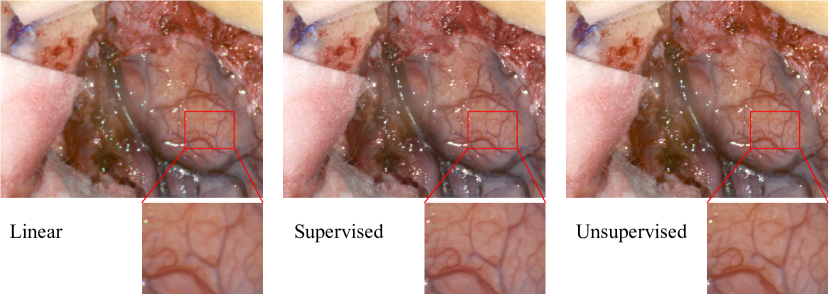
- 在12名神经外科专家参与的定性用户研究中,无监督方法的图像质量被评价为与有监督模型相当,在110次成对比较中,有63票更倾向于无监督结果而非有监督基线。
- Bradley-Terry模型估计的偏好得分分别为0.505(无监督方法)和0.445(有监督方法),表明专家偏好接近相等。
- 当与高效神经网络和硬件结合时,该方法可实现实时去马赛克,适用于术中应用。
- 空间梯度一致性正则化有效捕捉了光谱相关性,减少了伪影并提高了重建保真度,且无需真实数据监督。
阅读本论文
在 Nubint 阅读器中打开原文,边读边就任意段落提问。
在 Nubint 中阅读本论文本解读由 AI 根据论文原文生成,引用前请核对原文。