
[论文解读] Spectroscopy of edge and bulk collective modes in fractional Chern insulators
该论文提出了一种利用相互干涉的拉盖尔-高斯光束的光谱学协议,用于探测在超冷原子中实现的分数量子霍尔绝缘体中的手征性边缘模式和体磁-罗顿模式。通过可控地转移角动量和能量,该方法通过局域密度测量检测边缘和体激发态,证明即使在具有实际实验参数的两体玻色子系统中,这些特征信号也可被探测到。
The exploration of atomic fractional quantum Hall (FQH) states is now within reach in optical-lattice experiments. While ground-state signatures have been observed in a system realizing the Hofstadter-Bose-Hubbard model in a box [Leonard et al., Nature 2023], how to access hallmark low-energy collective modes remains a central open question in this context. We introduce a spectroscopic scheme based on two interfering Laguerre-Gaussian beams, which transfer a controlled angular momentum and energy to the system. The edge and bulk responses to the probe are detected through local density measurements, by tracking the transfer of atoms between the bulk and the edge of the FQH droplet. This detection scheme is shown to simultaneously reveal two specific signatures of FQH states: their chiral edge branch and their bulk magneto-roton mode. We numerically benchmark our method by considering few bosons in the $ν=1/2$ Laughlin ground state of the Hofstadter-Bose-Hubbard model, and demonstrate that these signatures are already detectable in realistic systems of two bosons, provided that the box potential is larger than the droplet. Our work paves the way for the detection of fractional statistics in cold atoms through edge signatures.
研究动机与目标
- 开发一种光谱学方法,用于探测超冷原子分数量子霍尔态中的低能集体模式,特别是手征性边缘模式和体磁-罗顿模式。
- 实现实验上探测当前可访问的少数体系统(如两体分数量子霍尔液滴)中的这些普遍性特征信号。
- 提供一种实用且实验可行的协议,通过量子气体显微镜实现局域密度测量。
- 通过边缘模式计数和体模式角动量结构区分拓扑相。
- 建立角动量分辨吸收谱与边缘态的共形场论预测之间的联系。
提出的方法
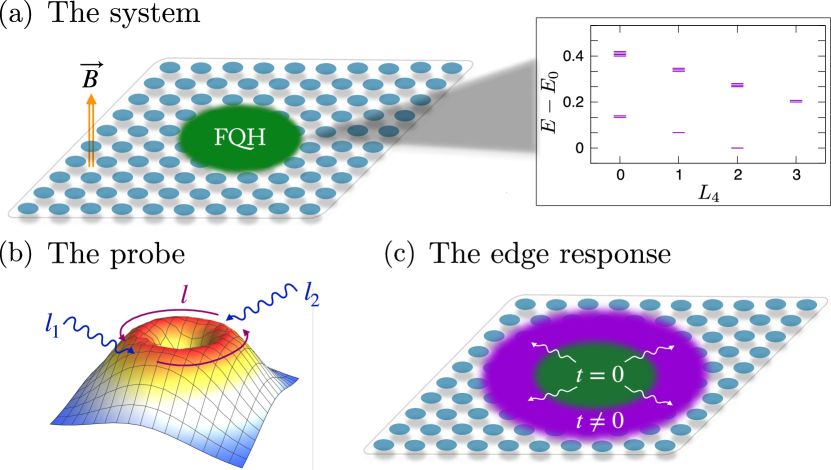
- 该协议采用两束相互干涉的拉盖尔-高斯激光束,向系统转移受控的角动量 $ l = l_1 - l_2 $ 和能量 $ \bar{\hbar}\omega $。
- 探测场通过激光场的空间分布与多体波函数的矩阵元耦合到系统,从而选择性激发边缘和体模式。
- 通过时间演化后的局域密度变化测量响应:边缘处密度增加表明边缘态被激发,而体密度变化则表明磁-罗顿模式被激发。
- 通过测量作为探测频率 $ \omega $ 函数的体区与边缘区之间的密度转移,提取角动量分辨吸收谱。
- 该方法利用多体矩阵元中出现的近似选择定则,源于低能态中的涌现旋转对称性,以分辨混合的边缘和体模式。
- 数值模拟采用霍夫施塔特-玻色- Hubbard 模型,其中填充因子 $ \nu = 1/2 $,模拟在盒势约束下的少数玻色子系统。
实验结果
研究问题
- RQ1能否在少数体超冷原子系统中,利用光学光谱学探测分数量子霍尔绝缘体的手征性边缘模式?
- RQ2在仅有两个玻色子的系统中,能否实验分辨体磁-罗顿模式?
- RQ3探测的角动量和能量如何影响边缘和体模式的探测?
- RQ4观测到的光谱特征在多大程度上能区分不同分数量子霍尔态(如Laughlin态与Moore-Read态)?
- RQ5通过探测获得的边缘模式计数是否与自由手征玻色子的共形场论预测一致?
主要发现
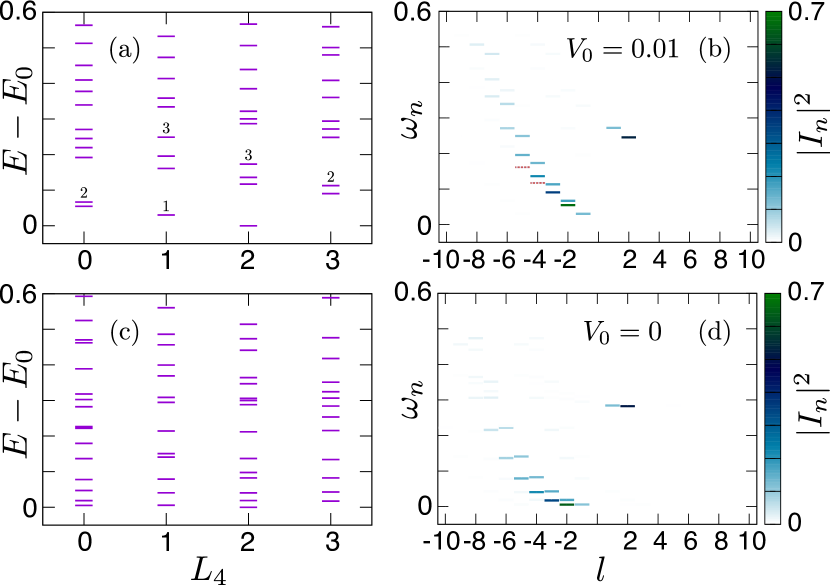
- 在盒势大于液滴尺寸的两体系统中,角动量分辨吸收谱中清晰分辨出手征性边缘模式和磁-罗顿模式。
- 在 $ l = -1 $ 时观察到 $ \omega \approx 0.03 \, \hbar/J $ 的共振峰,对应于边缘态激发,且在 $ t^* = 50 \, \hbar/J $ 后检测到 $ \Delta\rho_{\text{edge}} \sim 0.1-1 $ 的可探测密度转移。
- 该方法成功区分了边缘和体激发:边缘态在液滴边缘表现出密度增加,而磁-罗顿模式则引起体密度调制。
- 至 $ l = -3 $ 的边缘模式计数与自由手征玻色子的共形场论预测一致,证实了边缘的拓扑性质。
- 更强的约束使能级分裂增大,可在不延长观测时间的情况下分辨相同 $ l $ 的共振峰。
- 该协议在三粒子或四粒子系统中仍有效,表明其在两体极限之外具有鲁棒性。
阅读本论文
在 Nubint 阅读器中打开原文,边读边就任意段落提问。
在 Nubint 中阅读本论文本解读由 AI 根据论文原文生成,引用前请核对原文。