
[论文解读] SpeechGPT: Empowering Large Language Models with Intrinsic Cross-Modal Conversational Abilities
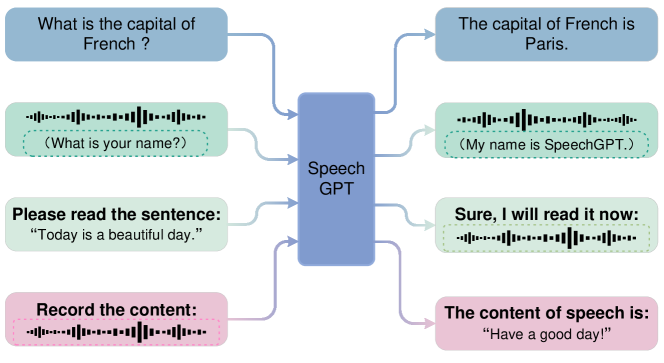
SpeechGPT 通过将离散语音表征整合到 LLM 的词汇表中,引入了一种具备内在跨模态对话能力的大语言模型,实现了语音与文本的端到端感知和生成。该模型通过三阶段训练流程和一种新型语音-文本指令数据集 SpeechInstruct,在多模态指令遵循和语音对话任务中取得了优异表现。
Multi-modal large language models are regarded as a crucial step towards Artificial General Intelligence (AGI) and have garnered significant interest with the emergence of ChatGPT. However, current speech-language models typically adopt the cascade paradigm, preventing inter-modal knowledge transfer. In this paper, we propose SpeechGPT, a large language model with intrinsic cross-modal conversational abilities, capable of perceiving and generating multi-model content. With discrete speech representations, we first construct SpeechInstruct, a large-scale cross-modal speech instruction dataset. Additionally, we employ a three-stage training strategy that includes modality-adaptation pre-training, cross-modal instruction fine-tuning, and chain-of-modality instruction fine-tuning. The experimental results demonstrate that SpeechGPT has an impressive capacity to follow multi-modal human instructions and highlight the potential of handling multiple modalities with one model. Demos are shown in https://0nutation.github.io/SpeechGPT.github.io/.
研究动机与目标
- 解决基于级联的语音-语言模型在语音与文本模态之间无法实现双向知识迁移的局限性。
- 克服将连续语音信号整合到基于离散标记的大语言模型中的挑战。
- 构建一种统一框架,使 LLM 具备内在的跨模态对话能力,支持语音理解与生成。
- 创建大规模、高质量的语音-文本指令数据集,以支持多模态 LLM 的有效指令微调。
- 证明单一模型可有效处理多样化跨模态任务,包括单模态、跨模态及语音对话任务。
提出的方法
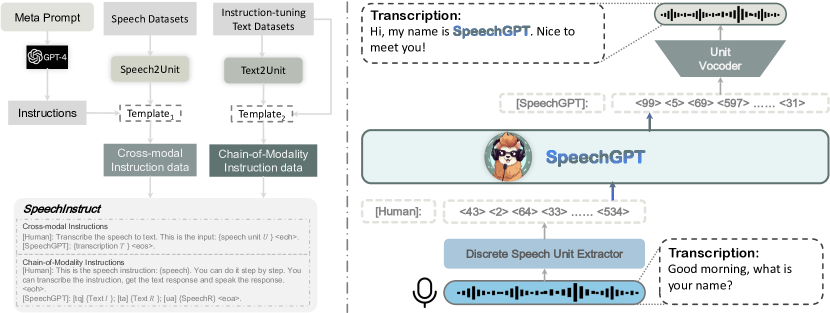
- 使用自监督语音模型将原始语音转换为离散单元,并将其整合到 LLM 的词汇空间中。
- 通过配对来自 ASR 数据集的离散语音标记与由 GPT-4 生成的自然语言指令,构建大规模语音-文本跨模态指令数据集 SpeechInstruct。
- 设计“模态链式”指令数据,使模型接收语音输入,以文本形式推理,并生成语音输出,以增强模态对齐。
- 实施三阶段训练策略:模态适应预训练(语音单元下一项预测)、跨模态指令微调(SpeechInstruct),以及使用 LoRA 实现参数效率的模态链式微调。
- 采用解码超参数,包括温度 0.8、top-k 采样(k=60)和 top-p 采样(p=0.8),以生成多样且连贯的回复。
- 以 LLaMA-13B 作为主干模型,在 A100 GPU 上训练,通过各阶段逐步增加批量大小和训练步数,以优化收敛性和性能。
实验结果
研究问题
- RQ1大语言模型是否能够天然具备支持语音感知与生成的跨模态对话能力?
- RQ2将离散语音标记整合到 LLM 词汇表中,对实现端到端多模态指令遵循的有效性如何?
- RQ3统一模型在处理多样化任务(包括单模态、跨模态及语音对话交互)方面的能力达到何种程度?
- RQ4三阶段训练范式对跨模态对齐和指令遵循性能的影响如何?
- RQ5新构建的语音-文本指令数据集(SpeechInstruct)是否能显著提升模型在跨模态上遵循复杂、自然化人类指令的能力?
主要发现
- SpeechGPT 在遵循多模态人类指令方面表现出色,能够成功生成准确且符合上下文的回复,适用于多种任务。
- 人工评估证实,SpeechGPT 在语音对话交互中符合 HHH 准则(无害、有用、诚实),表明其生成回复具有鲁棒性和安全性。
- 该模型实现了有效的跨模态理解与生成,表现为能够解释语音输入并生成相关语音回复,而无需依赖外部 ASR 或 TTS 模块。
- 三阶段训练流程显著提升了跨模态对齐效果,其中模态链式微调阶段增强了模态迁移与推理能力。
- SpeechInstruct 是首个大规模语音-文本跨模态指令数据集,可有效支持微调,并涵盖多种指令类型,包括任务导向型和开放式查询。
- 尽管在语用信号处理和多轮对话支持方面仍存在局限,SpeechGPT 为基于离散语音表征的端到端多模态 LLM 建立了强有力的基线。
阅读本论文
在 Nubint 阅读器中打开原文,边读边就任意段落提问。
在 Nubint 中阅读本论文本解读由 AI 根据论文原文生成,引用前请核对原文。