
[论文解读] Stable Diffusion-based Data Augmentation for Federated Learning with Non-IID Data
Gen-FedSD 使用一个预训练的 Stable Diffusion 模型来生成面向各客户端的合成数据,使本地 FL 数据更接近 IID,并在非 IID 分布下提升性能与收敛性。
The proliferation of edge devices has brought Federated Learning (FL) to the forefront as a promising paradigm for decentralized and collaborative model training while preserving the privacy of clients' data. However, FL struggles with a significant performance reduction and poor convergence when confronted with Non-Independent and Identically Distributed (Non-IID) data distributions among participating clients. While previous efforts, such as client drift mitigation and advanced server-side model fusion techniques, have shown some success in addressing this challenge, they often overlook the root cause of the performance reduction - the absence of identical data accurately mirroring the global data distribution among clients. In this paper, we introduce Gen-FedSD, a novel approach that harnesses the powerful capability of state-of-the-art text-to-image foundation models to bridge the significant Non-IID performance gaps in FL. In Gen-FedSD, each client constructs textual prompts for each class label and leverages an off-the-shelf state-of-the-art pre-trained Stable Diffusion model to synthesize high-quality data samples. The generated synthetic data is tailored to each client's unique local data gaps and distribution disparities, effectively making the final augmented local data IID. Through extensive experimentation, we demonstrate that Gen-FedSD achieves state-of-the-art performance and significant communication cost savings across various datasets and Non-IID settings.
研究动机与目标
- 在非 IID 数据分布下,将联邦学习确立为一种隐私保护的去中心化训练范式并予以动机驱动。
- 通过生成合成数据使每个客户端的数据分布与全局分布对齐,解决 FL 性能下降的根本原因。
- 提出 Gen-FedSD,以合成高质量、按类别条件分布的图像,针对每个客户端的数据缺口进行定制。
- 证明按客户端扩散模型的数据增强可以产生类似 IID 的本地数据,并在标准数据集上提升 FL 基准性能。
提出的方法
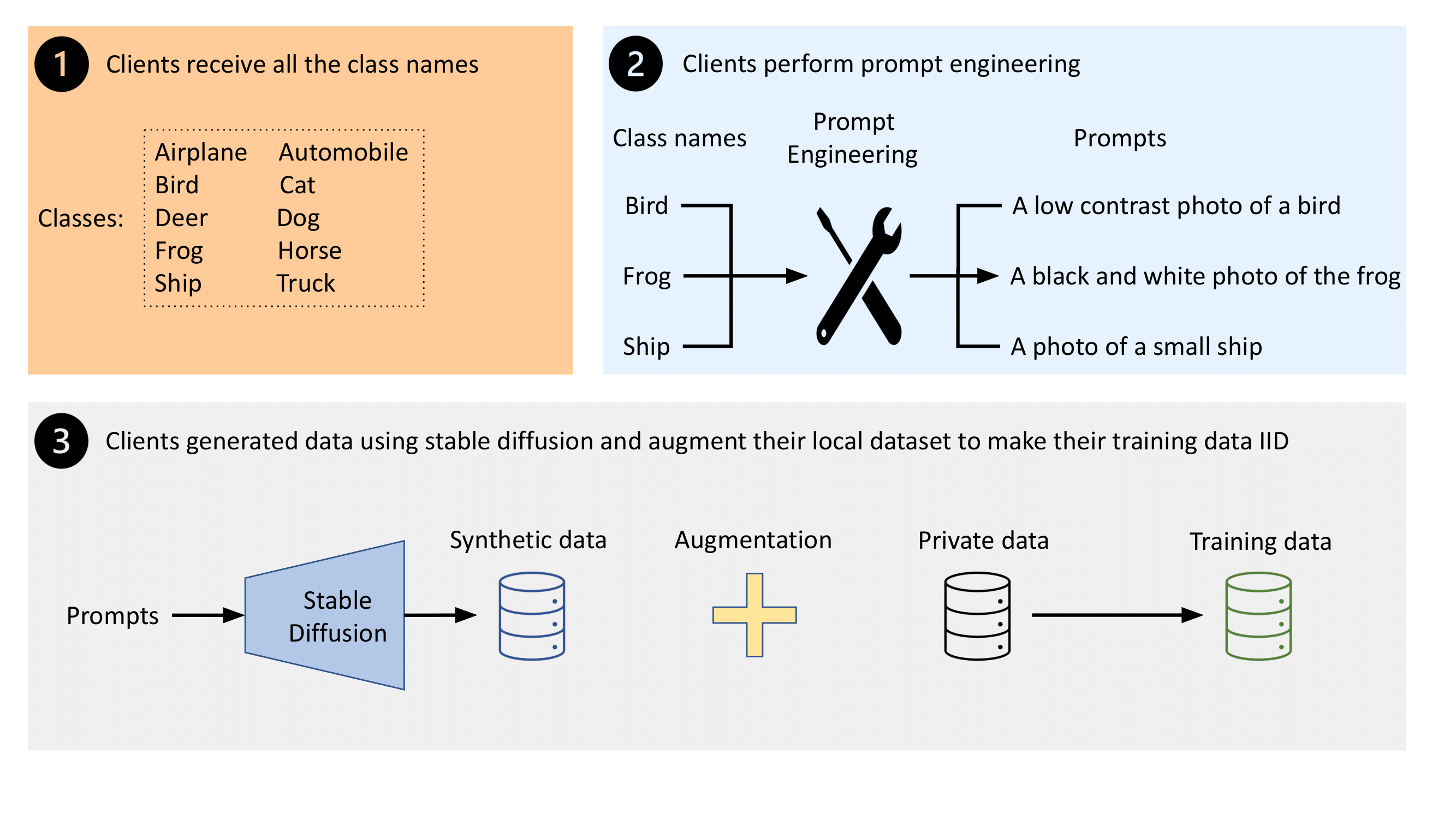
- 客户端从服务器接收全局类别标签并生成描述每个类别的文本提示。
- 使用预训练的 Stable Diffusion 模型从这些提示中合成类别条件图像。
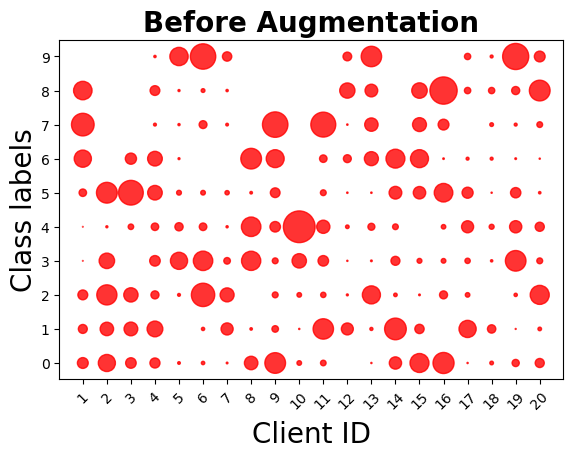
- 对每个客户端生成合成数据以使各类别计数达到相同,从而得到在全局分布下为 IID 的增强本地数据集。
- 将增强数据与本地数据结合用于训练 FL 模型,减少客户端漂移。
- 评估不同的提示设计(标准提示 vs. 多样提示),研究提示多样性对性能的影响。
- 将 Gen-FedSD 与标准 FL 基线进行比较(FedAvg、FedProx、FedNova、Scaffold)。
实验结果
研究问题
- RQ1按客户端的基于扩散的数据增强是否能将本地客户端分布与全局数据分布对齐,以减轻 FL 中的非 IID 效应?
- RQ2提示设计(多样 vs. 固定提示)如何影响合成数据的质量以及 FL 性能?
- RQ3在 varying 非 IID 设置下,Gen-FedSD 相对于 CIFAR-10 和 CIFAR-100 的准确度提升和通信成本影响是什么?
- RQ4Gen-FedSD 是否在实现设备端推断扩散模型的同时保留隐私?
主要发现
- 在非 IID 设置下,Gen-FedSD 显著提升了 FL 基线的准确性(在 CIFAR-10 上至少提升 12%,在 CIFAR-100 上至少提升 6%,在温和的异质性条件下)。
- 在极端非 IID 情况下,Gen-FedSD 的准确性提升至少为 20%(CIFAR-10)和 7%(CIFAR-100)。
- Gen-FedSD 加速收敛并降低评估数据集的通信成本。
- 提示多样性相较于固定提示进一步提升 Gen-FedSD 的性能。
- Gen-FedSD 在应用扩增时提升了若干基线的性能,有时甚至超过 FedAvg。
阅读本论文
在 Nubint 阅读器中打开原文,边读边就任意段落提问。
在 Nubint 中阅读本论文本解读由 AI 根据论文原文生成,引用前请核对原文。