
[论文解读] Stable Neural Stochastic Differential Equations in Analyzing Irregular Time Series Data
本论文引入三种稳定的 Neural SDEs(Langevin 型 SDE、线性噪声 SDE、几何 SDE),通过受控路径处理不规则时间序列,证明存在性/唯一性,并通过大量实验展示对分布偏移和缺失数据的鲁棒性。
Irregular sampling intervals and missing values in real-world time series data present challenges for conventional methods that assume consistent intervals and complete data. Neural Ordinary Differential Equations (Neural ODEs) offer an alternative approach, utilizing neural networks combined with ODE solvers to learn continuous latent representations through parameterized vector fields. Neural Stochastic Differential Equations (Neural SDEs) extend Neural ODEs by incorporating a diffusion term, although this addition is not trivial, particularly when addressing irregular intervals and missing values. Consequently, careful design of drift and diffusion functions is crucial for maintaining stability and enhancing performance, while incautious choices can result in adverse properties such as the absence of strong solutions, stochastic destabilization, or unstable Euler discretizations, significantly affecting Neural SDEs' performance. In this study, we propose three stable classes of Neural SDEs: Langevin-type SDE, Linear Noise SDE, and Geometric SDE. Then, we rigorously demonstrate their robustness in maintaining excellent performance under distribution shift, while effectively preventing overfitting. To assess the effectiveness of our approach, we conduct extensive experiments on four benchmark datasets for interpolation, forecasting, and classification tasks, and analyze the robustness of our methods with 30 public datasets under different missing rates. Our results demonstrate the efficacy of the proposed method in handling real-world irregular time series data.
研究动机与目标
- 以 Neural SDEs 为工具,推动对包含缺失数据的不规则时间序列的鲁棒处理。
- 提出三类稳定的 Neural SDEs 以确保良好性与稳定性。
- 在漂移项中引入受控路径 z̄(t)=zeta(t,z(t),X(t);θζ) 以改善序列观测建模。
- 在理论上分析在分布偏移和缺失数据下的鲁棒性。
- 在多个数据集上对插值、预测和分类任务进行经验验证。
提出的方法
- 给出 Langevin-type Neural LSDE,其漂移项为 gamma,扩散项为 sigma;在 Lipschitz 和增长条件下证明存在性与唯一性。
- 定义带线性乘法扩散的 Linear Noise Neural LNSDE;分析稳定性性质。
- 定义几何形式的 Geometric Neural GSDE;展示非负性与吸收态性质。
- 对神经组件施加3.1–3.3 条件以确保 SDE 解的良好性。
- 将受控路径 z̄(t)=zeta(t,z(t),X(t);θζ) 纳入漂移项,在漂移项中用 z̄(t) 替代 z(t)。
- 给出鲁棒性结果(定理 3.5 与 3.6),在输入扰动下对输出分布差异给出非渐近界。
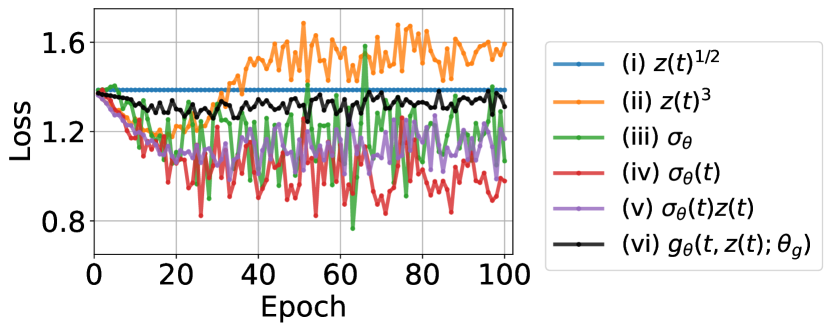
- 进行消融实验,比较扩散非线性性与受控路径(ζ)及扩散 σ。
实验结果
研究问题
- RQ1是否可以设计出在分布偏移和缺失数据下仍保持性能的稳定 Neural SDE?
- RQ2Langevin 型、Linear Noise 和 Geometric SDE 形式是否提供存在性、唯一性与鲁棒性的理论保证?
- RQ3在漂移项中引入受控路径是否能提升对不规则时间序列的经验性能?
- RQ4不同扩散架构(仿射与非线性)如何影响稳定性与准确性?
- RQ5在缺失情况下,所提模型在插值、预测和分类任务上的经验有效性如何?
主要发现
- 提出并证明在合理假设下,三种稳定的 Neural SDE 类别(LSDE、LNSDE、GSDE)具有唯一强解。
- 神经 GSDE 展现出非负性和吸收态性质,与深度 ReLU 网络相关联。
- 理论结果表明对分布偏移和缺失数据具有鲁棒性,输出分布变化的非渐近界在深度 T 增大时衰减。
- 在插值、预测和分类的四个基准测试中的经验结果表明,在不同的缺失率下所提出的方法优于基线。
- 消融研究证实纳入受控路径和非线性扩散函数有助于提升性能。
- 在30个公开数据集、缺失率各异的情况下,所提出的 Neural LSDE、LNSDE 和 GSDE 相较于传统 RNN、Neural CDE 及其他 Neural SDE 变体,达到顶级的准确性和鲁棒性。
阅读本论文
在 Nubint 阅读器中打开原文,边读边就任意段落提问。
在 Nubint 中阅读本论文本解读由 AI 根据论文原文生成,引用前请核对原文。