
[论文解读] Stimulated emission of signal photons from dark matter waves
本文提出一种利用超导腔制备 Fock 态 |n=4⟩ 的量子增强暗物质搜索方法,通过该态激发暗物质波发射信号光子。通过将腔初始化为高光子数 Fock 态,信号速率与扫描速率提升 2.78 倍,从而在 5.965 GHz 频率下以 90% 置信度排除暗光子动能混合角 ε ≥ 4.24×10⁻¹³。
The manipulation of quantum states of light has resulted in significant advancements in both dark matter searches and gravitational wave detectors [1-4]. Current dark matter searches operating in the microwave frequency range use nearly quantum-limited amplifiers [3, 5, 6]. Future high frequency searches will use photon counting techniques [1] to evade the standard quantum limit. We present a signal enhancement technique that utilizes a superconducting qubit to prepare a superconducting microwave cavity in a non-classical Fock state and stimulate the emission of a photon from a dark matter wave. By initializing the cavity in an $|n=4 angle$ Fock state, we demonstrate a quantum enhancement technique that increases the signal photon rate and hence also the dark matter scan rate each by a factor of 2.78. Using this technique, we conduct a dark photon search in a band around $\mathrm{5.965\, GHz \, (24.67\, μeV)}$, where the kinetic mixing angle $ε\geq 4.35 imes 10^{-13}$ is excluded at the $90\%$ confidence level.
研究动机与目标
- 通过利用光的非经典态来突破暗物质探测中的标准量子极限。
- 通过量子态工程提升微波频段暗物质探测中的信号光子速率与扫描速度。
- 证明 Fock 态初始化与低噪声、亚 SQL 光子计数技术的兼容性。
- 利用超导腔系统中的受激辐射,设定暗光子动能混合角 ε 的新排除极限。
提出的方法
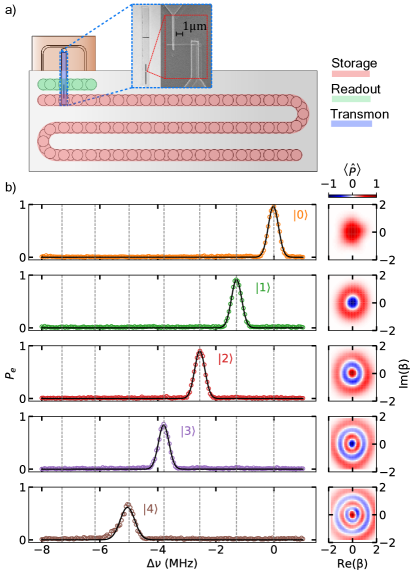
- 利用在 transmon 量子比特上施加最优控制脉冲(OCT),将超导微波腔制备为 |n=4⟩ Fock 态。
- 利用 Fock 态作为种子态,通过共振耦合从相干暗物质波中激发光子发射。
- 采用基于量子比特的单光子探测器,实现亚 SQL 背景速率与高保真度光子数测量。
- 应用量子增强的信号速率标定:信号速率提升 (n+1)η,其中 n=4,η 为探测效率。
- 采用 Ramsey 干涉测量技术,以亚 Hz 精度测量腔的频率与品质因数,以降低系统不确定性。
- 将暗物质线型(Q_DM ~10⁶)与腔响应卷积,以确定被排除的参数空间。
实验结果
研究问题
- RQ1在超导腔中制备 Fock 态是否能将暗物质探测的信号速率提升至超越标准量子极限?
- RQ2Fock 态初始化在微波频段探测中能将暗物质扫描速率提升多少?
- RQ3在态制备过程中,当背景光子平均占据数超过多少时,Fock 态保真度会显著下降?
- RQ4引入 Fock 态种子对暗光子动能混合角 ε 的探测灵敏度有何影响?
- RQ5受激辐射技术能否与亚 SQL 光子计数结合,以实现更高的探测灵敏度?
主要发现
- 当腔被初始化为 |n=4⟩ Fock 态时,信号光子速率与暗物质扫描速率均提升 2.78 倍。
- 基于实验数据与误差传播,以 90% 置信度设定暗光子动能混合角 ε ≥ 4.24×10⁻¹³ 的排除极限,频率为 5.965 GHz。
- 当平均注入光子数超过 n̄ > 0.05 时,Fock 态制备保真度显著下降,从而设定了背景容忍度的实际限制。
- 排除极限中的主要系统不确定性来源于相干驱动的振幅(a₀),其标准差 σ_ε ≈ 3.30×10⁻¹³。
- 该技术与现有亚 SQL 光子计数技术兼容,可在提升信号速率的同时实现噪声受限探测。
- 有效信号增强因子与 (n+1)η 成正比,证实了在 Fock 态种子腔中受激辐射的理论预测。
阅读本论文
在 Nubint 阅读器中打开原文,边读边就任意段落提问。
在 Nubint 中阅读本论文本解读由 AI 根据论文原文生成,引用前请核对原文。