
[论文解读] Stochastic Approximation with Delayed Updates: Finite-Time Rates under Markovian Sampling
本论文首次对在马氏抽样下具有延迟更新的随机逼近(SA)进行了有限时间收敛性分析,建立了向不动点附近噪声球的指数收敛。论文提出了一种新颖的归纳证明技术,确保迭代值的统一有界性,并设计了一种延迟自适应SA方案,通过将指数与平均延迟τ_avg而非最大延迟τ_max关联,改进了收敛性,实现了无需事先知晓延迟的步长调节。
Motivated by applications in large-scale and multi-agent reinforcement learning, we study the non-asymptotic performance of stochastic approximation (SA) schemes with delayed updates under Markovian sampling. While the effect of delays has been extensively studied for optimization, the manner in which they interact with the underlying Markov process to shape the finite-time performance of SA remains poorly understood. In this context, our first main contribution is to show that under time-varying bounded delays, the delayed SA update rule guarantees exponentially fast convergence of the \emph{last iterate} to a ball around the SA operator's fixed point. Notably, our bound is \emph{tight} in its dependence on both the maximum delay $τ_{max}$, and the mixing time $τ_{mix}$. To achieve this tight bound, we develop a novel inductive proof technique that, unlike various existing delayed-optimization analyses, relies on establishing uniform boundedness of the iterates. As such, our proof may be of independent interest. Next, to mitigate the impact of the maximum delay on the convergence rate, we provide the first finite-time analysis of a delay-adaptive SA scheme under Markovian sampling. In particular, we show that the exponent of convergence of this scheme gets scaled down by $τ_{avg}$, as opposed to $τ_{max}$ for the vanilla delayed SA rule; here, $τ_{avg}$ denotes the average delay across all iterations. Moreover, the adaptive scheme requires no prior knowledge of the delay sequence for step-size tuning. Our theoretical findings shed light on the finite-time effects of delays for a broad class of algorithms, including TD learning, Q-learning, and stochastic gradient descent under Markovian sampling.
研究动机与目标
- 为解决在多智能体和大规模强化学习设置下,马氏抽样中具有延迟更新的随机逼近(SA)缺乏有限时间理论分析的问题。
- 弥合异步和多智能体强化学习中延迟SA的实证成功与在时间相关(马氏)抽样下缺乏理论依据之间的差距。
- 开发一种能同时考虑时变延迟和底层马氏过程混合时间的收敛性分析。
- 提出并分析一种延迟自适应SA方案,通过依赖平均延迟τ_avg而非最大延迟τ_max,改进收敛性。
- 提供无需事先知晓延迟序列的步长调节方法,提升实际可应用性。
提出的方法
- 提出一种新颖的归纳证明技术,建立迭代值的统一有界性,从而在时变有界延迟下实现紧密的有限时间界。
- 分析在马氏抽样下原始延迟SA更新规则,推导出收敛速率与max{τ_max, τ_mix}成比例的结论,其中τ_mix为马氏过程的混合时间。
- 引入一种延迟自适应SA方案,根据观测到的延迟动态调整更新规则,降低收敛指数对τ_max的依赖。
- 通过递归误差界分析表明,期望平方误差以依赖于τ_avg的速率呈指数衰减。
- 推导出在收敛速率最优条件下的显式步长条件,界为exp(−αμT/(4τ_avg + 4)),其中T为迭代次数。
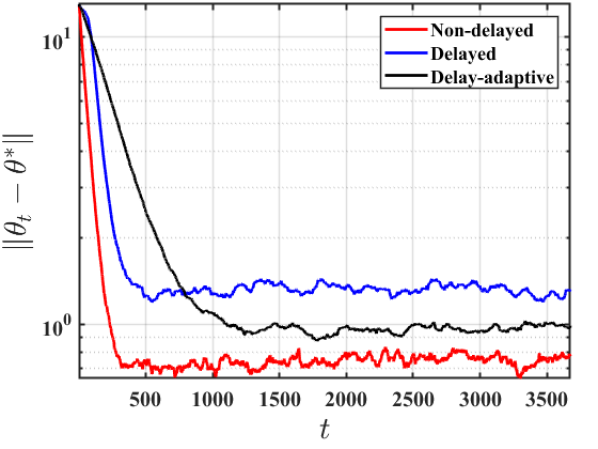
- 通过在马氏抽样和随机延迟下的TD(0)学习仿真验证理论结果,对比非延迟、原始延迟和延迟自适应算法。
实验结果
研究问题
- RQ1时变延迟与马氏过程混合时间之间的相互作用如何影响具有延迟更新的随机逼近的有限时间收敛性?
- RQ2一种能确保迭代值统一有界性的新颖归纳证明技术,是否能在延迟和马氏抽样存在的情况下,提供比现有方法更紧的收敛界?
- RQ3是否存在一种延迟自适应SA方案,能降低收敛速率对最大延迟τ_max的依赖,转而依赖于平均延迟τ_avg?
- RQ4能否设计出一种无需事先知晓延迟序列的延迟自适应方案,以实现步长调节?
- RQ5在实践中,原始延迟SA与所提出的延迟自适应方案的理论收敛速率和噪声球大小如何比较?
主要发现
- 原始延迟SA更新规则实现了向不动点附近噪声球的指数收敛,收敛指数与max{τ_max, τ_mix}成比例,其中τ_mix为底层马氏过程的混合时间。
- 所提出的归纳证明技术确保了迭代值的统一有界性,并得出了在τ_max和τ_mix依赖关系上最优的紧界。
- 对于延迟自适应SA方案,收敛指数依赖于τ_avg而非τ_max,显著提升了对罕见大延迟的鲁棒性。
- 在相同步长下,延迟自适应方案相比原始延迟方法具有更小的收敛噪声球,因其对τ_max的敏感性更低。
- 通过在TD(0)学习上的仿真验证了理论分析结果,表明延迟自适应算法收敛到比原始延迟版本更小的噪声球,尽管收敛速率较慢,与理论权衡一致。
- 延迟自适应方案允许更宽松的步长选择,因其无需将步长反比于τ_max进行调节,从而在实际应用中更具可行性。
阅读本论文
在 Nubint 阅读器中打开原文,边读边就任意段落提问。
在 Nubint 中阅读本论文本解读由 AI 根据论文原文生成,引用前请核对原文。