
[论文解读] Strong lensing selection effects
本文通过建模强引力透镜调查如何偏差星系和背景源的群体,量化了强透镜选择效应,表明透镜星系系统性地比一般星系更质量大、更紧凑、暗物质更丰富。对于完整至0.5"爱因斯坦半径的类Euclid调查,恒星质量比的偏差仅为~10%,使得可直接使用透镜数据标定恒星质量而无需校正。
Context. Strong lenses are a biased subset of the general population of galaxies. Aims. The goal of this work is to quantify how lens galaxies and lensed sources differ from their parent distribution, namely the strong lensing bias. Methods. We first studied how the strong lensing cross-section varies as a function of lens and source properties. Then, we simulated strong lensing surveys with data similar to that expected for Euclid and measured the strong lensing bias in different scenarios. We focused particularly on two quantities: the stellar population synthesis mismatch parameter, $α_{sps}$, defined as the ratio between the true stellar mass of a galaxy and the stellar mass obtained from photometry, and the central dark matter mass at fixed stellar mass and size. Results. Strong lens galaxies are biased towards larger stellar masses, smaller half-mass radii and larger dark matter masses. The amplitude of the bias depends on the intrinsic scatter in the mass-related parameters of the galaxy population and on the completeness in Einstein radius of the lens sample. For values of the scatter that are consistent with observed scaling relations and a minimum detectable Einstein radius of $0.5''$, the strong lensing bias in $α_{sps}$ is $10\%$, while that in the central dark matter mass is $5\%$. The bias has little dependence on the properties of the source population: samples of galaxy-galaxy lenses and galaxy-quasar lenses that probe the same Einstein radius distribution are biased in a very similar way. Conclusions. Given current uncertainties, strong lensing observations can be used directly to improve our current knowledge of the inner structure of galaxies, without the need to correct for selection effects. Time-delay measurements of $H_0$ from lensed quasars can take advantage of prior information obtained from galaxy-galaxy lenses with similar Einstein radii.
研究动机与目标
- 量化强引力透镜调查如何选择星系及背景源的有偏子集。
- 建模调查选择函数对透镜星系性质(如恒星质量、大小和暗物质含量)的影响。
- 评估当前恒星群体合成参数的不确定性是否可利用强引力透镜数据约束。
- 评估从星系-星系透镜到星系-类星体透镜在时间延迟H₀测量中先验的可转移性。
- 确定选择偏差对爱因斯坦半径内在弥散和调查完整性的依赖性。
提出的方法
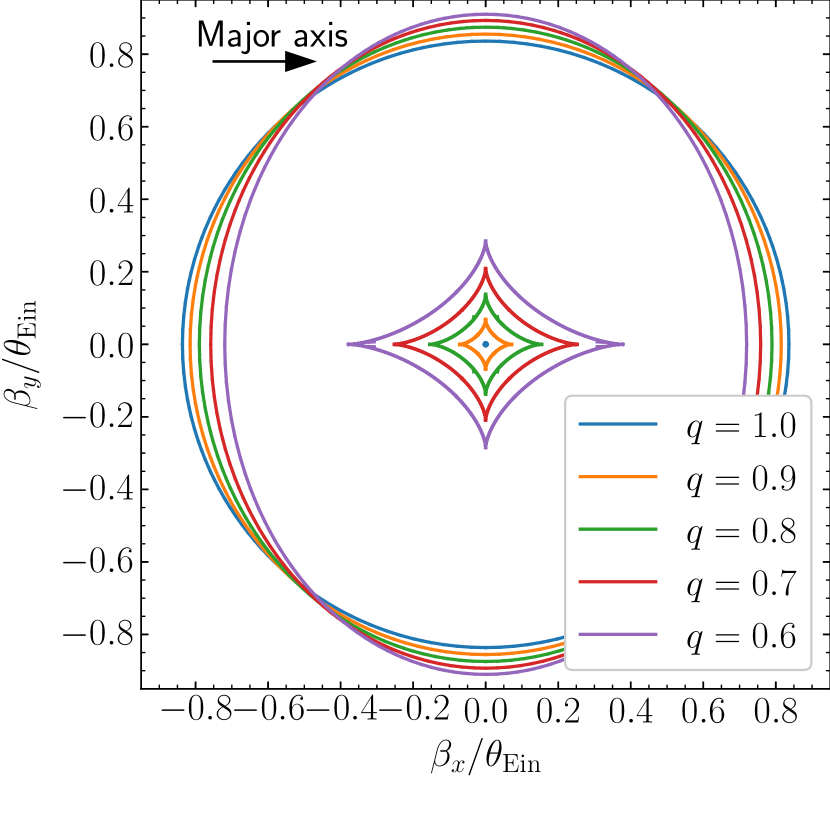
- 作者使用解析和半解析模型,计算了透镜和源属性的强透镜截面。
- 他们模拟了具有真实调查特征(包括检测极限和图像分离阈值)的类Euclid透镜调查。
- 选择函数建模为 P_SL(ψ_g, ψ_s|S) ∝ P_g(ψ_g) P_s(ψ_s) P_sel(ψ_g, ψ_s|S),结合了透镜几何和检测完整性。
- 恒星群体合成不匹配参数 α_sps 定义为真实与光度恒星质量的比值,用于量化质量测量偏差。
- 在固定恒星质量和大小下测量中心暗物质质量,以隔离结构偏差。
- 模拟比较了星系-星系透镜与星系-类星体透镜,以评估选择效应对源群体的依赖性。

实验结果
研究问题
- RQ1强透镜选择函数如何偏差透镜星系性质(如恒星质量、大小和暗物质含量)的观测分布?
- RQ2恒星群体合成参数的内在弥散在多大程度上影响选择偏差的幅度?
- RQ3在检测小爱因斯坦半径透镜的完整性如何影响选择偏差的幅度?
- RQ4能否可靠地将星系-星系透镜的信息用作星系-类星体透镜系统在H₀测量中的先验?
- RQ5选择函数是否在背景源的大小分布中引入偏差,而不仅仅是其星等分布?
主要发现
- 对于完整至0.5"爱因斯坦半径的类Euclid调查,恒星群体合成不匹配参数 α_sps 的强透镜偏差为10%,即0.04 dex。
- 在固定恒星质量和大小下,中心暗物质质量的偏差为5%,即0.02 dex,假设条件相同。
- 在固定恒星质量下,平均晕质量的偏差为0.07 dex,表明存在中等但可测量的选择效应。
- 强透镜偏差几乎与源群体无关:当爱因斯坦半径匹配时,星系-星系和星系-类星体透镜表现出相似的偏差幅度。
- 选择函数拓宽了背景源的星等分布,但对固定星等下的大小分布无显著偏差。
- 在使用星系-星系透镜先验估算类星体透镜时间延迟H₀时,H₀推断的偏差估计约为1%,支持约束的可转移性。
阅读本论文
在 Nubint 阅读器中打开原文,边读边就任意段落提问。
在 Nubint 中阅读本论文本解读由 AI 根据论文原文生成,引用前请核对原文。