
[论文解读] StyleRF: Zero-shot 3D Style Transfer of Neural Radiance Fields
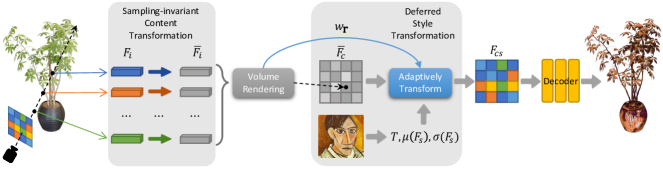
StyleRF 提出了一种零样本 3D 风格迁移方法,通过在神经辐射场的显式 3D 特征网格内变换特征,实现高保真度的风格化。它通过采样无关的内容变换和在 2D 特征图上的延迟风格变换,实现了多视角一致性与高质量的风格化,从而在无需微调的情况下泛化到任意未见过的风格,相比之前的方法在几何结构和视觉质量上均有显著提升。
3D style transfer aims to render stylized novel views of a 3D scene with multi-view consistency. However, most existing work suffers from a three-way dilemma over accurate geometry reconstruction, high-quality stylization, and being generalizable to arbitrary new styles. We propose StyleRF (Style Radiance Fields), an innovative 3D style transfer technique that resolves the three-way dilemma by performing style transformation within the feature space of a radiance field. StyleRF employs an explicit grid of high-level features to represent 3D scenes, with which high-fidelity geometry can be reliably restored via volume rendering. In addition, it transforms the grid features according to the reference style which directly leads to high-quality zero-shot style transfer. StyleRF consists of two innovative designs. The first is sampling-invariant content transformation that makes the transformation invariant to the holistic statistics of the sampled 3D points and accordingly ensures multi-view consistency. The second is deferred style transformation of 2D feature maps which is equivalent to the transformation of 3D points but greatly reduces memory footprint without degrading multi-view consistency. Extensive experiments show that StyleRF achieves superior 3D stylization quality with precise geometry reconstruction and it can generalize to various new styles in a zero-shot manner.
研究动机与目标
- 解决 3D 风格迁移中的三重困境:精确的几何重建、高质量的风格化,以及对任意新风格的泛化能力。
- 实现无需微调即可泛化到未见过的参考风格的零样本 3D 风格迁移。
- 在风格化过程中保持多视角一致性,同时降低内存和计算成本。
- 通过显式体素渲染 3D 特征网格,实现高保真度的 3D 几何结构重建。
提出的方法
- 使用高层深度特征的显式网格表示 3D 场景,通过体素渲染实现精确的几何结构重建。
- 直接在辐射场的特征空间中执行风格迁移,相比隐式参数注入,提升了风格化的表达能力。
- 引入采样无关的内容变换(SICT),通过体素自适应归一化和通道自注意力机制,将风格与批量统计分离。
- 通过矩阵乘法和自适应偏置添加,将风格变换延迟到 2D 体素渲染特征图上,降低内存使用量,同时保持多视角一致性。
- 利用射线权重调制的自适应偏置添加,捕捉全局风格属性(如色彩基调)。
- 直接在 $256 \times 256$ 小 patch 上进行训练,无需下采样,实现高效且高分辨率的风格化。
实验结果
研究问题
- RQ13D 风格迁移能否在零样本风格化过程中实现高保真度的几何结构重建并保持多视角一致性?
- RQ2如何使风格迁移对采样 3D 点批次的整体统计保持不变,以确保跨视角的一致性?
- RQ3在 2D 特征图上延迟风格变换能否在显著降低内存和计算量的同时,实现与 3D 点变换相当的风格化效果?
- RQ4所提出的方法能否在无需微调或预训练的情况下泛化到任意未见过的参考风格?
- RQ5与基于隐式参数或基于优化的方法相比,3D 辐射场中特征空间的风格迁移在质量与效率方面表现如何?
主要发现
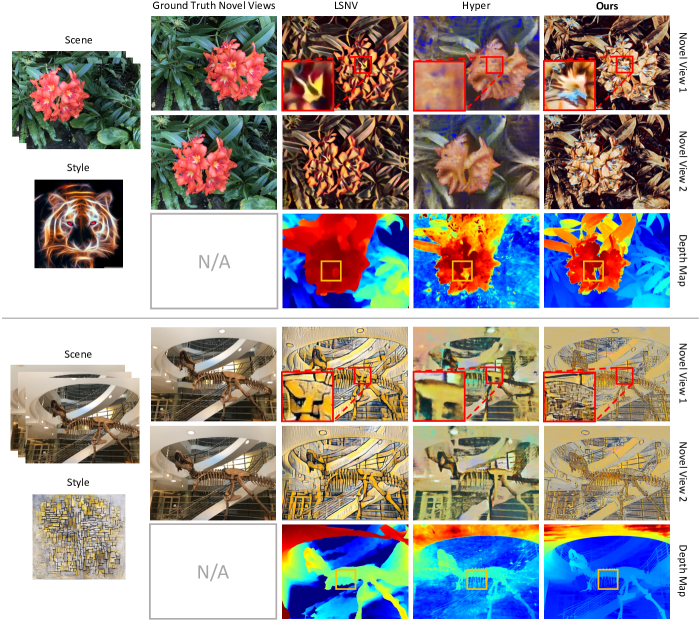
- StyleRF 在定量和定性评估中均优于现有零样本 3D 风格迁移方法,实现了卓越的 3D 风格化质量与精确的几何结构重建。
- 所提出的采样无关内容变换(SICT)消除了由批量依赖归一化引起的块状伪影,显著提升了多视角一致性。
- 延迟风格变换(DST)降低了内存使用量,并支持在不进行下采样的情况下训练完整的 $256 \times 256$ 图像块,提升了效率与分辨率。
- DST 中的自适应偏置添加通过保留如色彩基调等全局风格属性,提升了风格化质量,使风格迁移更加自然和准确。
- 通过插值场景特征图,StyleRF 实现了平滑的多风格插值,能够在任意风格之间生成和谐且视觉连贯的过渡效果。
- 该方法通过使用 3D 一致的掩码对 3D 场景的分割区域应用不同风格,支持组合式 3D 风格迁移,实现无限的艺术化组合而无需重新训练。
阅读本论文
在 Nubint 阅读器中打开原文,边读边就任意段落提问。
在 Nubint 中阅读本论文本解读由 AI 根据论文原文生成,引用前请核对原文。