
[论文解读] Supervised Masked Knowledge Distillation for Few-Shot Transformers
本文提出了一种新型框架——监督掩码知识蒸馏(SMKD),通过联合应用[cls]标记的对比学习与类内图像间的掩码块重建,提升了少样本视觉Transformer的性能。通过在自蒸馏设置中引入标签信息,SMKD有效缓解了过拟合问题,并在四个少样本基准上实现了最先进性能,显著优于先前方法。
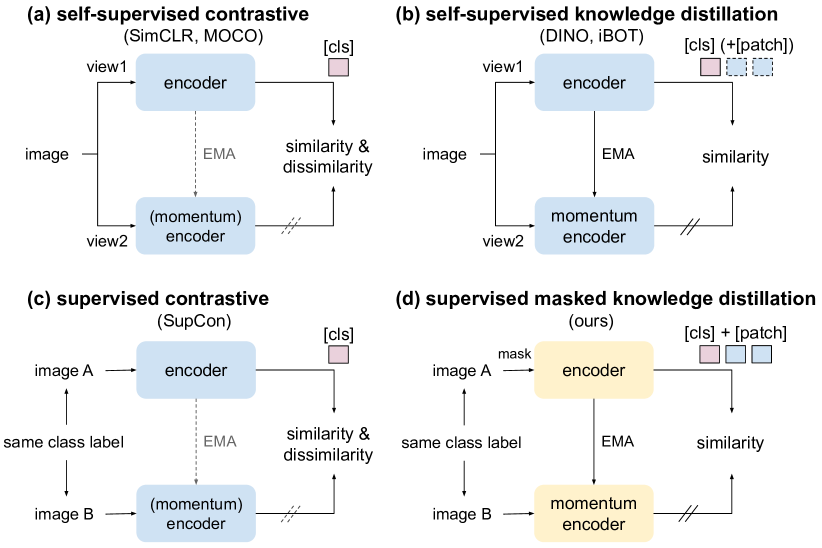
Vision Transformers (ViTs) emerge to achieve impressive performance on many data-abundant computer vision tasks by capturing long-range dependencies among local features. However, under few-shot learning (FSL) settings on small datasets with only a few labeled data, ViT tends to overfit and suffers from severe performance degradation due to its absence of CNN-alike inductive bias. Previous works in FSL avoid such problem either through the help of self-supervised auxiliary losses, or through the dextile uses of label information under supervised settings. But the gap between self-supervised and supervised few-shot Transformers is still unfilled. Inspired by recent advances in self-supervised knowledge distillation and masked image modeling (MIM), we propose a novel Supervised Masked Knowledge Distillation model (SMKD) for few-shot Transformers which incorporates label information into self-distillation frameworks. Compared with previous self-supervised methods, we allow intra-class knowledge distillation on both class and patch tokens, and introduce the challenging task of masked patch tokens reconstruction across intra-class images. Experimental results on four few-shot classification benchmark datasets show that our method with simple design outperforms previous methods by a large margin and achieves a new start-of-the-art. Detailed ablation studies confirm the effectiveness of each component of our model. Code for this paper is available here: https://github.com/HL-hanlin/SMKD.
研究动机与目标
- 为解决由于缺乏归纳偏置和标注数据有限导致的视觉Transformer在少样本学习中的过拟合问题。
- 通过将标签信息整合到掩码知识蒸馏框架中,弥合自监督与监督少样本学习之间的性能差距。
- 开发一种简单而有效的方法,同时利用全局[cls]标记与局部块标记,以提升泛化能力。
- 在不需大批次或负样本的情况下,统一监督对比学习与自监督掩码蒸馏的优势。
提出的方法
- 提出一种监督掩码知识蒸馏框架(SMKD),将自监督掩码蒸馏扩展至监督设置。
- 对类内图像间的[cls]标记应用监督对比损失,以改善全局表征学习。
- 提出一种新颖的掩码块重建任务,对类内图像中的掩码块进行重建,增加学习难度并促进泛化。
- 利用交叉注意力计算类内图像间对应块标记的相似性,实现在无真实标签情况下进行块级知识蒸馏。
- 结合[cls]级别与块级别对比损失,并共享投影头,以实现全局与局部表征之间的语义互补。
- 通过自注意力权重对块标记进行加权平均池化,以增强特征表示,尤其提升对背景鲁棒的特征。

实验结果
研究问题
- RQ1使用掩码块重建的监督知识蒸馏能否提升视觉Transformer在少样本学习中的泛化能力?
- RQ2与仅使用全局或局部特征相比,[cls]标记与块标记的联合学习如何影响性能?
- RQ3通过交叉注意力实现类内对齐是否能提升低数据场景下的模型鲁棒性并减少过拟合?
- RQ4结合监督与自监督目标的统一框架是否能优于两阶段或基于辅助损失的方法?
- RQ5不同特征聚合策略(如[cls]、平均池化、加权平均池化)对最终少样本准确率的贡献如何?
主要发现
- SMKD在四个少样本图像分类基准上达到新的最先进水平,1-shot时准确率达74.28%,5-shot时达88.82%(ImageNet-1000)。
- [cls]级别与块级别对比损失的结合在1-shot设置下使基线模型提升13.35%,5-shot设置下提升8.44%。
- 使用块标记的加权平均池化使[cls]标记性能在1-shot时提升3.02%,5-shot时提升0.79%,表明特征质量得到增强。
- 消融研究证实[cls]与块级别蒸馏具有互补性,完整SMKD模型优于单一组件。
- 该方法在性能上优于监督对比学习与自监督掩码蒸馏基线,表明结合标签监督与掩码重建具有显著优势。
- 当结合[cls]标记、加权平均池化与平均池化标记时,模型性能进一步提升,1-shot时达74.28%,5-shot时达88.82%。
阅读本论文
在 Nubint 阅读器中打开原文,边读边就任意段落提问。
在 Nubint 中阅读本论文本解读由 AI 根据论文原文生成,引用前请核对原文。