
[论文解读] SV3D: Novel Multi-view Synthesis and 3D Generation from a Single Image using Latent Video Diffusion
SV3D 提出了一种新颖的潜在视频扩散模型,能够从单张图像实现高分辨率、姿态可控的多视角生成,利用 Stable Video Diffusion 的多视角一致性。通过结合显式相机控制、掩码得分蒸馏采样和解耦光照优化,该方法在新视角合成与 3D 重建任务中均达到最先进性能。
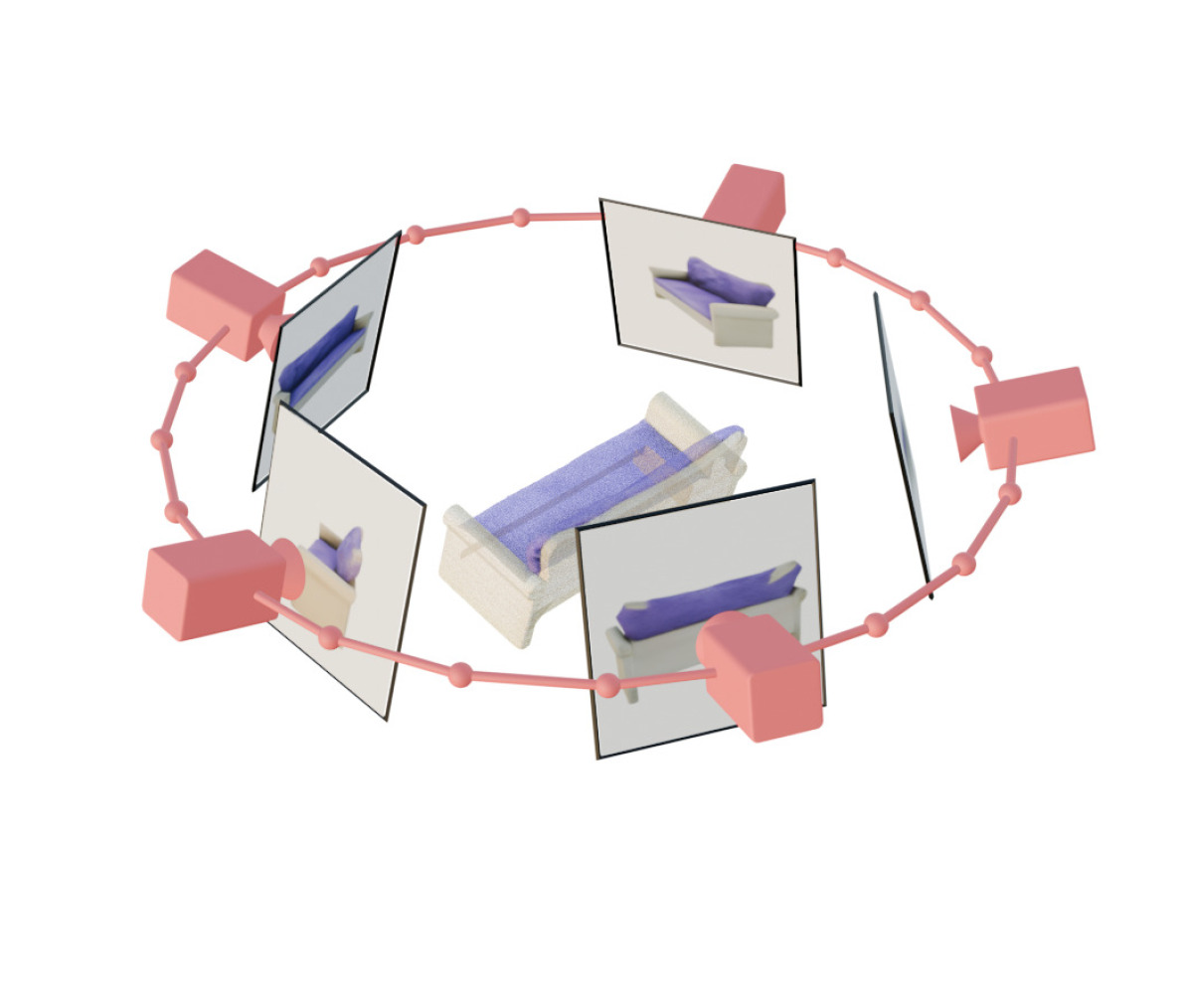
We present Stable Video 3D (SV3D) -- a latent video diffusion model for high-resolution, image-to-multi-view generation of orbital videos around a 3D object. Recent work on 3D generation propose techniques to adapt 2D generative models for novel view synthesis (NVS) and 3D optimization. However, these methods have several disadvantages due to either limited views or inconsistent NVS, thereby affecting the performance of 3D object generation. In this work, we propose SV3D that adapts image-to-video diffusion model for novel multi-view synthesis and 3D generation, thereby leveraging the generalization and multi-view consistency of the video models, while further adding explicit camera control for NVS. We also propose improved 3D optimization techniques to use SV3D and its NVS outputs for image-to-3D generation. Extensive experimental results on multiple datasets with 2D and 3D metrics as well as user study demonstrate SV3D's state-of-the-art performance on NVS as well as 3D reconstruction compared to prior works.
研究动机与目标
- 解决现有图像到视频扩散模型在新视角合成(NVS)任务中多视角一致性不足的问题。
- 实现从单张图像生成姿态可控、高分辨率的轨道视角序列。
- 通过利用 NeRF 和 DMTet 优化中一致且多样的新视角,提升 3D 物体重建质量。
- 通过联合优化解耦光照模型,减少 3D 网格中的预设光照伪影。
- 开发掩码得分蒸馏采样(SDS)损失,以提升遮挡区域的 3D 重建质量。
提出的方法
- 将潜在视频扩散模型 Stable Video Diffusion(SVD)适配用于图像到视频生成,并引入显式相机姿态条件控制,实现可控的轨道视角合成。
- 提出三种变体:SV3D^u(均匀轨道)、SV3D^c(圆形轨道)和 SV3D^p(基于正弦函数的动态轨道),以评估视角多样性与一致性。
- 利用 SV3D 生成的多视角图像作为监督信号,通过光度损失和掩码 SDS 损失,对 NeRF 和 DMTet 表示进行 3D 优化。
- 提出三角形 CFG 缩放策略以稳定训练过程,并在 3D 优化期间提升生成保真度。
- 联合优化解耦光照模型,同时优化 3D 形状与纹理,以减少光照伪影。
- 应用掩码 SDS 损失以提升在合成视角中不可见区域的重建质量。
实验结果
研究问题
- RQ1潜在视频扩散模型能否被有效适配用于从单张图像实现姿态可控的多视角生成?
- RQ2与基于 2D 扩散模型的 NVS 相比,利用视频扩散模型的多视角一致性是否能提升 3D 重建质量?
- RQ3显式相机控制与动态轨道设计如何影响生成视角的质量与一致性?
- RQ4掩码 SDS 损失在多大程度上改善了遮挡区域的 3D 重建质量?
- RQ5解耦光照优化能否减少从合成视角生成的 3D 网格中的光照伪影?
主要发现
- SV3D^p 搭配动态轨道与掩码 SDS 损失在 GSO 数据集上取得了最佳 2D 指标,LPIPS 为 0.119,PSNR 为 17.405,CLIP-S 为 0.877。
- 使用 SV3D^p 的 3D 重建实现了 0.024 的 Chamfer Distance(CD)与 0.614 的 3D IoU,优于先前方法(包括 Stable Zero123 与 SyncDreamer)。
- 引入掩码 SDS 损失可提升 3D 质量,相比无 SDS 训练,CD 降低 0.003,3D IoU 提升 0.003。
- SV3D^p 搭配动态轨道显著优于静态轨道与均匀轨道变体,证明了多样化视角采样的重要性。
- 解耦光照优化有效减少了光照伪影,使生成的 3D 网格纹理更加真实且一致。
- 用户研究与定量指标共同表明,SV3D 生成的 3D 物体在一致性、真实感与细节方面均优于先前最先进方法。
阅读本论文
在 Nubint 阅读器中打开原文,边读边就任意段落提问。
在 Nubint 中阅读本论文本解读由 AI 根据论文原文生成,引用前请核对原文。