
[论文解读] Synth$^2$: Boosting Visual-Language Models with Synthetic Captions and Image Embeddings
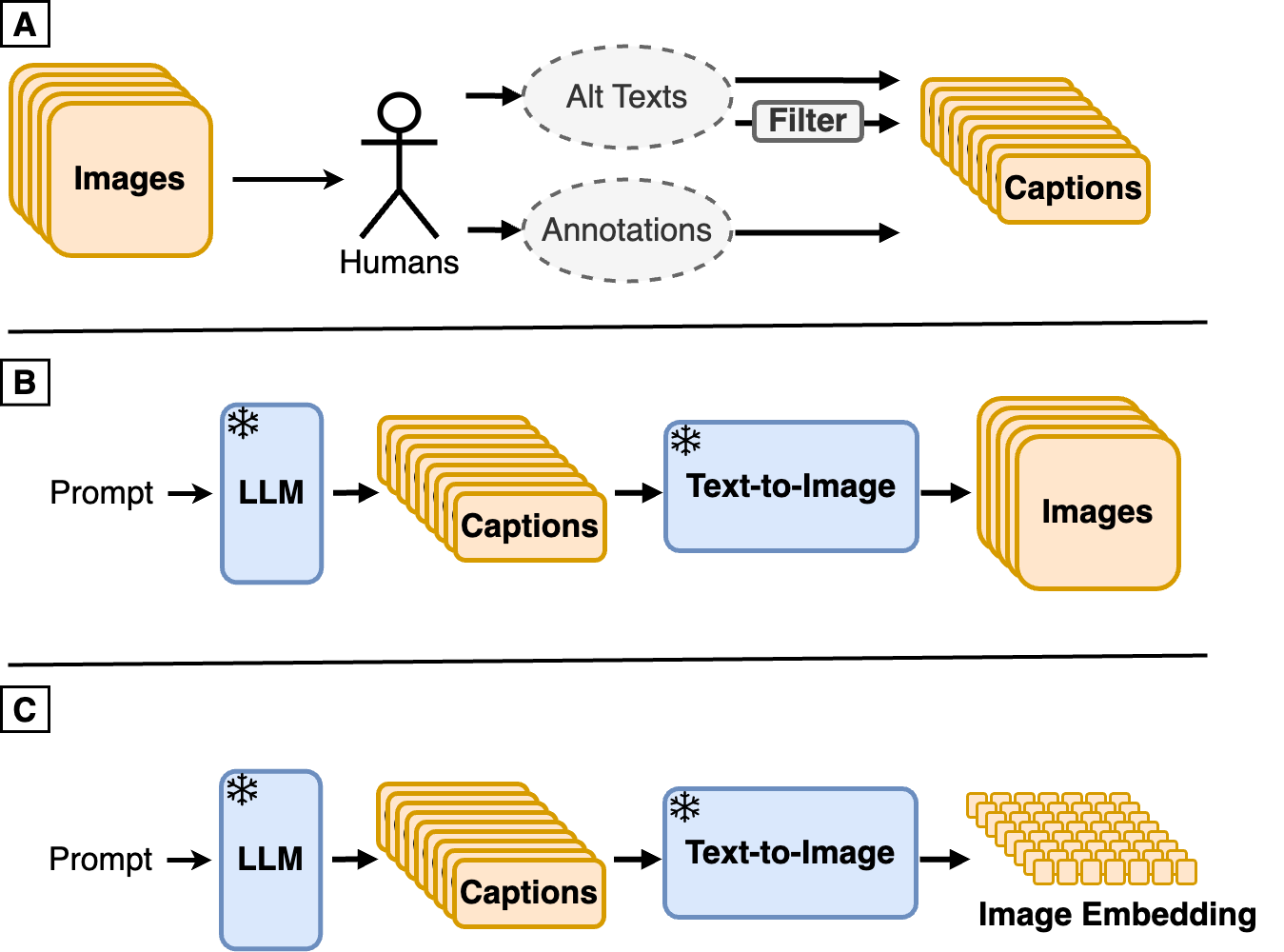
本文提出 Synth$^2$,一种利用预训练大语言模型(LLM)和文本到图像模型生成高质量合成图像-文本对的方法,用于训练视觉语言模型(VLM)。通过直接从 LLM 生成的描述中合成图像嵌入(跳过像素空间渲染),该方法仅用 1/3 的训练步数即可达到与人工标注数据相当的性能,并在使用合成数据增强的基线基础上实现 17% 的性能提升。
The creation of high-quality human-labeled image-caption datasets presents a significant bottleneck in the development of Visual-Language Models (VLMs). In this work, we investigate an approach that leverages the strengths of Large Language Models (LLMs) and image generation models to create synthetic image-text pairs for efficient and effective VLM training. Our method employs a pretrained text-to-image model to synthesize image embeddings from captions generated by an LLM. Despite the text-to-image model and VLM initially being trained on the same data, our approach leverages the image generator's ability to create novel compositions, resulting in synthetic image embeddings that expand beyond the limitations of the original dataset. Extensive experiments demonstrate that our VLM, finetuned on synthetic data achieves comparable performance to models trained solely on human-annotated data, while requiring significantly less data. Furthermore, we perform a set of analyses on captions which reveals that semantic diversity and balance are key aspects for better downstream performance. Finally, we show that synthesizing images in the image embedding space is 25\% faster than in the pixel space. We believe our work not only addresses a significant challenge in VLM training but also opens up promising avenues for the development of self-improving multi-modal models.
研究动机与目标
- 解决收集高质量人工标注图像-描述数据集以训练视觉语言模型(VLM)的瓶颈问题。
- 通过利用生成模型创建合成数据,降低数据整理成本并提升 VLM 训练的数据效率。
- 实现可扩展、可定制且公平的合成数据生成,避免从外部预训练图像模型中泄露知识。
- 评估合成数据在提升下游任务(如图像描述)中 VLM 性能的有效性。
- 证明在图像嵌入空间中训练可显著提升计算效率,同时不损失模型性能。
提出的方法
- 在与 VLM 训练所用数据集相同的语料上微调文本到图像模型,以防止来自外部模型的知识迁移。
- 使用预训练的大语言模型(LLM)生成合成描述,作为图像生成的输入提示。
- 利用文本到图像模型直接从描述中合成图像嵌入,跳过像素空间的图像生成过程。
- 结合真实人工标注数据与合成的图像-文本嵌入对来训练 VLM。
- 在整个流程中操作于图像嵌入空间,以减少内存和计算开销。
- 采用受控图像生成技术,确保合成数据的保真度与公平性,避免来自现成模型的偏见。
实验结果
研究问题
- RQ1通过 LLM 和文本到图像模型生成的合成图像-文本对是否能有效提升 VLM 在图像描述任务上的性能?
- RQ2在图像嵌入空间中生成合成数据是否相比像素空间生成具有显著的计算优势?
- RQ3在真实数据与合成数据混合训练的 VLM 是否能超越仅使用人工标注数据训练的基线模型?
- RQ4随着合成数据量的增加,使用合成数据训练的 VLM 性能如何变化?
- RQ5生成模型中的偏见在多大程度上影响了合成训练数据的质量与公平性?
主要发现
- 使用合成数据训练的 VLM 相较于仅使用人工标注数据训练的基线模型,性能提升了 17%。
- Synth$^2$ 仅用三分之一的训练步数即达到与真实数据基线相当的性能,证明了其卓越的数据效率。
- 在图像嵌入空间中生成比像素空间生成快 25%,训练吞吐量达到每秒 2.08 步,优于像素空间的每秒 1.66 步。
- 在零样本图像描述基准测试中,模型取得了 26.0 的 CIDEr 分数,与真实数据基线性能相当。
- 该方法表明,在嵌入空间中生成合成数据可保持高质量输出,同时大幅降低计算开销。
- 在与 VLM 相同的数据集上微调文本到图像模型,消除了来自外部模型的知识泄露,确保了评估的公平性。
阅读本论文
在 Nubint 阅读器中打开原文,边读边就任意段落提问。
在 Nubint 中阅读本论文本解读由 AI 根据论文原文生成,引用前请核对原文。