
[论文解读] T-Rex2: Towards Generic Object Detection via Text-Visual Prompt Synergy
T-Rex2 提出了一种统一的、基于提示的物体检测框架,通过对比学习协同文本与视觉提示,实现开放集和长尾场景下的鲁棒零样本检测。通过联合编码文本描述和视觉范例(点/框),其在 LVIS 和 COCO 基准上实现了最先进性能,展现出模态间的相互增强作用。
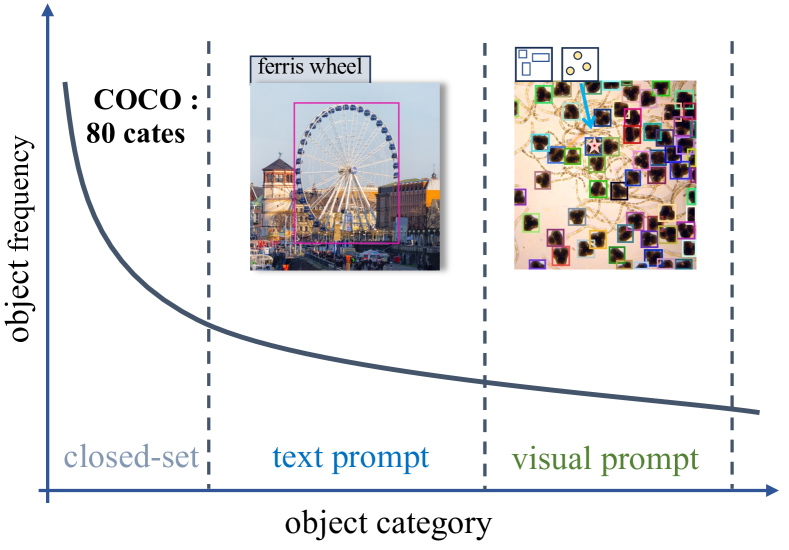
We present T-Rex2, a highly practical model for open-set object detection. Previous open-set object detection methods relying on text prompts effectively encapsulate the abstract concept of common objects, but struggle with rare or complex object representation due to data scarcity and descriptive limitations. Conversely, visual prompts excel in depicting novel objects through concrete visual examples, but fall short in conveying the abstract concept of objects as effectively as text prompts. Recognizing the complementary strengths and weaknesses of both text and visual prompts, we introduce T-Rex2 that synergizes both prompts within a single model through contrastive learning. T-Rex2 accepts inputs in diverse formats, including text prompts, visual prompts, and the combination of both, so that it can handle different scenarios by switching between the two prompt modalities. Comprehensive experiments demonstrate that T-Rex2 exhibits remarkable zero-shot object detection capabilities across a wide spectrum of scenarios. We show that text prompts and visual prompts can benefit from each other within the synergy, which is essential to cover massive and complicated real-world scenarios and pave the way towards generic object detection. Model API is now available at \url{https://github.com/IDEA-Research/T-Rex}.
研究动机与目标
- 解决现有开放集物体检测方法仅依赖文本提示的局限性,这些方法因数据稀缺和语言模糊性而难以处理罕见或难以描述的物体。
- 克服视觉提示的不足,尽管其对新实例具有强特定性,但缺乏对抽象物体类别的泛化能力。
- 开发一种统一模型,可动态在文本与视觉提示之间切换,以应对多样的现实检测场景。
- 通过融合文本与视觉提示的互补优势,实现对常见物体和长尾物体的零样本检测。
- 通过后融合设计实现高推理效率与交互性,支持用户对视觉提示的实时交互。
提出的方法
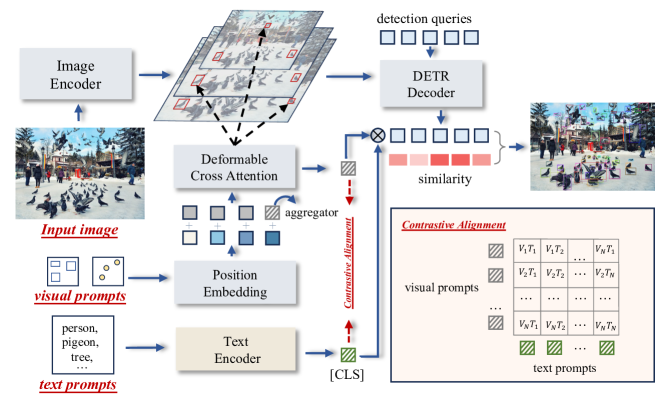
- 采用端到端的 DETR 架构,配备两个并行编码器:一个用于文本提示(使用 CLIP 的文本编码器),另一个用于视觉提示(一种新颖的基于可变形注意力的视觉提示编码器)。
- 引入对比学习模块,显式对齐文本与视觉提示嵌入,从而在训练过程中实现相互增强。
- 支持四种推理工作流:仅文本提示、仅视觉提示、通过单张图像上的框/点进行交互式视觉提示,以及文本-视觉提示融合。
- 采用后融合策略以最小化推理成本——图像特征仅通过主干网络和图像编码器提取一次,而提示编码器与解码器则根据用户交互迭代运行。
- 利用多样化数据引擎:Bamboo 数据集用于丰富文本类别,SA-1B 用于视觉提示泛化,TAP 用于弱监督。
- 通过对比损失优化模型,以对齐文本与视觉提示,使视觉提示能够继承抽象泛化能力,同时使文本提示获得更强的描述能力。
实验结果
研究问题
- RQ1通过对比学习结合文本与视觉提示,能否提升开放集物体检测中的零样本泛化能力?
- RQ2文本与视觉提示之间的协同作用在长尾物体分布上表现如何,特别是在罕见或难以描述的物体上?
- RQ3在统一模型中,视觉提示在多大程度上能增强文本提示的描述能力,反之亦然?
- RQ4在包含多样化和长尾类别的基准上,混合提示推理模式是否优于单一模态方法?
- RQ5在交互式视觉提示过程中,模型能否在保持高精度的同时维持实时推理速度?
主要发现
- T-Rex2 在使用文本与视觉提示联合推理的零样本检测中,COCO-Val 上达到 42.5 AP,LVIS-Val 上达到 41.7 $AP_{f}$,显著优于单一模态基线方法。
- 在 LVIS 上,混合提示模式相比仅文本提示,将 $AP_{r}$ 提升 2.7 个百分点,$AP_{f}$ 提升 1.5 个百分点,表明在罕见类别上具有强大泛化能力。
- 视觉提示编码器在 Swin-T 上实现 33.33 FPS 的实时交互速度,适用于自动图像标注等应用。
- 引入 Bamboo 数据集使文本提示在 LVIS 上的性能提升 +3.8 AP,表明更丰富的类别覆盖可增强零样本泛化能力。
- SA-1B 数据引擎提升了视觉提示能力,但略微降低了通用性能,提示在视觉提示学习中仍需更优的弱监督策略。
- 消融实验表明,在 COCO 上联合使用两种提示类型会导致性能下降(例如,仅文本提示为 45.8 AP,混合模式为 42.5 AP),表明在常见物体场景下可能存在潜在干扰。
阅读本论文
在 Nubint 阅读器中打开原文,边读边就任意段落提问。
在 Nubint 中阅读本论文本解读由 AI 根据论文原文生成,引用前请核对原文。