
[论文解读] Tag-LLM: Repurposing General-Purpose LLMs for Specialized Domains
Tag-LLM 引入领域输入标签和函数输入标签,作为可学习的嵌入,以使通用大语言模型适应专业领域,实现零-shot 泛化,并在 NLP 翻译以及非语言任务(如蛋白质/SMILES 性质预测和药物-靶点结合亲和力)等方面达到竞争力甚至更优的表现。
Large Language Models (LLMs) have demonstrated remarkable proficiency in understanding and generating natural language. However, their capabilities wane in highly specialized domains underrepresented in the pretraining corpus, such as physical and biomedical sciences. This work explores how to repurpose general LLMs into effective task solvers for specialized domains. We introduce a novel, model-agnostic framework for learning custom input tags, which are parameterized as continuous vectors appended to the LLM's embedding layer, to condition the LLM. We design two types of input tags: domain tags are used to delimit specialized representations (e.g., chemical formulas) and provide domain-relevant context; function tags are used to represent specific functions (e.g., predicting molecular properties) and compress function-solving instructions. We develop a three-stage protocol to learn these tags using auxiliary data and domain knowledge. By explicitly disentangling task domains from task functions, our method enables zero-shot generalization to unseen problems through diverse combinations of the input tags. It also boosts LLM's performance in various specialized domains, such as predicting protein or chemical properties and modeling drug-target interactions, outperforming expert models tailored to these tasks.
研究动机与目标
- 说明通用型大语言模型在专门领域表现不佳的动机,并提出一个可重复使用的标记框架,以在不进行全面微调的情况下对 LLM 进行条件化。
- 引入两种可学习的输入标签(领域标签和函数标签),在 LLM 输入中参数化为嵌入向量。
- 开发一个三阶段训练协议,利用领域内辅助数据和领域知识来学习领域标签和函数标签。
- 展示在多语种翻译及非语言任务(蛋白质、SMILES、药物发现)上的零-shot 泛化和具有竞争力的表现。
- 强调 Tag-LLM 的模型无关性和即插即用特性,以及其在新领域和新任务上的可扩展性。
提出的方法
- 定义两种标签类型:领域标签,用于界定领域特定数据并编码领域层面的信息,函数标签用于编码任务语义,可以在跨领域共享。
- 将每个标签表示为一个可学习的 p-by-d 嵌入矩阵,附加到 LLM 的嵌入空间,初始值来自词汇表中平均 token 嵌入。
- 三阶段训练协议:(阶段1)通过在未标注的领域内数据上进行下一个 token 预测来训练领域标签;(阶段2)在输入中嵌入领域标签的情况下,使用带标签数据训练单领域函数标签;(阶段3)使用多个领域标签的跨领域函数标签来训练以学习共享能力。
- 为非文本输出(例如标量预测)扩展函数标签的回归头,以改进数值预测任务。
- 采用模块化、分层的标记框架,允许增量添加标签和组合式问题求解。
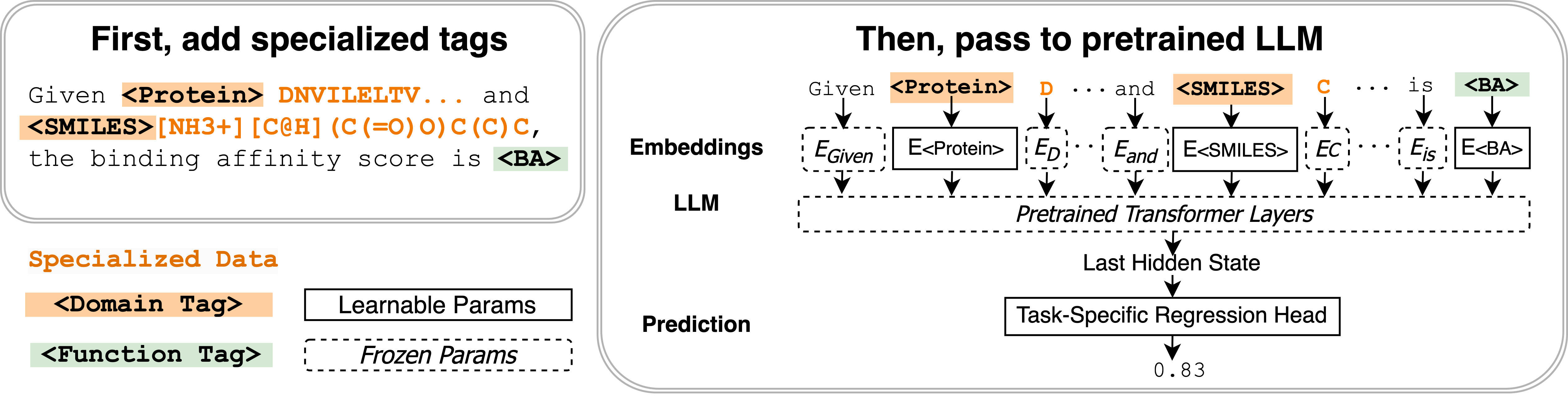
实验结果
研究问题
- RQ1一组模块化的可学习输入标签是否能够实现对尚未看到的领域-任务组合的零-shot 泛化?
- RQ2领域标签和函数标签是否将领域知识与任务指令解耦,从而优于标准提示微调?
- RQ3与领域特定或通用基线相比,Tag-LLM 在多语种翻译和非语言科学任务(蛋白质、SMILES、药物发现)上的表现如何?
- RQ4标签长度、丰富度以及回归头的引入对预测准确性的影响?
- RQ5一个模型无关的标记框架是否能够以最少的带标签数据扩展到新的领域和任务?
主要发现
- 领域标签在专门数据上充当有效的上下文切换器。
- 单一、共享的函数标签可以支持多个领域以完成不同任务。
- Tag-LLM 在看到的领域和未见的领域-任务组合上实现了有竞争力的多语种翻译表现。
- Tag-LLM 在若干药物发现数据集上达到最先进的结果,且通常优于基线的 PEFT 方法。
- 用与任务相关的知识丰富领域标签能够提升表现;回归头有助于非文本输出和数值预测。
- 该方法通过领域标签和函数标签的组合对未知问题实现零-shot 泛化。

阅读本论文
在 Nubint 阅读器中打开原文,边读边就任意段落提问。
在 Nubint 中阅读本论文本解读由 AI 根据论文原文生成,引用前请核对原文。