
[论文解读] TANGOS: Regularizing Tabular Neural Networks through Gradient Orthogonalization and Specialization
TANGOS 是一种针对表格神经网络的新型正则化框架,通过惩罚神经元激活的重叠与非稀疏性,强制实现梯度正交化与专业化。通过鼓励神经元关注不同且稀疏的输入特征,TANGOS 提升了模型在分布外数据上的泛化能力,优于标准正则化方法,并在与现有方法结合时进一步提升性能。
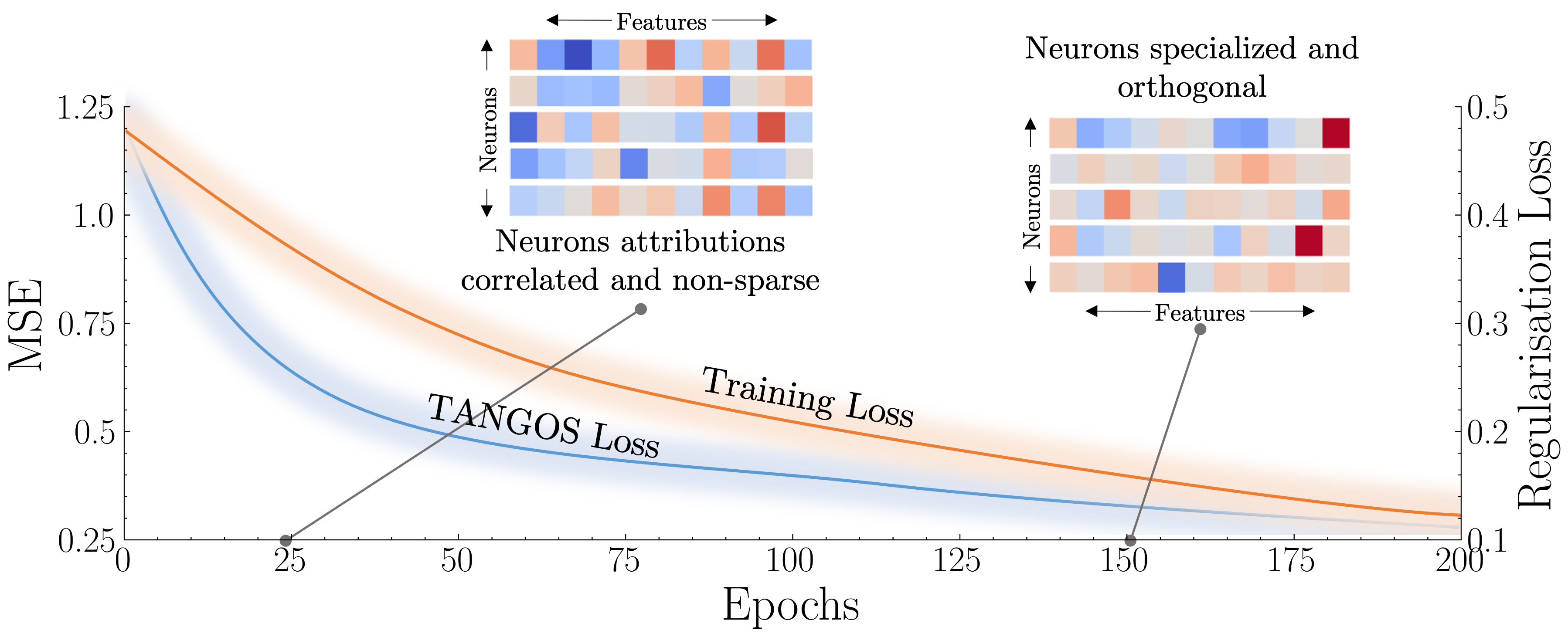
Despite their success with unstructured data, deep neural networks are not yet a panacea for structured tabular data. In the tabular domain, their efficiency crucially relies on various forms of regularization to prevent overfitting and provide strong generalization performance. Existing regularization techniques include broad modelling decisions such as choice of architecture, loss functions, and optimization methods. In this work, we introduce Tabular Neural Gradient Orthogonalization and Specialization (TANGOS), a novel framework for regularization in the tabular setting built on latent unit attributions. The gradient attribution of an activation with respect to a given input feature suggests how the neuron attends to that feature, and is often employed to interpret the predictions of deep networks. In TANGOS, we take a different approach and incorporate neuron attributions directly into training to encourage orthogonalization and specialization of latent attributions in a fully-connected network. Our regularizer encourages neurons to focus on sparse, non-overlapping input features and results in a set of diverse and specialized latent units. In the tabular domain, we demonstrate that our approach can lead to improved out-of-sample generalization performance, outperforming other popular regularization methods. We provide insight into why our regularizer is effective and demonstrate that TANGOS can be applied jointly with existing methods to achieve even greater generalization performance.
研究动机与目标
- 解决在表格数据上训练的深度神经网络中存在的过拟合与泛化能力差的问题。
- 提出一种新型正则化方法,利用神经元激活来促进潜在表征中的结构多样性。
- 通过鼓励神经元在不同输入特征上实现稀疏且非重叠的关注,提升低数据量场景下的泛化性能。
- 证明 TANGOS 可与现有正则化方法有效结合,实现进一步的性能增益。
- 通过将性能提升与潜在空间中弱学习器之间的多样性增加相联系,提供可解释性见解。
提出的方法
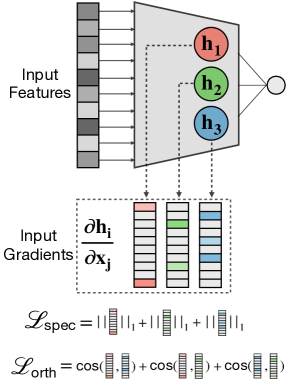
- TANGOS 引入一种新型正则化器,基于神经元对输入特征的梯度激活进行操作。
- 通过鼓励神经元聚焦于输入特征中互不重叠的稀疏子集,惩罚非正交与非专业化激活。
- 通过基于梯度的显著性图计算神经元级别的激活,并对这些激活在神经元之间的余弦相似度与稀疏性施加联合惩罚。
- 该正则化器具有可微性,可集成到训练目标中,实现端到端优化。
- 该框架与标准深度学习组件兼容,可与如 Dropout、权重衰减和批量归一化等现有正则化方法结合使用。
- 实验在 UCI 的 20 个表格数据集上进行,采用标准预处理流程,包括特征标准化、独热编码与缺失值填补。
实验结果
研究问题
- RQ1基于梯度激活的正则化是否能提升表格神经网络的泛化能力?
- RQ2在神经元激活中强制实现正交性与专业化是否能提升表格数据上的模型性能?
- RQ3在分布外性能方面,TANGOS 与 L1、L2、Dropout 和批量归一化等成熟正则化方法相比表现如何?
- RQ4TANGOS 是否能与其它正则化方法有效结合,以进一步增强泛化能力?
- RQ5潜在空间中何种结构特征导致了 TANGOS 的性能提升?
主要发现
- 在 20 个表格数据集上,TANGOS 在泛化性能方面优于基线模型及所有标准正则化方法(L1、L2、Dropout、批量归一化、输入噪声、Mixup)。
- 在波士顿房价(BH)数据集上,TANGOS 的测试损失为 0.362 ± 0.021,优于基线(0.389 ± 0.007)及其他正则化方法。
- 在葡萄酒质量(WQ)数据集上,TANGOS 的测试损失为 0.364 ± 0.003,显著低于基线(0.394 ± 0.033)。
- 在宫颈癌(CE)数据集上,TANGOS 的测试损失为 0.185 ± 0.009,优于基线(0.211 ± 0.008)。
- TANGOS 在回归与分类任务中均表现出一致的性能提升,尤其在低数据量场景下提升最为显著。
- 当与 Dropout 和权重衰减等其他正则化方法结合时,TANGOS 实现了更大的性能增益,表明存在协同效应。
阅读本论文
在 Nubint 阅读器中打开原文,边读边就任意段落提问。
在 Nubint 中阅读本论文本解读由 AI 根据论文原文生成,引用前请核对原文。