
[论文解读] TCAN: Text-oriented Cross Attention Network for Multimodal Sentiment Analysis
TCAN 提出了一种面向多模态情感分析的文本导向交叉注意力网络,通过将文本模态作为主导引导来实现视觉与听觉模态的融合。通过使用带有门控机制的文本查询交叉注意力以及单模态联合学习,TCAN 在 CMU-MOSI 和 CMU-MOSEI 数据集上实现了最先进性能,有效平衡了各模态的贡献并降低了噪声影响。
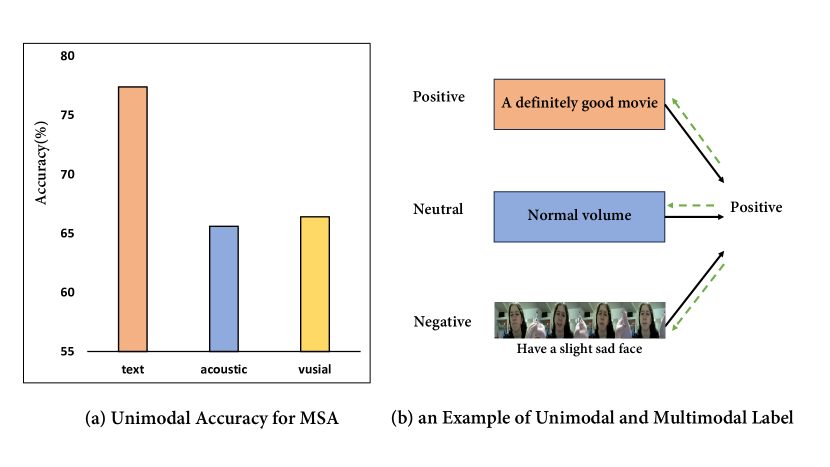
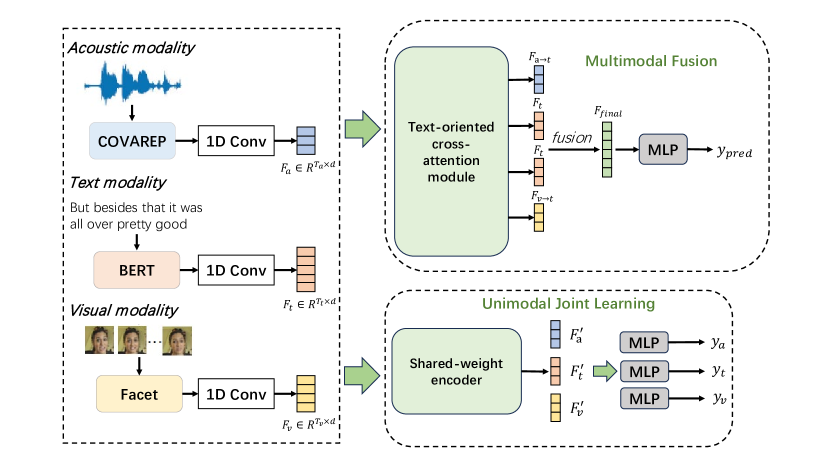
Multimodal Sentiment Analysis (MSA) endeavors to understand human sentiment by leveraging language, visual, and acoustic modalities. Despite the remarkable performance exhibited by previous MSA approaches, the presence of inherent multimodal heterogeneities poses a challenge, with the contribution of different modalities varying considerably. Past research predominantly focused on improving representation learning techniques and feature fusion strategies. However, many of these efforts overlooked the variation in semantic richness among different modalities, treating each modality uniformly. This approach may lead to underestimating the significance of strong modalities while overemphasizing the importance of weak ones. Motivated by these insights, we introduce a Text-oriented Cross-Attention Network (TCAN), emphasizing the predominant role of the text modality in MSA. Specifically, for each multimodal sample, by taking unaligned sequences of the three modalities as inputs, we initially allocate the extracted unimodal features into a visual-text and an acoustic-text pair. Subsequently, we implement self-attention on the text modality and apply text-queried cross-attention to the visual and acoustic modalities. To mitigate the influence of noise signals and redundant features, we incorporate a gated control mechanism into the framework. Additionally, we introduce unimodal joint learning to gain a deeper understanding of homogeneous emotional tendencies across diverse modalities through backpropagation. Experimental results demonstrate that TCAN consistently outperforms state-of-the-art MSA methods on two datasets (CMU-MOSI and CMU-MOSEI).
研究动机与目标
- 为解决多模态情感分析中模态贡献失衡的问题,其中如文本等强模态常被低估。
- 缓解在多模态融合过程中未对齐的视觉与听觉序列中的噪声与冗余。
- 通过实现文本与其他模态之间的双向、交互式学习,提升表征学习效果。
- 开发一种灵活的框架,根据语义丰富度动态平衡不同模态的贡献。
- 在基准多模态情感分析数据集上超越现有最先进方法。
提出的方法
- 模型使用两个双模态融合模块:文本-视觉(TV)和文本-听觉(TA),其中文本模态作为其他模态上交叉注意力的查询。
- 在与其他模态进行交叉注意力之前,对文本模态应用自注意力机制以增强其内部表征。
- 引入门控控制机制,以抑制视觉与听觉模态中的噪声和冗余特征。
- 采用单模态联合学习方法,通过反向传播共享的情感信号对齐各模态的表征。
- 架构基于堆叠的 Transformer 模型,结合文本导向的交叉注意力机制,实现多模态表征的迭代优化。
- 文本导向交叉注意力模块的数量(N)经过调优,在 CMU-MOSI 上最优性能出现在 N=5 时。
实验结果
研究问题
- RQ1如何使多模态情感分析模型有效优先考虑语义丰富度更高、噪声更低的文本模态?
- RQ2与对称的三模态融合相比,基于文本查询的交叉注意力在未对齐的多模态序列中能在多大程度上提升融合性能?
- RQ3门控机制的引入在多模态融合中对噪声抑制和性能稳定性有何影响?
- RQ4在 TCAN 中,为平衡表征深度与模态引导效果,最优的交叉注意力层数量(N)是多少?
- RQ5联合进行单模态与多模态训练能否提升不同模态间的一致性与泛化能力?
主要发现
- TCAN 在 CMU-MOSI 和 CMU-MOSEI 两个数据集上均实现了最先进性能,F1 分数超越了现有最先进方法。
- 消融实验表明,若移除门控机制或单模态联合训练,性能会显著下降,证明了二者有效性。
- 当将文本模态替换为其他主导模态时,模型性能显著下降,证实了文本在语义上的主导地位。
- 在 CMU-MOSI 上,文本导向交叉注意力模块的最优数量为 N=5,超过此数量后性能下降,原因可能是过拟合或引导能力退化。
- 可视化结果表明,TCAN 正确地为强模态(如文本)分配更高权重,并能补偿视觉与听觉模态中弱或冲突的信号。
- 在单模态预测冲突的模糊情况下,模型能成功生成更接近多模态真实标签的预测。
阅读本论文
在 Nubint 阅读器中打开原文,边读边就任意段落提问。
在 Nubint 中阅读本论文本解读由 AI 根据论文原文生成,引用前请核对原文。