
[论文解读] Tele-Aloha: A Low-budget and High-authenticity Telepresence System Using Sparse RGB Cameras
Tele-Aloha 提出了一种低成本、实时的远程存在系统,仅使用四台RGB摄像头、一台消费级GPU和一种自体立体显示技术,即可实现高保真度、30 fps、2K的新视角合成,延迟低于150ms。该系统通过级联视差估计算法、基于高斯点阵化的神经光栅化技术以及加权混合方法,实现高保真度,无需深度传感器或头戴式显示器即可提供沉浸式共在体验。
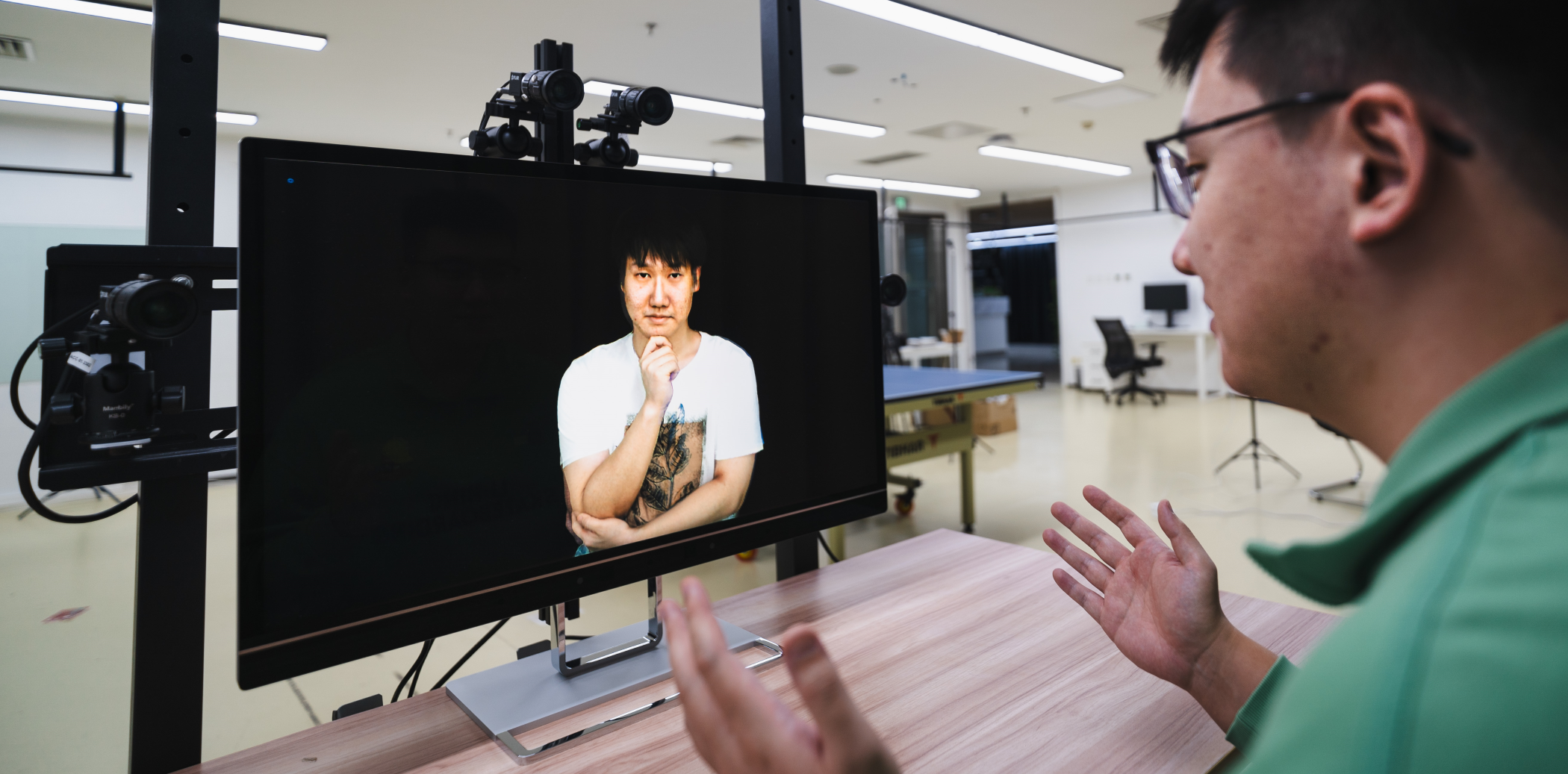
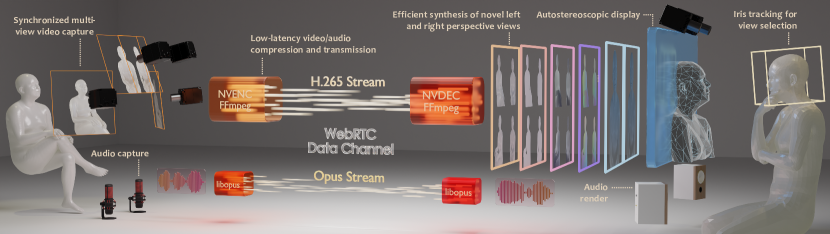
In this paper, we present a low-budget and high-authenticity bidirectional telepresence system, Tele-Aloha, targeting peer-to-peer communication scenarios. Compared to previous systems, Tele-Aloha utilizes only four sparse RGB cameras, one consumer-grade GPU, and one autostereoscopic screen to achieve high-resolution (2048x2048), real-time (30 fps), low-latency (less than 150ms) and robust distant communication. As the core of Tele-Aloha, we propose an efficient novel view synthesis algorithm for upper-body. Firstly, we design a cascaded disparity estimator for obtaining a robust geometry cue. Additionally a neural rasterizer via Gaussian Splatting is introduced to project latent features onto target view and to decode them into a reduced resolution. Further, given the high-quality captured data, we leverage weighted blending mechanism to refine the decoded image into the final resolution of 2K. Exploiting world-leading autostereoscopic display and low-latency iris tracking, users are able to experience a strong three-dimensional sense even without any wearable head-mounted display device. Altogether, our telepresence system demonstrates the sense of co-presence in real-life experiments, inspiring the next generation of communication.
研究动机与目标
- 开发一种低成本、高真实感的远程存在系统,用于同伴之间的上半身通信。
- 通过仅使用稀疏RGB摄像头而非昂贵的深度传感器,实现鲁棒、实时的3D渲染,消除对深度传感器的依赖。
- 在消费级硬件上实现实时、高分辨率(2048×2048)的新视角合成,延迟极低(<150ms)。
- 通过自体立体显示技术实现沉浸式共在体验,无需可穿戴设备。
- 设计一种成本低廉(约15,000美元)且可扩展、适用于消费级部署的系统。
提出的方法
- 采用级联视差估计算法,从稀疏RGB输入中生成鲁棒的深度线索,提升大基线摄像机对的精度。
- 通过3D高斯点阵化实现神经光栅化,将编码的潜在特征投影到目标视角,实现低分辨率图像解码。
- 采用加权混合机制对解码图像进行优化,提升至完整的2K分辨率,增强视觉保真度并减少伪影。
- 系统利用实时眼动追踪技术,选择最优源视角用于新视角合成,确保自然的透视渲染效果。
- 所有组件均通过CUDA和TensorRT(fp16)进行优化,且使用CUDA图技术以最小化端到端系统延迟。
- 自体立体显示技术提供无需头戴设备的3D视觉感知体验,增强共在感。
实验结果
研究问题
- RQ1能否仅使用四台消费级RGB摄像头且不依赖深度传感器,构建一个高保真、实时的远程存在系统?
- RQ2在实时系统中,仅依靠稀疏RGB输入,如何实现鲁棒且准确的深度估计?
- RQ33D高斯点阵化能否被适配用于远程存在场景下的即时、低延迟新视角合成?
- RQ4当结合神经光栅化与加权混合技术进行2K渲染时,可实现的延迟与图像质量如何?
- RQ5自体立体显示技术在无需可穿戴设备的情况下,能在多大程度上实现沉浸式共在体验?
主要发现
- 在合成数据集上,所提系统在PSNR、SSIM和LPIPS指标上分别达到26.543、0.928和0.095,优于以往高效的新型视角合成方法。
- 级联视差估计算法在大基线设置下,相比未初始化的基线方法,将端点误差(EPE)降低了19.4%,显著提升了深度估计的鲁棒性。
- 通过级联初始化,仅需3次迭代光流更新即可达到与无初始化条件下16次更新相当的精度,显著减少计算时间。
- 在局域网(LAN)环境下,端到端系统延迟测量为149ms,满足可接受实时远程存在的阈值(≤150ms)。
- 在真实场景实验中,系统展现出强烈的共在感知效果,用户报告在自体立体显示上获得了沉浸式的3D体验。
- 在镜面物体(如眼镜)上出现失败案例,因其各向异性的反光特性会干扰视差估计。
阅读本论文
在 Nubint 阅读器中打开原文,边读边就任意段落提问。
在 Nubint 中阅读本论文本解读由 AI 根据论文原文生成,引用前请核对原文。