
[论文解读] TESTAM: A Time-Enhanced Spatio-Temporal Attention Model with Mixture of Experts
TESTAM 是一种 Mixture-of-Experts 模型,通过将门控网络重新定义为分类任务,动态选择三种空间建模专家——仅时间建模、静态图和动态图——以改进交通预测。它在 METR-LA、PEMS-BAY 和 EXPY-TKY 数据集上实现了最先进性能,通过上下文感知、现场建模重复性和非重复性交通模式,超越了 13 种现有方法。
Accurate traffic forecasting is challenging due to the complex dependency on road networks, various types of roads, and the abrupt speed change due to the events. Recent works mainly focus on dynamic spatial modeling with adaptive graph embedding or graph attention having less consideration for temporal characteristics and in-situ modeling. In this paper, we propose a novel deep learning model named TESTAM, which individually models recurring and non-recurring traffic patterns by a mixture-of-experts model with three experts on temporal modeling, spatio-temporal modeling with static graph, and dynamic spatio-temporal dependency modeling with dynamic graph. By introducing different experts and properly routing them, TESTAM could better model various circumstances, including spatially isolated nodes, highly related nodes, and recurring and non-recurring events. For the proper routing, we reformulate a gating problem into a classification problem with pseudo labels. Experimental results on three public traffic network datasets, METR-LA, PEMS-BAY, and EXPY-TKY, demonstrate that TESTAM achieves a better indication and modeling of recurring and non-recurring traffic. We published the official code at https://github.com/HyunWookL/TESTAM
研究动机与目标
- 解决在具有重复性和非重复性交通模式的大规模路网中建模复杂、动态时空依赖关系的挑战。
- 通过实现对每种交通状况下最适当空间建模方法的现场选择,克服仅使用静态或动态图建模的局限性。
- 通过将门控问题重新表述为具有双损失函数的多标签分类任务,提升 Mixture-of-Experts 架构中的路由准确性。
- 增强模型在各种交通场景(包括孤立道路和高流量事件)下的鲁棒性和适应性。
- 在具有不同网络规模和动态特性的多个真实世界数据集上,展示卓越的预测性能。
提出的方法
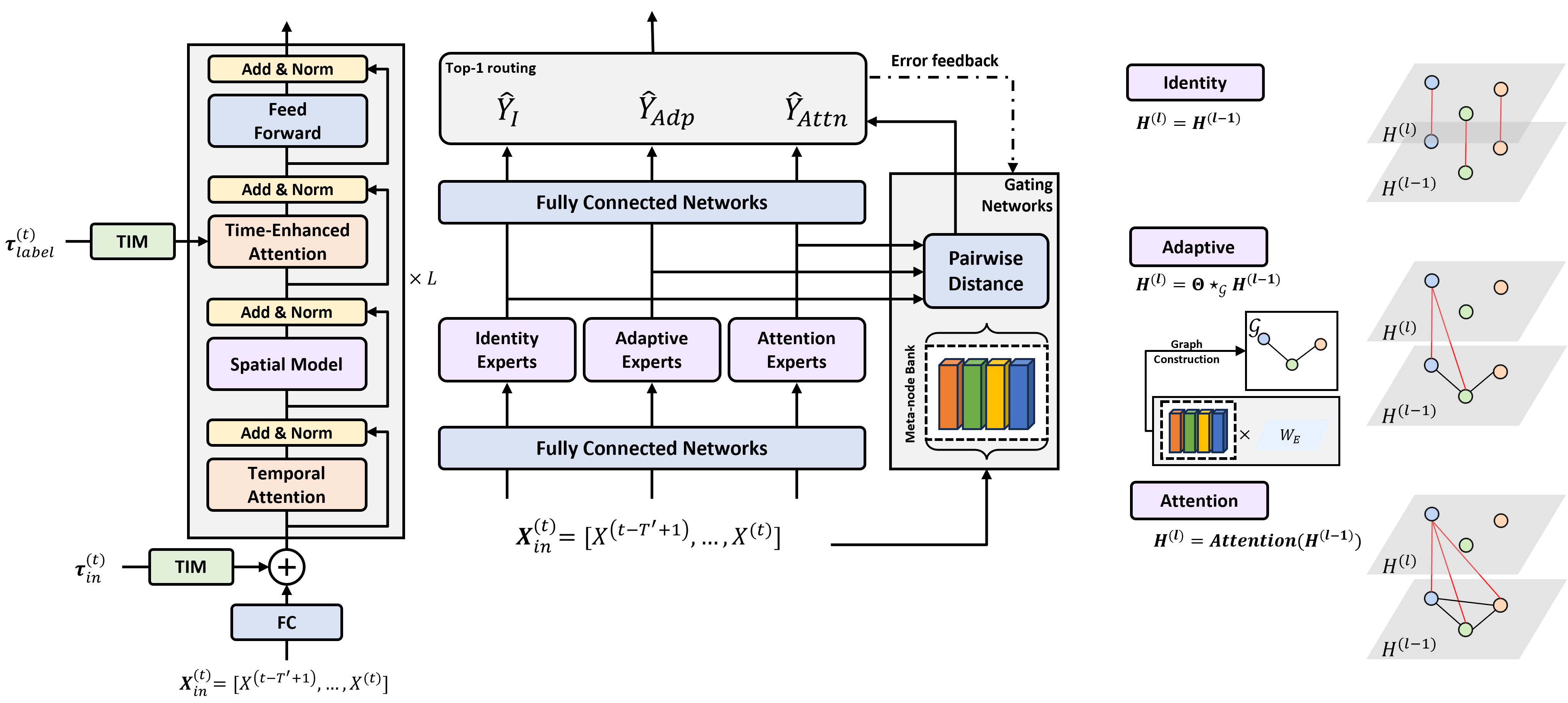
- TESTAM 采用 Mixture-of-Experts 框架,包含三种不同专家:一种无空间建模(仅时间建模),一种使用可学习的静态图,一种使用通过注意力机制学习的动态图。
- 门控网络根据输入交通状况和每个专家的上一隐藏状态,基于基于分类的路由机制,为每个时间步选择最优专家。
- 路由通过两种损失函数进行训练:一种用于避免最差专家选择,另一种用于引导选择至表现最佳的专家,从而提升路由的稳定性和准确性。
- 引入时间增强的自注意力机制,以更好地捕捉时间动态,利用周期性嵌入建模如高峰时段等重复性模式。
- 采用混合图学习策略,结合静态和动态图表示,以在稳定性与适应性之间取得平衡。
- 应用两阶段训练协议:首先独立训练专家;然后使用双损失目标微调门控网络,以优化路由决策。
实验结果
研究问题
- RQ1基于交通上下文的动态专家路由是否能相比固定或集成式空间建模,提升预测准确性?
- RQ2将门控问题重新表述为分类任务,是否能带来比标准 MoE 训练更稳定、更准确的路由?
- RQ3结合静态与动态图建模是否比单独使用任一方法更有效,以捕捉重复性和非重复性交通模式?
- RQ4时间增强注意力的引入如何改善对周期性交通行为的建模?
- RQ5TESTAM 在具有复杂拓扑结构的大规模真实世界路网中是否具有良好的泛化能力?
主要发现
- TESTAM 在所有三个基准数据集——METR-LA、PEMS-BAY 和 EXPY-TKY 上均取得最佳性能,超越了 13 种现有方法,在 MAE、RMSE 和 MAPE 指标上表现更优。
- 在 METR-LA 上,TESTAM 实现 2.93 MAE、5.95 RMSE 和 7.99% MAPE,优于次佳方法 0.07 MAE 和 0.17 RMSE。
- 在 PEMS-BAY 上,TESTAM 记录 1.53 MAE、3.47 RMSE 和 3.41% MAPE,较第二佳方法提升 0.03 MAE 和 0.10 RMSE。
- 在 EXPY-TKY 上,TESTAM 实现 6.40 MAE、10.40 RMSE 和 28.67% MAPE,展现出在大规模、复杂路网中的强劲性能。
- 消融研究证实,两种路由损失均至关重要:移除最佳路由引导会使 METR-LA 上的 MAE 增加 0.04,而移除最差路由避免则导致性能下降。
- 将身份专家替换为基于 GCN 的专家(替换设置)后,性能显著劣于甚至低于最差路由避免变体,证实了多样化专家架构的价值。
阅读本论文
在 Nubint 阅读器中打开原文,边读边就任意段落提问。
在 Nubint 中阅读本论文本解读由 AI 根据论文原文生成,引用前请核对原文。