
[论文解读] The 2022 high-energy outburst and radio disappearing act of the magnetar 1E 1547.0-5408
本研究报告了射电波段明亮的磁星1E 1547.0−5408在2022年的爆发,观测到软X射线通量增加,且此前持久射电辐射消失,随后出现自转加速跳变,自转频率下降率持续上升。缺乏硬X射线谱变化表明磁极附近发生局部磁重连,可能由小尺度地壳断裂或瞬态粒子风引起,未发生全局磁场重排。
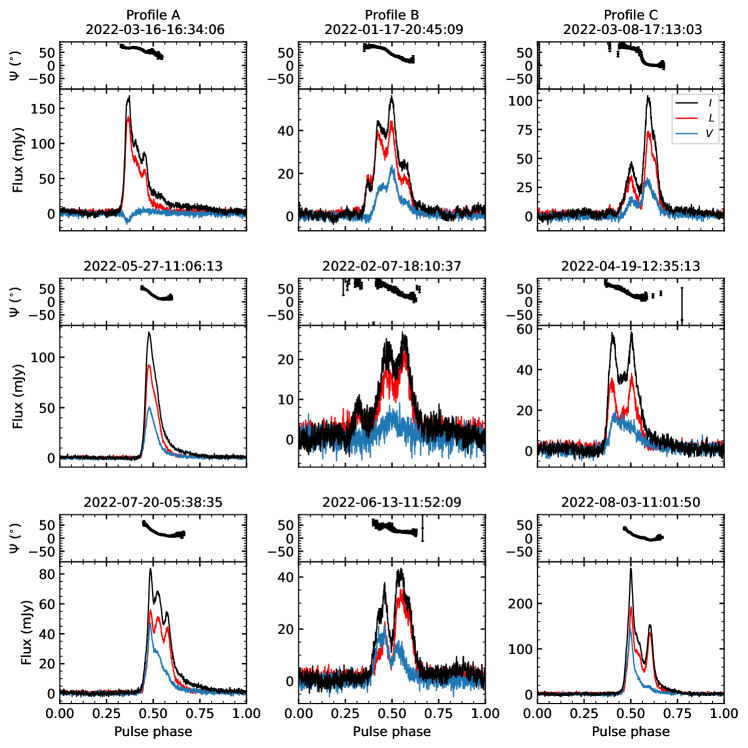
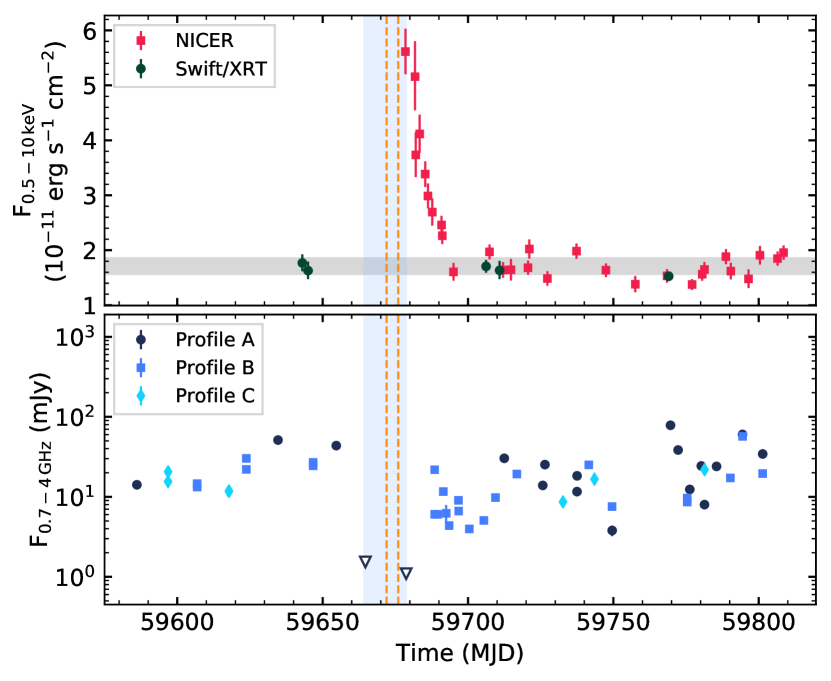
We report the radio and high-energy properties of a new outburst from the radio-loud magnetar 1E 1547.0$-$5408. Following the detection of a short burst from the source with Swift-BAT on 2022 April 7, observations by NICER detected an increased flux peaking at $(6.0 \pm 0.4) imes 10^{-11}$ erg s$^{-1}$ cm$^{-2}$ in the soft X-ray band, falling to the baseline level of $1.7 imes10^{-11}$ erg s$^{-1}$ cm$^{-2}$ over a 17-day period. Joint spectroscopic measurements by NICER and NuSTAR indicated no change in the hard non-thermal tail despite the prominent increase in soft X-rays. Observations at radio wavelengths with Murriyang, the 64-m Parkes radio telescope, revealed that the persistent radio emission from the magnetar disappeared at least 22 days prior to the initial Swift-BAT detection and was re-detected two weeks later. Such behavior is unprecedented in a radio-loud magnetar, and may point to an unnoticed slow rise in the high-energy activity prior to the detected short-bursts. Finally, our combined radio and X-ray timing revealed the outburst coincided with a spin-up glitch, where the spin-frequency and spin-down rate increased by $0.2 \pm 0.1$ $μ$Hz and $(-2.4 \pm 0.1) imes 10^{-12}$ s$^{-2}$ respectively. A linear increase in spin-down rate of $(-2.0 \pm 0.1) imes 10^{-19}$ s$^{-3}$ was also observed over 147 d of post-outburst timing. Our results suggest that the outburst may have been associated with a reconfiguration of the quasi-polar field lines, likely signalling a changing twist, accompanied by spatially broader heating of the surface and a brief quenching of the radio signal, yet without any measurable impact on the hard X-ray properties.
研究动机与目标
- 表征射电波段明亮磁星1E 1547.0−5408新爆发期间的高能与射电行为。
- 研究爆发期间及之后磁星的时变演化,特别是跳变的存在。
- 确定射电辐射消失是否先于高能活动,从而挑战标准爆发模型。
- 评估爆发对硬X射线非热谱尾和磁场拓扑结构的影响。
- 探讨观测到的射电抑制与自转频率下降率演化背后的物理解释。
提出的方法
- 利用Swift-BAT进行初始爆发探测,NICER进行软X射线光 light curves 和光谱分析的多波段监测。
- 结合NICER与NuSTAR进行X射线谱分析,测量硬非热谱尾并搜索谱变化。
- 利用帕克斯射电望远镜(Murriyang)进行高时间分辨率射电观测,追踪脉泽射电辐射的持续性与消失。
- 使用tempo2和RMNest软件对射电与X射线数据进行时变分析,检测自转加速跳变并测量自转频率与自转频率下降率的演化。
- 通过线性拟合自转频率的三阶时间导数,对自转频率下降率演化进行建模。
- 使用HEAsoft、XSPEC和PSRCHIVE进行数据降噪与脉冲轮廓分析。
实验结果
研究问题
- RQ11E 1547.0−5408的射电辐射是否在高能爆发开始前已消失?
- RQ2软X射线通量增加的本质是什么?其是否与硬X射线非热成分的变化相关?
- RQ3所观测到的自转加速跳变由何引起?自转频率下降率的持续增加如何与磁场重连相关?
- RQ4为何射电辐射被抑制,而硬X射线谱未检测到可测量变化?
- RQ5该爆发是否为更长期活动增强的一部分,如与2008年爆发的相似性所暗示的那样?
主要发现
- 软X射线通量在17天内增至(6.0±0.4)×10⁻¹¹ erg s⁻¹ cm⁻²,达到峰值后恢复至基线水平(1.7×10⁻¹¹ erg s⁻¹ cm⁻²)。
- 在软X射线耀发期间,硬X射线非热谱尾未显示谱变化,表明未发生全局磁场重排。
- 持久射电辐射在Swift-BAT爆发探测前至少22天已消失,表明存在高能活动的隐藏前兆阶段。
- 射电辐射在初始爆发约两周后重新出现,并在约3周内恢复至爆发前水平。
- 发生自转加速跳变,自转频率瞬时增加0.2±0.1 μHz,自转频率下降率增加(−2.4±0.1)×10⁻¹² s⁻²。
- 在爆发后147天内,测得自转频率下降率呈线性增加(−2.0±0.1)×10⁻¹⁹ s⁻³,表明磁应力持续松弛。
阅读本论文
在 Nubint 阅读器中打开原文,边读边就任意段落提问。
在 Nubint 中阅读本论文本解读由 AI 根据论文原文生成,引用前请核对原文。