
[论文解读] The asymmetry of dawn: evidence for asymmetric reionization histories from a joint analysis of cosmic microwave background and astrophysical data
本研究通过联合分析宇宙微波背景(CMB)极化数据、哈勃前沿场(HFF)紫外光度数据以及类星体和伽马射线暴的中性氢分数测量,对再电离历史进行约束。研究提出了一种扩展的电离历史模型,允许电离氢分数随红移呈现非对称演化,发现对对称再电离的强烈反对证据(4σ),τ = 0.0542⁺⁰.⁰⁰¹⁷₋₀.⁰⁰²⁸(68%可信区间),其精度高于仅使用普朗克2018年数据的结果,且在不同CMB似然函数下均具稳健性。
We show that by jointly fitting cosmic microwave background (CMB) and astrophysical data - a compilation of UV luminosity data from the Hubble Frontier Field and neutral hydrogen data from distant sources-, we can infer on the shape of the evolution of the ionized hydrogen fraction with redshift in addition to constraining the average optical depth $τ$.For this purpose, we introduce here a novel extended model that includes hydrogen ionization histories which are monotonic with redshift, but allow for an asymmetry as indicated from our previous works on a free reconstruction of reionization. By using our baseline data combination, we obtain $τ=0.0542^{+0.0017}_{-0.0028}$, consistent with our previous works and tighter than the one inferred by Planck 2018 data because of the combination of CMB with astrophysical data. We find that the symmetric hypothesis within our parametrization is disfavoured at 4 $σ$.We test our findings by using alternative likelihoods for CMB polarization at low multipoles, i.e. based on the 2020 reprocessing of Planck HFI data or on the joint analysis of WMAP and Planck LFI data, obtaining consistent results that disfavour the symmetric hypothesis of the reionization history at high statistical significant level.These results will be further tested by more precise astrophysical data such as from JWST and Euclid deep fields.
研究动机与目标
- 通过结合CMB与天体物理数据,提升对再电离历史的约束,超越平均光学厚度τ。
- 利用一种新型扩展模型,测试再电离历史的对称性,该模型允许电离氢分数随红移呈现非对称演化。
- 评估在不同CMB极化似然函数和数据组合下,非对称再电离结果的稳健性。
- 利用贝叶斯证据评估扩展非对称模型相对于对称双曲正切(Tanh)模型的偏好程度。
提出的方法
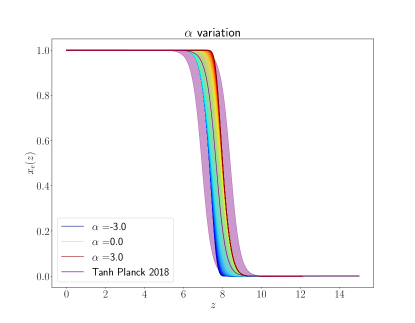
- 作者提出一种扩展的再电离模型,将电离氢分数参数化为随红移单调变化的函数,并引入不对称参数α,以允许电离程度的上升与下降过程不对称。
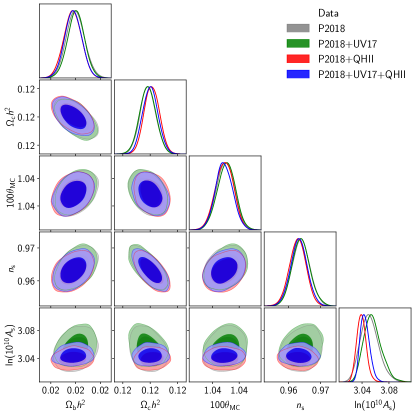
- 将普朗克2018年CMB极化数据与哈勃前沿场(HFF)在红移z = 6.5–11的紫外光度密度测量数据,以及类星体、伽马射线暴和星系的中性氢分数数据相结合。
- 采用贝叶斯框架推断在对称与非对称模型假设下,再电离参数(包括τ和不对称参数α)的后验分布。
- 测试了多种替代CMB似然函数,包括2020年重新处理的普朗克HFI数据和联合WMAP+普朗克LFI似然函数,以评估结果的稳健性。
- 通过贝叶斯证据进行模型比较,评估扩展非对称模型相对于可调宽度对称Tanh模型的偏好程度。
- 将不对称参数α的先验扩展至负值,以检验对正不对称性偏好结果的稳健性。
实验结果
研究问题
- RQ1在联合CMB与天体物理数据约束下,再电离历史是呈对称还是非对称?
- RQ2将CMB极化数据与紫外光度及中性氢分数数据结合,如何改善对τ和电离历史形状的约束?
- RQ3在不同CMB极化似然函数(如普朗克2018年、重新处理的HFI、WMAP+LFI)下,再电离非对称性的证据是否依然稳健?
- RQ4与标准对称Tanh模型相比,扩展非对称模型的贝叶斯偏好程度如何?
- RQ5不同紫外星等截断(如-15与-17)如何影响对非对称性和光学厚度的推断?
主要发现
- 联合分析普朗克2018年CMB极化数据、HFF紫外光度数据(极限星等-17)及中性氢分数数据,得到τ = 0.0542⁺⁰.⁰⁰¹⁷₋₀.⁰⁰²⁸(68%可信区间),其精度高于仅使用普朗克2018年数据的结果。
- 在扩展模型框架下,对称再电离假设的显著性超过4σ,被强烈反对。
- 在替代CMB极化似然函数下——SROLL2(2020年重新处理的普朗克HFI)和WMAP+普朗克LFI——结果一致,τ分别为0.0552⁺⁰.⁰⁰³¹₋₀.⁰⁰¹⁸和0.0562⁺⁰.⁰⁰¹⁹₋₀.⁰⁰⁴⁰,两者均反对对称性。
- 在完整数据组合下,基于贝叶斯证据,扩展非对称模型显著优于对称Tanh模型。
- 即使对不对称参数α施加负值先验,结果仍偏好正值,α > 5.28(68%可信区间)且α > 3.07(95%可信区间),表明再电离过程具有陡峭的开始和渐进的结束。
- UV15数据集(更暗的源,极限星等-15)约束力较弱,对称模型仅在95%可信区间内被反对,凸显了紫外数据深度在探测非对称性中的关键作用。
阅读本论文
在 Nubint 阅读器中打开原文,边读边就任意段落提问。
在 Nubint 中阅读本论文本解读由 AI 根据论文原文生成,引用前请核对原文。