
[论文解读] The BACCO simulation project: biased tracers in real space
本论文提出了一种基于神经网络的模拟器,用于模拟真实空间中具有偏置的追踪场的两点关联函数,其训练基于超过400个宇宙学模拟,覆盖包含大质量中微子和动力学暗能量的8维参数空间。通过采用宇宙学缩放算法和二阶拉格朗日微扰理论,该模拟器在预测星系功率谱时实现了1–2%的精度,有效范围达 $k \sim 0.7h\,\mathrm{Mpc}^{-1}$,从而支持从大尺度结构巡天中进行精确的宇宙学推断。
We present an emulator for the two-point clustering of biased tracers in real space. We construct this emulator using neural networks calibrated with more than $400$ cosmological models in a 8-dimensional cosmological parameter space that includes massive neutrinos an dynamical dark energy. The properties of biased tracers are described via a Lagrangian perturbative bias expansion which is advected to Eulerian space using the displacement field of numerical simulations. The cosmology-dependence is captured thanks to a cosmology-rescaling algorithm. We show that our emulator is capable of describing the power spectrum of galaxy formation simulations for a sample mimicking that of a typical Emission-Line survey at $z \sim 1$ with an accuracy of $1-2\%$ up to nonlinear scales $k \sim 0.7 h \mathrm{Mpc}^{-1}$.
研究动机与目标
- 开发一种快速、精确的模拟器,用于在广泛宇宙学参数空间内模拟真实空间中偏置追踪场的聚类行为。
- 利用拉格朗日微扰理论和宇宙学缩放方法,对星系追踪场的非线性聚类进行建模,以降低计算成本。
- 通过精确建模星系功率谱,实现对欧几里得和DESI等未来大尺度结构巡天的精确宇宙学约束。
- 在具有真实选型函数和宇宙方差误差的模拟星系样本上验证模拟器性能。
- 提供一个公开可用的工具,用于建模星系聚类,包括星系-星系弱引力透镜和未来红移空间扩展的应用。
提出的方法
- 使用包含超过400个宇宙学模拟的训练数据集,其参数空间为8维,涵盖大质量中微子和动力学暗能量。
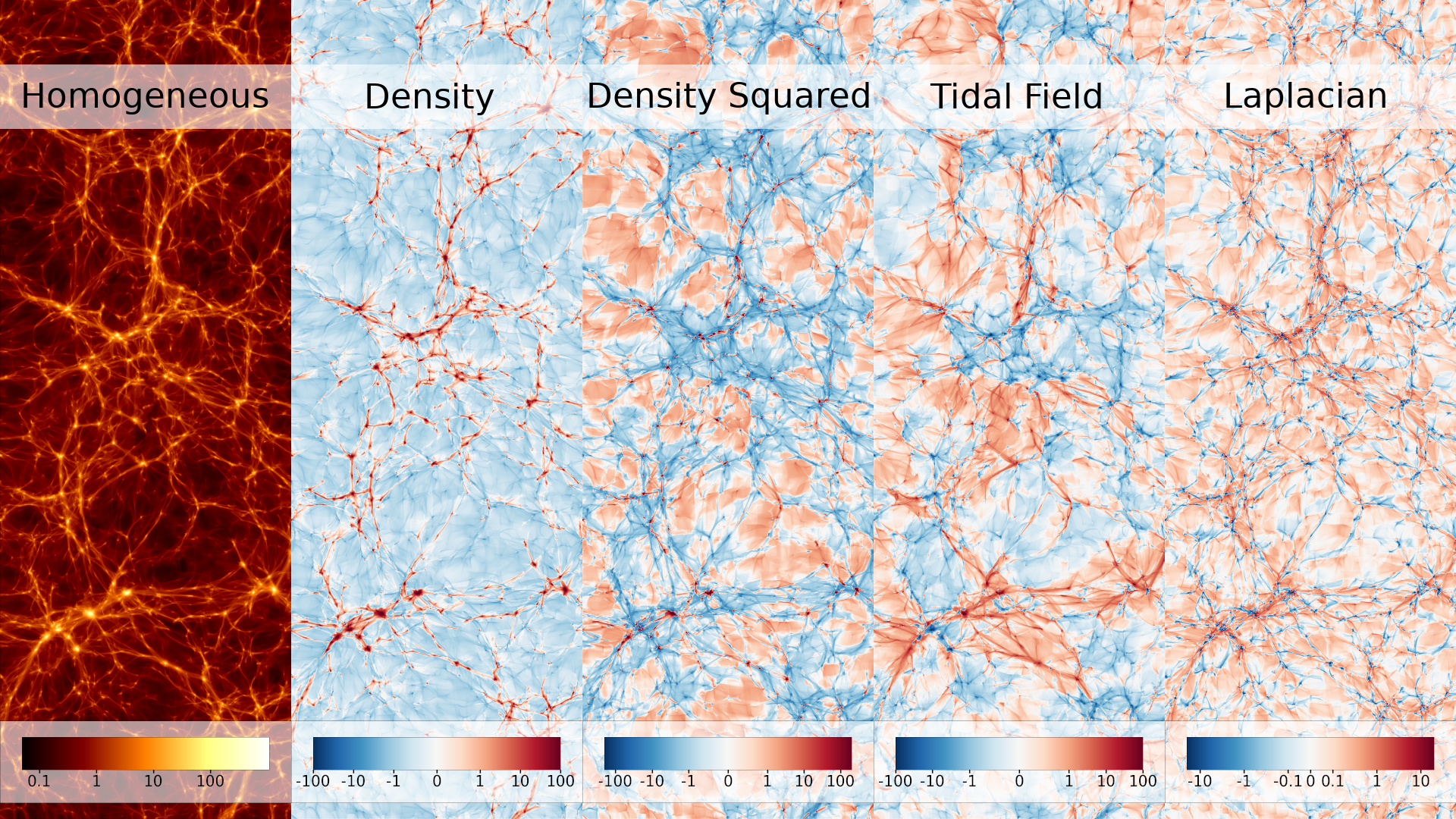
- 从模拟中计算出密度、潮汐场和密度拉普拉斯算子的二阶拉格朗日偏置展开项,并利用位移场将这些项演化至欧几里得空间。
- 应用宇宙学缩放算法,从一组少量参考模拟中重现全宇宙学参数空间内的拉格朗日场。
- 使用神经网络模拟偏置项的功率谱,其预测结果通过独立模拟输出进行验证。
- 通过结合理论LPT预测与模拟输出,减小需模拟的物理量的动态范围。
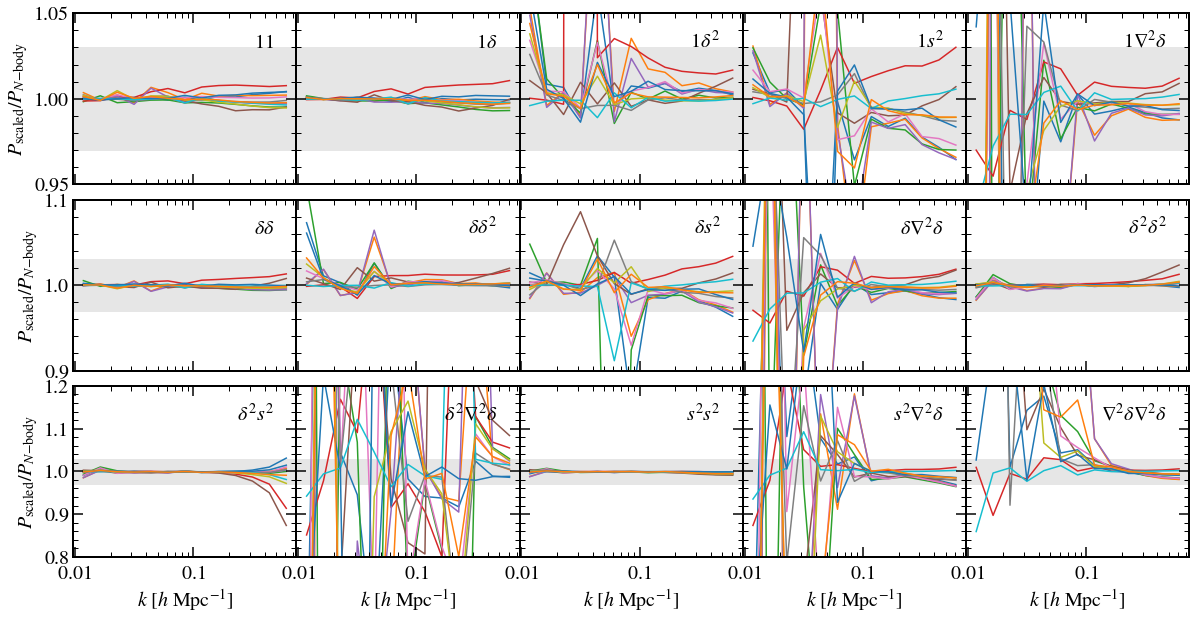
- 在200组独立的宇宙学-红移组合上对模拟器进行验证,性能评估涵盖涉及 $1$、$\delta$、$\delta^2$、$s^2$ 和 $\nabla^2\delta$ 的项。
实验结果
研究问题
- RQ1神经网络模拟器能否在广泛宇宙学参数空间(包括对$\Lambda$CDM的扩展)内准确预测偏置追踪场的功率谱?
- RQ2宇宙学缩放技术在有限数量模拟的基础上,能否在多样化宇宙学中高保真地重现拉格朗日场?
- RQ3拉格朗日微扰理论项与模拟结果结合,能否在 $k \sim 0.7h\,\mathrm{Mpc}^{-1}$ 范围内准确建模非线性聚类?
- RQ4模拟器能否在关键偏置项(如 $1$ 和 $\delta$)上实现亚百分之一的精度,同时保持对高阶项的可接受精度?
- RQ5模拟器能否用于从包含宇宙方差误差的真实模拟星系样本中约束偏置参数,包括非线性尺度?
主要发现
- 该模拟器在预测模拟星系样本(类比于 $z \sim 1$ 处的发射线巡天)的功率谱时,实现了1–2%的精度,有效范围达 $k \sim 0.7h\,\mathrm{Mpc}^{-1}$。
- 在整个尺度范围内,均匀场($1$)和线性密度场($\delta$)的偏置项均实现了百分之一量级的精度。
- 高阶项如 $\delta^2$、$s^2$ 和 $\nabla^2\delta$ 的再现精度为百分之几,但特定组合(如 $\delta^2 s^2$ 和 $\delta^2 \nabla^2\delta$)在零交叉尺度附近性能有所下降。
- 宇宙学缩放技术成功地从少量参考模拟中高保真地重现了全8维宇宙学参数空间内的拉格朗日场。
- 当应用于具有真实星系数密度和宇宙方差的模拟星系样本时,该模拟器能够实现跨广泛动态范围(包括非线性尺度)的自洽星系聚类拟合。
- 该方法在建模星系-星系弱引力透镜和未来红移空间聚类扩展方面展现出强大潜力。
阅读本论文
在 Nubint 阅读器中打开原文,边读边就任意段落提问。
在 Nubint 中阅读本论文本解读由 AI 根据论文原文生成,引用前请核对原文。