
[论文解读] The Effectiveness of LLMs as Annotators: A Comparative Overview and Empirical Analysis of Direct Representation
本文评估了大型语言模型(LLMs),特别是 GPT-3.5-turbo,作为直接标注者的性能,通过对比其预测的观点分布与 2023 年 SemEval 任务中四个主观 NLP 数据集的人工标注分布。研究发现,LLMs 显现出显著偏差,尤其倾向于对攻击性类别赋予高置信度,且在非英语文本上的表现明显更差,F1 分数更低,熵值更高,表明其与人类标注模式的对齐程度较差。
Large Language Models (LLMs) have emerged as powerful support tools across various natural language tasks and a range of application domains. Recent studies focus on exploring their capabilities for data annotation. This paper provides a comparative overview of twelve studies investigating the potential of LLMs in labelling data. While the models demonstrate promising cost and time-saving benefits, there exist considerable limitations, such as representativeness, bias, sensitivity to prompt variations and English language preference. Leveraging insights from these studies, our empirical analysis further examines the alignment between human and GPT-generated opinion distributions across four subjective datasets. In contrast to the studies examining representation, our methodology directly obtains the opinion distribution from GPT. Our analysis thereby supports the minority of studies that are considering diverse perspectives when evaluating data annotation tasks and highlights the need for further research in this direction.
研究动机与目标
- 通过对比 LLM 的预测观点分布与人工标注的观点分布,评估其作为直接标注者的效果。
- 探究 LLM 是否能够准确反映主观分类任务中的人类分歧。
- 考察语言(英语与阿拉伯语)对 LLM 标注性能和偏差的影响。
- 使用熵和 F1 指标评估人类与 LLM 生成的观点分布之间的对齐程度。
- 识别 LLM 在建模数据标注中人类细微观点方面的能力局限。
提出的方法
- 本研究直接向 GPT-3.5-turbo 发出提示,要求其为四个 SemEval 2023 主观 NLP 数据集中的每个样本输出观点分布(例如,“攻击性”和“非攻击性”类别的概率)。
- 人类观点分布基于同一数据集中多位标注者之间的多数投票得出。
- 通过 F1 分数和交叉熵(CE)损失评估 LLM 预测与人类基线之间的性能差异。
- 分别计算人类和 LLM 分布的熵值,以评估不确定性及分布对齐程度。
- 对错误类型(假正例和假负例)进行分类,以分析 LLM 预测中的偏差模式。
- 通过对比英语和阿拉伯语提示下的结果,评估语言依赖的性能与偏差。
实验结果
研究问题
- RQ1LLM 生成的观点分布与主观 NLP 任务中人工标注的观点分布对齐程度如何?
- RQ2LLM 作为标注者在英语与非英语输入之间的性能表现有何差异?
- RQ3LLM 生成的观点分布中,偏差的性质与程度如何,特别是对攻击性类别标签的偏差?
- RQ4LLM 生成的分布熵值与人工标注分布的熵值相比如何?
- RQ5直接提示 LLM 输出观点分布,能否有效捕捉标注任务中的人类分歧?
主要发现
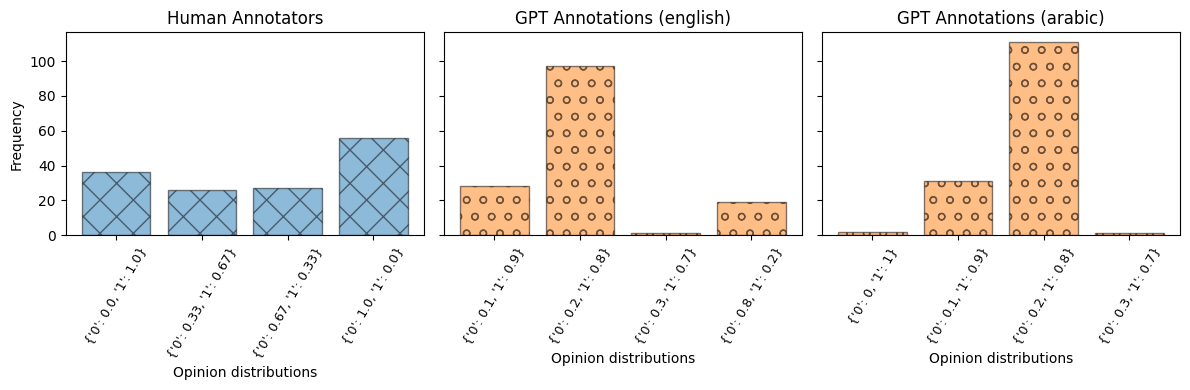
- GPT-3.5-turbo 显现出强烈的偏差,倾向于对攻击性类别赋予高置信度,尤其在使用阿拉伯语文本提示时,导致在 HS-Brexit 数据集上出现 100% 的假正例错误。
- 该模型在阿拉伯语提示下的 F1 分数显著下降(0.256),相较于英语提示(0.448),表明存在语言相关的性能退化。
- LLM 生成的观点分布平均熵值高于人类分布,表明其不确定性更高,且对单一标签的集中度更低。
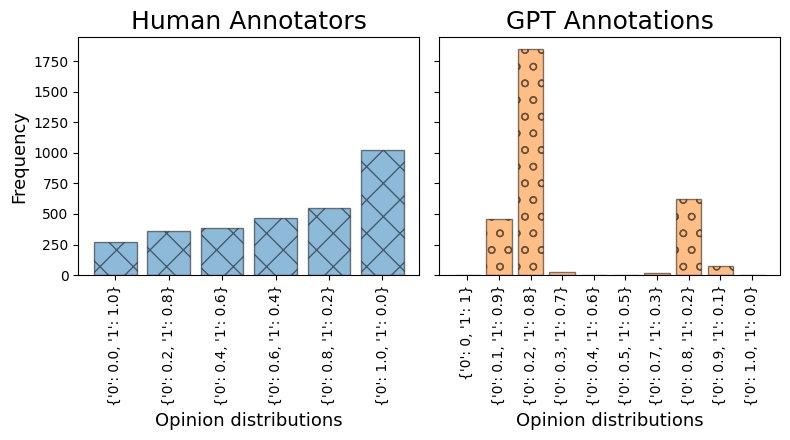
- 该模型始终生成双峰分布,偏好 {'0':0.2, '1':0.8} 和 {'0':0.8, '1':0.2},与人类共识模式明显偏离。
- 尽管在某些情况下与基线性能相当,但 GPT-3.5-turbo 在 F1 和交叉熵指标上始终劣于微调模型。
- 本研究证实,直接提示 LLM 输出观点分布会导致其与人类标注产生错位,尤其在非英语语境及敏感内容上更为显著。
阅读本论文
在 Nubint 阅读器中打开原文,边读边就任意段落提问。
在 Nubint 中阅读本论文本解读由 AI 根据论文原文生成,引用前请核对原文。