
[论文解读] The Gas-Phase Mass--Metallicity Relation for Massive Galaxies at $z\sim0.7$ with the LEGA-C Survey
本研究利用LEGAC-Survey的深空VLT/VIMOS光谱,将大质量星系的气相质量-金属丰度关系(MZR)延伸至z ≈ 0.7时的log(M⋆/M☉) ≈ 11.1。结果揭示了在高 stellar 质量下MZR呈现平坦化趋势,与模拟预测相矛盾,为星系演化中活动星系核(AGN)反馈模型提供了关键的观测约束。
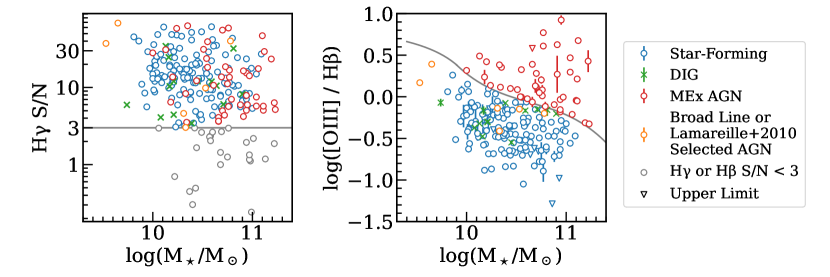
The massive end of the gas-phase mass--metallicity relation (MZR) is a sensitive probe of active galactic nuclei (AGN) feedback that is a crucial but highly uncertain component of galaxy evolution models. In this paper, we extend the $z\sim0.7$ MZR by $\sim$0.5 dex up to log$(M_\star/ extrm{M}_\odot)\sim11.1$. We use extremely deep VLT VIMOS spectra from the Large Early Galaxy Astrophysics Census (LEGA-C) survey to measure metallicities for 145 galaxies. The LEGA-C MZR matches the normalization of the $z\sim0.8$ DEEP2 MZR where they overlap, so we combine the two to create an MZR spanning from 9.3 to 11.1 log$(M_\star/ extrm{M}_\odot)$. The LEGA-C+DEEP2 MZR at $z\sim0.7$ is offset to slightly lower metallicities (0.05-0.13 dex) than the $z\sim0$ MZR, but it otherwise mirrors the established power law rise at low/intermediate stellar masses and asymptotic flattening at high stellar masses. We compare the LEGA-C+DEEP2 MZR to the MZR from two cosmological simulations (IllustrisTNG and SIMBA), which predict qualitatively different metallicity trends for high-mass galaxies. This comparison highlights that our extended MZR provides a crucial observational constraint for galaxy evolution models in a mass regime where the MZR is very sensitive to choices about the implementation of AGN feedback.
研究动机与目标
- 测量z ≈ 0.7时大质量星系的气相金属丰度,以探究质量-金属丰度关系(MZR)的高质质量端。
- 通过将现有MZR的测量范围在星系恒星质量上扩展约0.5 dex,达到log(M⋆/M☉) ≈ 11.1,实现进一步延伸。
- 将观测到的MZR与宇宙学模拟(IllustrisTNG和SIMBA)的预测进行比较,以约束活动星系核(AGN)反馈在星系演化中的作用。
- 为校准星系形成模型中AGN反馈参数化方案提供高精度的观测基准。
提出的方法
- 获取了来自LEGAC-Survey的145个大质量星系在红移范围0.6 < z < 1.0内的极深VLT VIMOS光谱。
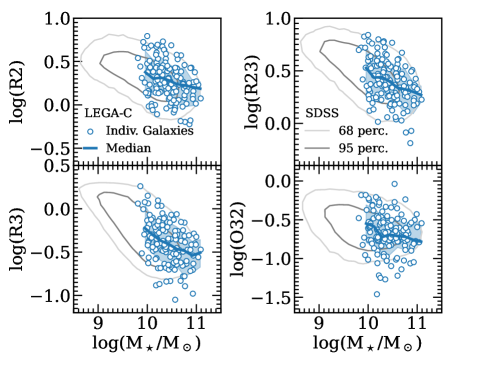
- 利用强发射线(如[O III] λ5007、Hβ、[O II] λ3727)通过光谱拟合与孔径修正,测量气相氧丰度(12 + log(O/H))。
- 将LEGAC-Survey数据与z ≈ 0.8的DEEP2 MZR结合,构建从log(M⋆/M☉) = 9.3到11.1的连续MZR。
- 将模拟的MZR(IllustrisTNG和SIMBA)归一化至log(M⋆/M☉) = 10.4处,与LEGAC-Survey+DEEP2 MZR直接比较。
- 使用统计拟合(LMFIT、emcee)推导金属丰度及其不确定性,同时考虑尘埃消光与孔径效应。
- 应用SFR加权与质量加权的金属丰度估计算法,评估模拟中选择效应的敏感性。
实验结果
研究问题
- RQ1在z ≈ 0.7时,气相MZR的高质质量端如何演化?在log(M⋆/M☉) ≈ 11.1处是否呈现平坦化或下降趋势?
- RQ2IllustrisTNG与SIMBA宇宙学模拟在高星系恒星质量下的预测与观测到的MZR相比如何?
- RQ3观测到的MZR在多大程度上约束了星系演化模型中AGN反馈的实现方式?
- RQ4考虑到模拟中的趋势,观测到的MZR是否与热模式或射电模式的AGN反馈机制一致?
- RQ5z ≈ 0.7时MZR的归一化与形状与本地(z ≈ 0)MZR相比如何?
主要发现
- LEGAC-Survey的MZR将MZR的高质质量端延伸至log(M⋆/M☉) ≈ 11.1,相比先前测量,动态范围扩展了约0.5 dex。
- 在z ≈ 0.7时,LEGAC-Survey+DEEP2 MZR相比本地z ≈ 0的MZR存在0.05–0.13 dex的金属丰度偏低偏移,与宇宙金属丰度演化一致。
- 观测到的MZR在高质质量区(log(M⋆/M☉) > 10.6)呈现平坦化趋势,金属丰度趋近于~12 + log(O/H) ≈ 8.75,与IllustrisTNG模拟预测的金属丰度下降趋势相反。
- IllustrisTNG模拟预测在log(M⋆/M☉) ≈ 10.6处出现金属丰度下降,这是由于喷射式AGN反馈将富含金属的气体排出,与观测结果不一致。
- SIMBA模拟预测金属丰度在log(M⋆/M☉) = 11之前持续上升,但在高质质量区仍高于观测到的MZR,表明金属过度生产或风金属装载效率不足。
- 观测到的MZR为校准模拟中AGN反馈提供了关键约束,支持金属喷射被抑制或呈现封闭盒式演化特征的模型。
阅读本论文
在 Nubint 阅读器中打开原文,边读边就任意段落提问。
在 Nubint 中阅读本论文本解读由 AI 根据论文原文生成,引用前请核对原文。