
[论文解读] The interstellar medium conditions of a strong Lya emitter at z = 8.279 revealed by JWST: a robust LyC leaker candidate at the Epoch of Reionization
利用詹姆斯·韦布空间望远镜(JWST)的NIRSpec和NIRCam数据,本研究分析了红移z = 8.279的GN-z8-LAE,一个强烈的Lyα发射体,揭示其为一个稳健的Lyman连续谱(LyC)逃逸候选体,逃逸光度分数f_esc > 14%。该星系表现出极端的恒星形成与恒星质量面密度、硬电离场,以及罕见的NIII]发射线,表明氮元素丰度超太阳系水平,支持其作为再电离时期早期再电离主导者的角色。
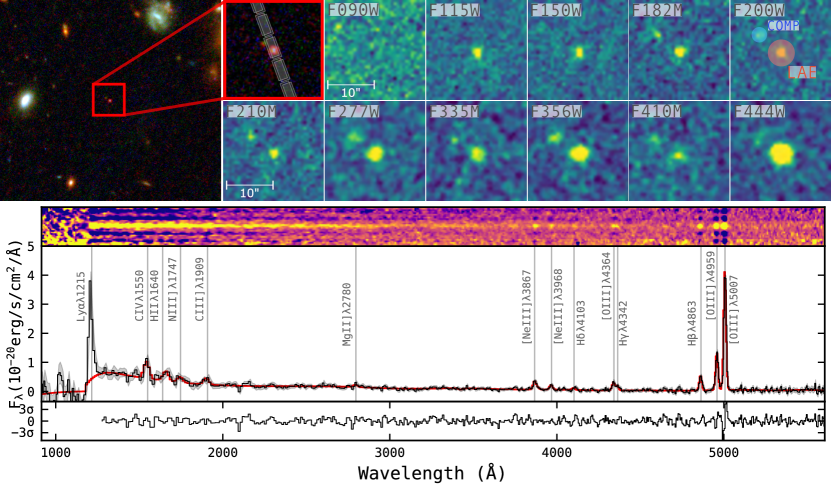
Making use of JWST NIRSpec and NIRCam data, we conduct a detailed analysis of the spectroscopic and photometric properties of GN-z8-LAE, a strong Lya emitter at z=8.279. Our goal is to investigate the interstellar medium (ISM) physical conditions that enable the Lya detection in this source at the Epoch of Reionization (EoR) and scrutinize GN-z8-LAE as an early reionizer. In broad agreement with previous results, we find that GN-z8-LAE is a young galaxy (age ~ 10 Myr) with a low stellar mass (M* ~ 10^7.66 Msun), significantly lower than those of most Lya emitters known at similarly high redshifts. The derived stellar mass and star formation rate surface densities are 355 Msun/pc^2 and 88 Msun/yr/kpc^2, respectively. Our spectral analysis indicates that: the Lya line peak has a small velocity offset 133+-72 km/s with respect to the galaxy systemic redshift; CIV] / CIII] ~ 3.3; the ISM is characterized by a hard ionization field, although no signature of AGN is present. Moreover, we report the presence of NIII]1750 emission with super-solar N abundance, which makes GN-z8-LAE one of the first known cases of a simultaneous strong Lya and nitrogen emitter at the EoR. Based on all these properties, we apply a wide range of methods to constrain the absolute Lyman continuum escape fraction of GN-z8-LAE, and find that it is >14% in all cases. Therefore, we conclude that GN-z8-LAE is a robust candidate for a Lyman continuum (LyC) leaker at the EoR which is being caught at the moment of efficiently reionizing its surrounding medium.
研究动机与目标
- 研究在再电离时期(EoR)高红移星系中促成Lyα发射的星际介质(ISM)条件。
- 评估GN-z8-LAE是否为Lyman连续谱(LyC)逃逸的强候选体,这是驱动宇宙再电离的关键要求。
- 表征GN-z8-LAE的物理属性,包括其恒星质量、恒星形成率面密度和电离场硬度。
- 探讨高红移星系中罕见NIII] λ1749–1753发射线的起源及其对金属丰度和恒星反馈的启示。
- 使用多种间接方法确定LyC逃逸分数(f_esc),建立其再电离潜力的稳健约束。
提出的方法
- 利用JWST NIRSpec和NIRCam数据进行深度光谱分析,测量发射线特性,包括Lyα、CIV、CIII]和NIII]线。
- 计算Lyα线速度偏移(Δv = 133 ± 72 km/s),相对于系统红移,以评估共振散射和ISM几何结构。
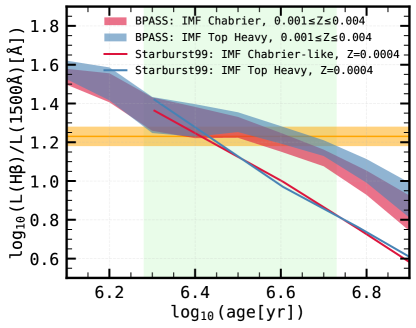
- 使用BAGPIPES代码进行光谱能量分布(SED)拟合与尘埃消光建模,估算恒星质量(M* ≈ 10^7.66 M☉)和恒星形成率(SFR)。
- 计算面密度:Σ_M* ≈ 355 M☉/pc² 和 Σ_SFR ≈ 88 M☉ yr⁻¹ kpc⁻²,以评估其紧凑性与恒星形成强度。
- 使用多种间接指标——CIV/CIII]比值、[OIII]/[OII]比值、Lyα线宽以及紫外谱指数(β ≈ -2.2 至 -2.7)——以约束f_esc。
- 应用CIV/CIII]比值(≈3.3)和NIII]检测,分别推断电离场硬度与氮元素过量丰度。
实验结果
研究问题
- RQ1GN-z8-LAE中促成z = 8.279处强Lyα发射的星际介质条件是什么?
- RQ2GN-z8-LAE中的LyC逃逸分数(f_esc)是多少?是否超过驱动再电离所需的阈值?
- RQ3该高红移星系中检测到NIII] λ1749–1753发射线的原因是什么?其对金属丰度和电离状态有何启示?
- RQ4GN-z8-LAE中极端的恒星质量与恒星形成率面密度与其LyC逃逸候选者身份有何关联?
- RQ5多种间接指标能否一致支持GN-z8-LAE作为再电离时期一个稳健的LyC逃逸候选体?
主要发现
- GN-z8-LAE是一个年龄约为10 Myr的年轻星系,恒星质量较低(M* ≈ 10^7.66 M☉),比同红移处大多数Lyα发射体更轻。
- 该星系表现出高面密度:Σ_M* ≈ 355 M☉/pc² 和 Σ_SFR ≈ 88 M☉ yr⁻¹ kpc⁻²,使其成为z ≈ 8时最紧凑且最强烈的恒星形成系统之一。
- Lyα线峰值仅相对于系统红移偏移Δv = 133 ± 72 km/s,表明共振散射极少,有利于LyC逃逸的几何条件。
- CIV/CIII]线比值约为3.3,表明电离场坚硬,与LyC逃逸候选体一致,尽管未检测到活动星系核(AGN)特征。
- 检测到NIII] λ1749–1753发射线意味着氮元素丰度超太阳系水平,这与推导出的亚太阳金属丰度不一致,可能与极端面密度或沃尔夫-拉叶星有关。
- 所有方法均得出f_esc > 14%,确立GN-z8-LAE为迄今在再电离时期发现的最稳健LyC逃逸候选体。
阅读本论文
在 Nubint 阅读器中打开原文,边读边就任意段落提问。
在 Nubint 中阅读本论文本解读由 AI 根据论文原文生成,引用前请核对原文。