
[论文解读] The JWST Resolved Stellar Populations Early Release Science Program II. Survey Overview
本文介绍了詹姆斯·韦伯太空望远镜(JWST)早期释放科学计划中针对分辨恒星群的研究,利用近红外相机(NIRCam)和近红外光谱仪(NIRISS)对三个不同的本星系群目标——M92、G12和WLM进行了27.5小时的成像观测。该研究获得了迄今为止最深的色-星等图(CMD),在M92中达到氢燃烧极限(mF090W ≈ 28.2,M ≈ +13.6),在Draco II中探测到银河系以外最轻质量的恒星(0.09 M☉),并在WLM中延伸至最老主序星转折点以下1.5个星等,验证了NIRCam暴露时间计算器(ETC)的性能,并实现了基于DOLPHOT模块的高精度测光。
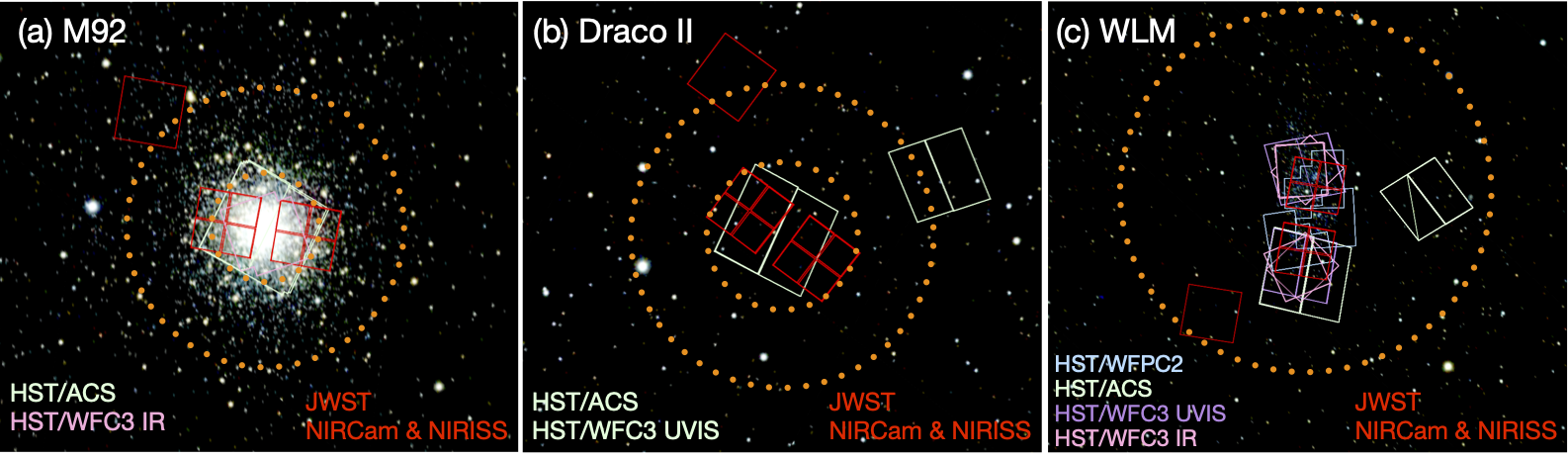
We present the JWST Resolved Stellar Populations Early Release Science (ERS) science program. We obtained 27.5 hours of NIRCam and NIRISS imaging of three targets in the Local Group (Milky Way globular cluster M92, ultra-faint dwarf galaxy Draco II, star-forming dwarf galaxy WLM), which span factors of $\sim10^5$ in luminosity, $\sim10^4$ in distance, and $\sim10^5$ in surface brightness. We describe the survey strategy, scientific and technical goals, implementation details, present select NIRCam color-magnitude diagrams (CMDs), and validate the NIRCam exposure time calculator (ETC). Our CMDs are among the deepest in existence for each class of target. They touch the theoretical hydrogen burning limit in M92 ($<0.08$ $M_{\odot}$; SNR $\sim5$ at $m_{F090W}\sim28.2$; $M_{F090W}\sim+13.6$), include the lowest-mass stars observed outside the Milky Way in Draco II (0.09 $M_{\odot}$; SNR $=10$ at $m_{F090W}\sim29$; $M_{F090W}\sim+12.1$), and reach $\sim1.5$ magnitudes below the oldest main sequence turnoff in WLM (SNR $=10$ at $m_{F090W}\sim29.5$; $M_{F090W}\sim+4.6$). The PARSEC stellar models provide a good qualitative match to the NIRCam CMDs, though are $\sim0.05$ mag too blue compared to M92 F090W$-$F150W data. The NIRCam ETC (v2.0) matches the SNRs based on photon noise from DOLPHOT stellar photometry in uncrowded fields, but the ETC may not be accurate in more crowded fields, similar to what is known for HST. We release beta versions of DOLPHOT NIRCam and NIRISS modules to the community. Results from this ERS program will establish JWST as the premier instrument for resolved stellar populations studies for decades to come.
研究动机与目标
- 确立JWST在早期运行阶段作为分辨恒星群研究首选设施的地位。
- 在亮度、距离和表面亮度范围广泛的不同恒星系统中,测试并验证NIRCam和NIRISS仪器的性能。
- 开发并部署适用于NIRCam和NIRISS的DOLPHOT模块,以实现未来科学任务中高精度密集场测光。
- 利用真实数据中的信噪比实测值,验证NIRCam暴露时间计算器(ETC)v2.0的准确性。
- 为球状星团、超晕矮星系和星暴矮星系生成迄今最深的色-星等图(CMD)。
提出的方法
- 对三个目标(M92:球状星团;Draco II:超晕矮星系;WLM:星暴矮星系)进行了27.5小时的NIRCam和NIRISS观测。
- 使用DOLPHOT(一种广泛使用的密集场测光软件包)进行初步测光还原,其中集成了新开发的NIRCam和NIRISS模块。
- 从DOLPHOT中提取单个恒星的信噪比(SNR),并与NIRCam ETC v2.0的预测值进行比较。
- 利用F090W和F150W滤光片生成深度色-星等图,达到极暗星等和低质量恒星。
- 将观测到的CMD与PARSEC恒星演化等时线模型进行比较,以评估模型在低质量恒星区域的拟合程度。
- 评估PSF拟合性能和信噪比测量的准确性,同时考虑明亮星等下的饱和效应以及暗淡星等下的PSF失配问题。
实验结果
研究问题
- RQ1JWST的NIRCam和NIRISS仪器在星等和质量方面,能够多深地探测本星系群中不同类型目标的恒星群?
- RQ2NIRCam ETC v2.0的预测值与真实数据中测得的实际信噪比在多大程度上一致?
- RQ3当前理论恒星模型(PARSEC)在多大程度上能准确再现M92和Draco II中低质量恒星的观测颜色?
- RQ4DOLPHOT测光流程能否有效适配JWST的NIRCam和NIRISS数据,尤其是在密集场中?
- RQ5在深空JWST成像中,影响信噪比测量的主要系统性效应(如拥挤、PSF失配)是什么?
主要发现
- M92的F090W–F150W色-星等图达到mF090W ≈ 28.2(M ≈ +13.6),触及质量小于0.08 M☉恒星的理论氢燃烧极限,且信噪比≈5。
- Draco II的色-星等图探测到质量低至0.09 M☉的恒星,信噪比为10时对应mF090W ≈ 29,为迄今在银河系以外观测到的最轻质量恒星。
- WLM的色-星等图延伸至最老主序星转折点以下约1.5个星等,达到mF090W ≈ 29.5(M ≈ +4.6),信噪比为10。
- PARSEC恒星模型与观测到的色-星等图在定性上吻合良好,但在M92和Draco II的低主序区域系统性地偏蓝约0.05 mag,可能源于对低质量恒星大气模型的局限性。
- DOLPHOT在M92中测得的信噪比与NIRCam ETC v2.0的预测值在大部分星等范围内偏差小于20%,在明亮和暗淡极端区域偏差较大,主要由饱和和PSF失配引起。
- NIRCam和NIRISS的DOLPHOT模块测试版及理论PSF模型已公开发布,可广泛用于未来密集场测光研究。

阅读本论文
在 Nubint 阅读器中打开原文,边读边就任意段落提问。
在 Nubint 中阅读本论文本解读由 AI 根据论文原文生成,引用前请核对原文。