
[论文解读] The more the merrier: SRG/eROSITA discovers two further galaxies showing X-ray quasi-periodic eruptions
本论文利用搭载于SRG空间站的eROSITA X射线望远镜,报告发现了两个新星系eRO-QPE3和eRO-QPE4,其表现出X射线准周期性喷发(QPEs)。研究结果揭示了若干新特性——包括eRO-QPE3中衰减的休眠期通量、QPE中最长的重复周期和最微弱的峰值亮度,以及eRO-QPE4中短暂的、更硬的X射线成分——这些发现支持了QPE与极端质量比旋进过程相关的理论模型,并凸显了未来需更大样本以理解其起源。
X-ray quasi-periodic eruptions (QPEs) are a novel addition to the group of extragalactic transients. In this work, we report the discovery of two further galaxies showing QPEs, eRO-QPE3 and eRO-QPE4, with the eROSITA X-ray telescope on board the Spectrum Roentgen Gamma observatory. Among the properties in common with those of known QPEs are: the thermal-like spectral shape in eruption (up to $kT\sim110-120$ eV) and quiescence ($kT\sim50-90$ eV) and its evolution during the eruptions (with a harder rise than decay); the lack of strong canonical signatures of active nuclei (from current optical, UV, infrared and radio data); and the low-mass nature of the host galaxies ($\log M_*\approx 9-10$) and their massive central black holes ($\log M_{ m BH}\approx 5-7$). These discoveries also bring several new insights into the QPE population: i) eRO-QPE3 shows eruptions on top of a decaying quiescence flux, providing further evidence for a connection between QPEs and a preceding tidal disruption event; ii) eRO-QPE3 exhibits the longest recurrence times and faintest peak luminosity of QPEs, compared to the known QPE population, excluding a correlation between the two; iii) we find evidence, for the first time, of a transient component that is harder, albeit much fainter, than the thermal QPE spectrum in eRO-QPE4; and iv) eRO-QPE4 displays the appearance (or significant brightening) of the quiescence disk component after the detection of QPEs, supporting its short-lived nature against a preexisting active galactic nucleus. Overall, the newly discovered properties (e.g., recent origin and/or transient nature of the quiescent accretion disk; lack of correlation between eruption recurrence timescales and luminosity) are qualitatively consistent with recent models that identify QPEs as extreme mass-ratio inspirals.
研究动机与目标
- 将已知的X射线准周期性喷发(QPE)源数量扩展至最初发现的少数几个之外。
- 调查新探测到的QPE的物理特性和变异性模式,以约束其形成模型。
- 检验QPE是否与低质量星系中的潮汐撕裂事件或瞬变吸积过程相关。
- 评估休眠吸积盘组分及其在QPE宿主星系中的演化作用。
- 评估在更广泛的QPE群体中,重复周期时间尺度和光度的统计显著性。
提出的方法
- 利用搭载于SRG空间站的eROSITA望远镜进行深度、大视场的X射线巡天,以探测休眠星系核中的周期性X射线喷发。
- 通过XMM-Newton、NICER、Swift-XRT、SALT和ATCA进行后续观测,以确认并表征X射线光 light curves 和光谱特性。
- 分析X射线光曲线,以测量重复周期时间、峰值光度以及喷发和休眠期的光谱演化。
- 对比X射线、光学、紫外、红外和射电波段的谱能分布,以排除活动星系核(AGN)特征并识别瞬变组分。
- 利用红移和宿主星系恒星质量估计值,推断黑洞质量,并评估QPE源所处的低质量星系环境。
- 应用统计建模,评估QPE的重复模式和变异性形态,包括不规则和中间行为。
实验结果
研究问题
- RQ1新发现的QPE源是否表现出与先前已知QPE一致的光谱和时间特性?
- RQ2eRO-QPE3中观测到的衰减休眠期通量是否为先前潮汐撕裂事件的证据,从而支持QPE与该事件的关联?
- RQ3QPE的重复周期时间与峰值光度之间是否存在相关性?eRO-QPE3是否表明二者之间缺乏此类关系?
- RQ4是否可在QPE源中识别出瞬变的、更硬的X射线组分,如在eRO-QPE4中所观测到的?
- RQ5在QPE探测后,休眠盘组分的出现或变亮是否支持吸积流具有瞬变性质?
主要发现
- eRO-QPE3表现出衰减的休眠期通量,为QPE开始之前曾发生过潮汐撕裂事件提供了有力证据。
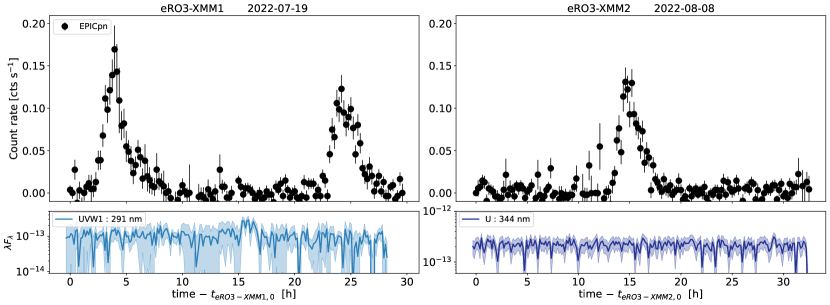
- eRO-QPE3是目前已知QPE中重复周期最长(约1.5天)且峰值光度最微弱(L_X ~ 1.5 × 10^42 erg s⁻¹)的源,表明重复周期与光度之间无相关性。
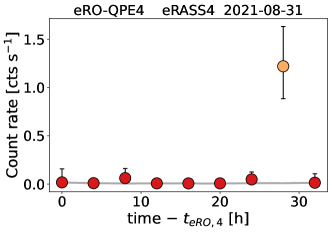
- eRO-QPE4在喷发期间表现出微弱但更硬的X射线组分,与软热谱明显不同,暗示其存在非热或不同的辐射机制。
- eRO-QPE4中的休眠吸积盘在QPE活动被探测到后显著变亮,支持吸积流具有瞬变起源,而非持续存在的AGN。
- eRO-QPE4的重复模式介于规则与不规则之间,表明QPE行为可能是一个连续谱而非严格的二分法。
- 发现两个新的QPE源增加了样本数量,并进一步支持QPE与极端质量比旋进过程相关,与当前理论模型一致。
阅读本论文
在 Nubint 阅读器中打开原文,边读边就任意段落提问。
在 Nubint 中阅读本论文本解读由 AI 根据论文原文生成,引用前请核对原文。