
[论文解读] The sample-dependent and sample-independent thermal transport properties of $α$-RuCl$_3$
本研究探讨了α-RuCl₃晶体中堆叠无序对热输运性质的影响,特别是纵向热导率中的场诱导振荡行为以及平面热霍尔效应。通过使用两种无序程度不同的晶体,作者发现振荡特征与约7.6 K处的之字形磁序相关,而非10 K或13 K处的高阶转变,且半量子化热霍尔平台强烈受无序抑制,表明本征量子现象对晶体质量极为敏感。
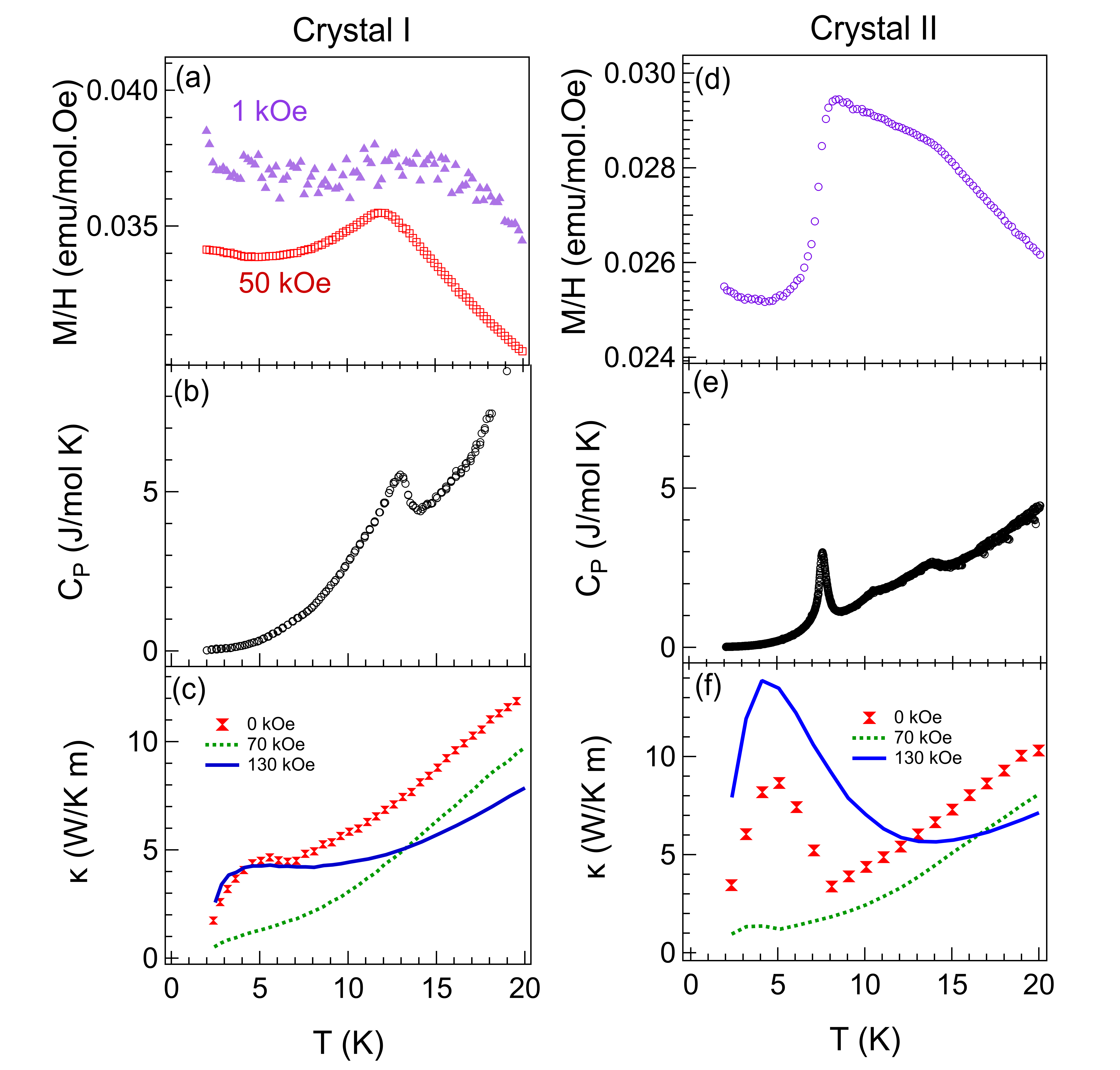
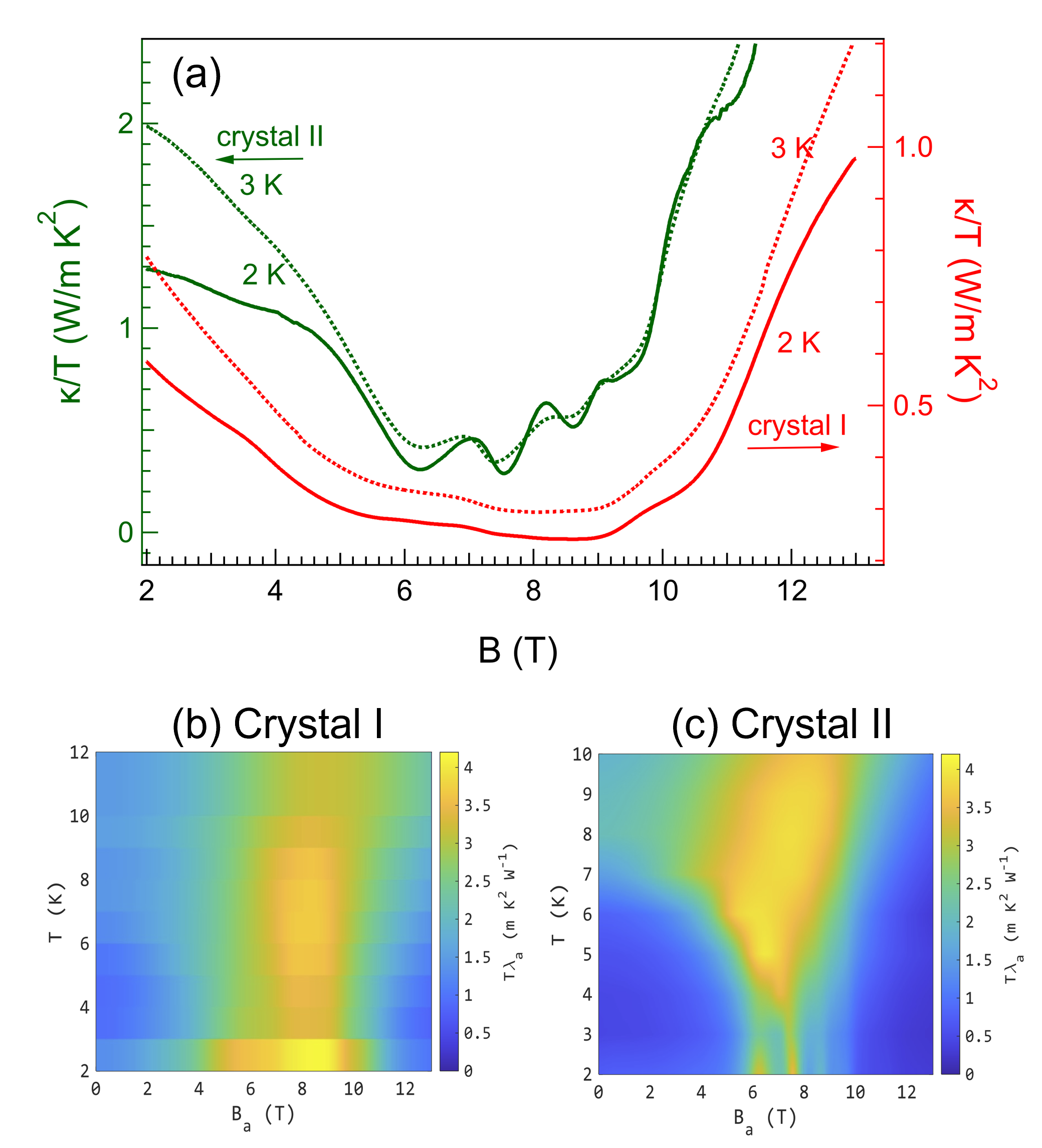
We investigated the thermal transport properties of two $α$-RuCl$_3$ crystals with different degrees of stacking disorder to understand the origin of the previously reported oscillatory feature in the field dependence of thermal conductivity. Crystal I shows only one magnetic order around 13\,K, which is near the highest T$_N$ for $α$-RuCl$_3$ with stacking faults. Crystal II has less stacking disorder, with a dominant heat capacity at 7.6\,K along with weak anomalies at 10\,K and 13\,K. In the temperature and field dependence of thermal conductivity, no obvious anomaly was observed to be associated with the magnetic order around 13\,K for either crystal or around 10\,K for crystal II. Crystal II, with less disorder, showed clear oscillations in the field dependence of thermal conductivity, while crystal I, with more disorder, did not. For crystal I, an L-shaped region in the temperature-field space was observed where thermal Hall conductivity $κ_{xy}$/T is within $\pm$20\% of the half quantized thermal Hall conductivity $κ_{HQ}$/T. While for crystal II, $κ_{xy}$/T reaches $κ_{HQ}$/T only in the high field and high temperature regime with no indication of a plateau at $κ_{HQ}$/T. Our thermal conductivity data suggest the oscillatory features are inherent to the zig-zag ordered phase with T$_N$ near 7\,K. Our planar thermal Hall effect measurements highlight the sensitivity of this phenomena to stacking disorder. Overall, our results highlight the importance of understanding and controlling crystallographic disorder for obtaining and interpreting intrinsic thermal transport properties in $α$-RuCl$_3$.
研究动机与目标
- 理解磁场下α-RuCl₃平面内热导率中振荡特征的起源。
- 研究通过机械形变引入的堆叠无序如何影响α-RuCl₃中的热输运性质。
- 确定所观察到的振荡是否源于磁场诱导的磁相变,或源于本征电子/磁序。
- 考察堆叠无序与半量子化热霍尔效应出现之间的关系。
- 澄清在量子自旋液体候选材料热输运测量中,本征与非本征效应的作用。
提出的方法
- 通过机械形变制备了两种堆叠无序程度不同的α-RuCl₃晶体。
- 利用比热测量识别了两组样品中7.6 K、10 K和13 K处的磁相变。
- 测量了纵向热导率和面内热霍尔导率(κxy)随温度和面内磁场的变化。
- 将归一化的热霍尔导率(κxy/T)与半量子化值(κHQ/T)进行比较,以评估量子化程度。
- 利用热阻率(Tλ)和κxy/T的颜色图可视化在整个相图中磁场与温度的依赖关系。
- 分析了温度-磁场空间中κxy/T在±20%范围内接近κHQ/T的L形区域,以识别潜在的量子化平台。
实验结果
研究问题
- RQ1α-RuCl₃的场依赖热导率中的振荡特征是否源于10 K和13 K处的磁相变?
- RQ2α-RuCl₃中的半量子化热霍尔效应是否为稳健的本征性质,还是对堆叠无序敏感?
- RQ3堆叠无序如何影响热导率中量子振荡的出现?
- RQ4所观测到的热输运异常是否可归因于约7.6 K处的之字形磁序,而非高阶转变?
- RQ5晶体质量在观测α-RuCl₃中本征量子自旋液体现象时起何种作用?
主要发现
- 晶体I具有高堆叠无序且主导磁相变为13 K,其在13 K或10 K处未表现出热导率中的明显异常,但在温度-磁场空间中表现出一个L形区域,其中κxy/T在半量子化值(κHQ/T)的±20%范围内。
- 晶体II堆叠无序程度较低,主导相变为7.6 K,其热导率仅在约7.6 K处之字形序存在时表现出振荡特征,表明这些振荡与该相紧密相关。
- 在晶体I中,高于4 K时热导率中的振荡特征消失,表明热激发抑制了振荡,与源于7.6 K相的量子起源一致。
- 对于晶体II,κxy/T仅在高场和高温区域接近κHQ/T,且未观察到平台,表明在无序样品中半量子化行为并不稳健。
- 平面热霍尔效应对堆叠无序极为敏感:晶体I在约80 kOe和6–12 K附近表现出一个宽而稳定的L形区域,而晶体II仅在约72 kOe附近表现出一个狭窄特征,且随温度发生移动。
- 在两组晶体中,10 K和13 K处热导率均无明显异常,表明这些相变并非驱动所观测振荡的原因,从而对‘振荡源于磁场诱导磁相变’的假设提出质疑。
阅读本论文
在 Nubint 阅读器中打开原文,边读边就任意段落提问。
在 Nubint 中阅读本论文本解读由 AI 根据论文原文生成,引用前请核对原文。