
[论文解读] The Spatial Complexity of Optical Computing and How to Reduce It
本文提出了一种空间高效的类脑光子学范式,通过利用受物理启发的结构性稀疏性——自由空间光学中的局部稀疏性以及光子芯片中的分块对角稀疏性——显著降低了光学计算系统的空间复杂度,在性能损失极小的情况下实现了高达90%的尺寸缩减,揭示了最优的缩放规律并实现了空间-精度之间的平衡权衡。
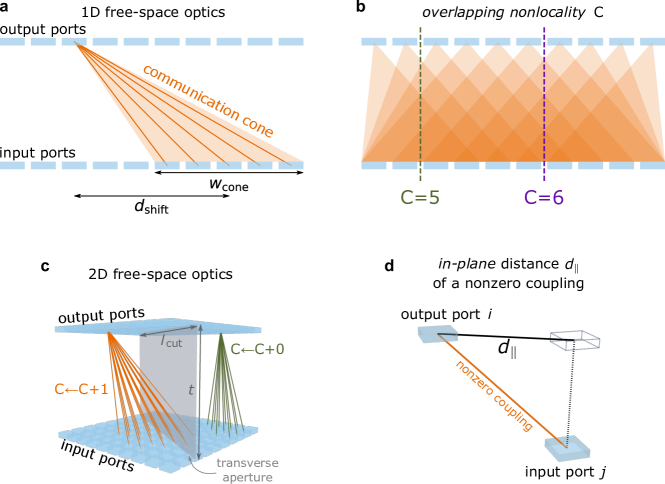
Similar to algorithms, which consume time and memory to run, hardware requires resources to function. For devices processing physical waves, implementing operations needs sufficient "space," as dictated by wave physics. How much space is needed to perform a certain function is a fundamental question in optics, with recent research addressing it for given mathematical operations, but not for more general computing tasks, e.g., classification. Inspired by computational complexity theory, we study the "spatial complexity" of optical computing systems in terms of scaling laws - specifically, how their physical dimensions must scale as the dimension of the mathematical operation increases - and propose a new paradigm for designing optical computing systems: space-efficient neuromorphic optics, based on structural sparsity constraints and neural pruning methods motivated by wave physics (notably, the concept of "overlapping nonlocality"). On two mainstream platforms, free-space optics and on-chip integrated photonics, our methods demonstrate substantial size reductions (to 1%-10% the size of conventional designs) with minimal compromise on performance. Our theoretical and computational results reveal a trend of diminishing returns on accuracy as structure dimensions increase, providing a new perspective for interpreting and approaching the ultimate limits of optical computing - a balanced trade-off between device size and accuracy.
研究动机与目标
- 为解决一个基本问题:在给定计算任务下,光学计算系统能小到何种程度,特别是针对分类等通用功能。
- 识别随任务复杂度增加而支配波基计算系统尺寸的时空缩放规律。
- 提出一种新型设计范式,在不牺牲性能的前提下减小物理尺寸,其灵感来源于计算复杂性理论与波物理。
- 探索光学计算中设备尺寸与精度之间的权衡关系,识别出在某一复杂度阈值后出现的收益递减现象。
- 通过基于物理的剪枝方法,实现神经网络稀疏模式与光学硬件设计的软硬件协同,促进二者对齐。
提出的方法
- 提出一种基于波物理启发的结构性稀疏性约束的空间高效类脑光子学框架,尤其关注‘重叠非局域性’特性。
- 将神经网络剪枝技术应用于光学系统,但根据物理波约束而非纯粹算法需求进行调整。
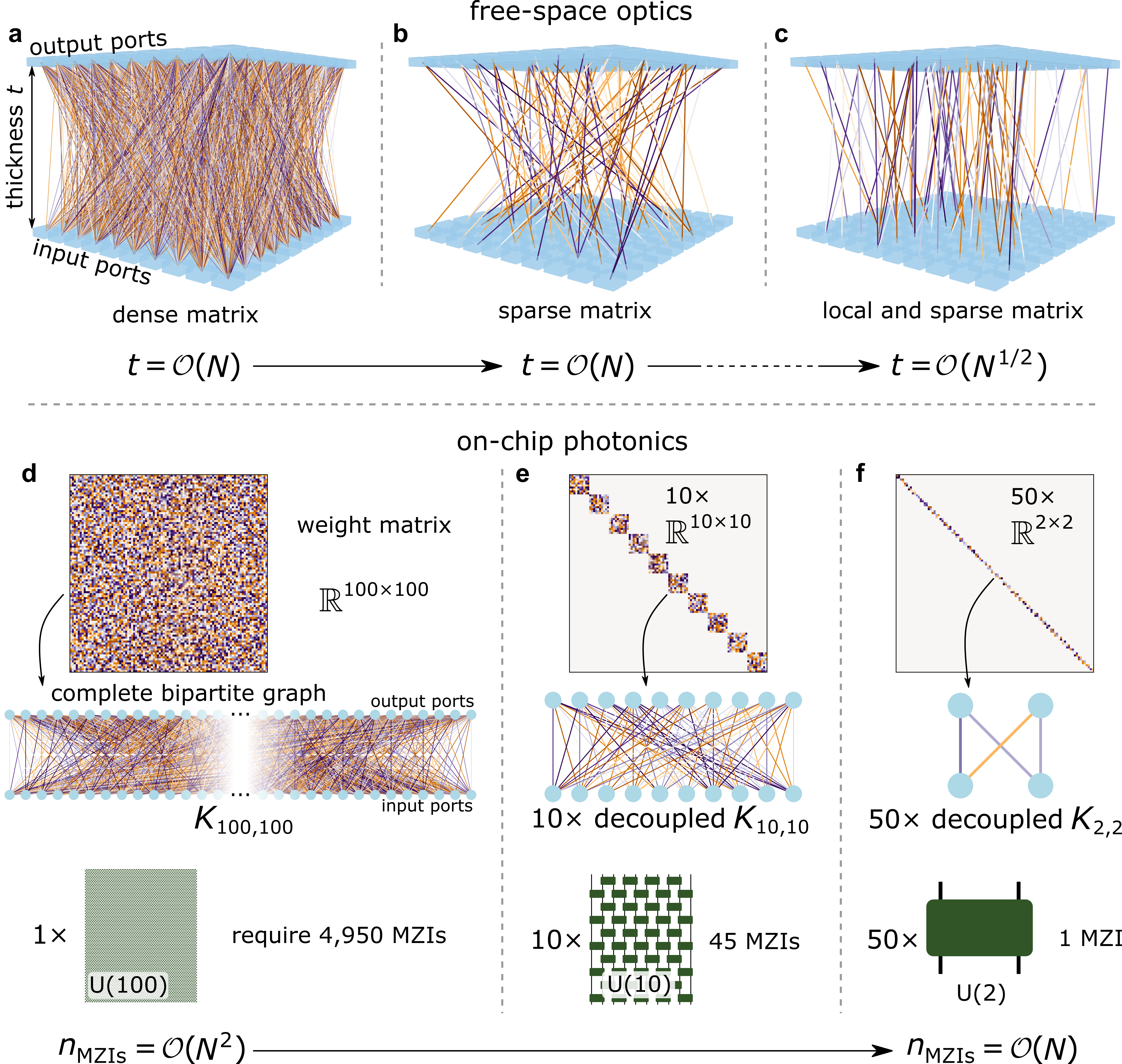
- 在自由空间光学中,强制采用‘局部稀疏’核矩阵结构,使耦合系数被限制在对角线附近,将厚度缩放从 O(N) 降低至 O(N^{1/2})。
- 在片上光子芯片中,将核矩阵实施分块对角化,分解为多个小型、解耦的完全二分图(K_{N',N'}),将Mach-Zehnder干涉仪数量从 O(N^2) 降低至准线性 O(N)。
- 采用图论方法建模光子芯片的连通性,实现高效分解为独立子网络。
- 通过计算建模与仿真,验证了在自由空间与集成光子平台中,稀疏光学系统的缩放规律与性能表现。
实验结果
研究问题
- RQ1随着计算任务维度的增加,光学计算系统的尺寸受何种基本空间缩放规律支配?
- RQ2如何设计光学计算系统,以实现最小物理占地面积下的最优缩放,同时保持高精度?
- RQ3结构性稀疏性(如局部稀疏性或分块对角化)在不降低性能的前提下,能在多大程度上减少空间复杂度?
- RQ4光学计算中的空间-精度权衡关系的本质是什么?是否存在某一尺寸之后出现收益递减现象?
- RQ5基于波物理启发的剪枝方法是否能实现神经网络稀疏性与光学硬件设计之间更紧密的协同?
主要发现
- 所提出的高效空间设计使自由空间光学与片上光子平台上的光学计算系统物理尺寸缩减至传统设计的1%–10%。
- 在采用局部稀疏核矩阵结构时,自由空间光学的厚度缩放规律从 O(N) 降低至 O(N^{1/2})。
- 光子芯片中核矩阵的分块对角化将所需Mach-Zehnder干涉仪数量从 O(N^2) 降低至准线性 O(N),实现了可扩展集成。
- 随着空间资源增加,精度的收益递减趋势明显,表明存在空间与性能之间的平衡权衡。
- 经过优化剪枝的光学神经网络在仅消耗1%–10%空间资源的情况下,达到与未剪枝网络相当的精度。
- 研究表明,调整光学系统全局连通性拓扑结构,其对性能优化的重要性与调节传统光学参数(如折射率对比度)相当。
阅读本论文
在 Nubint 阅读器中打开原文,边读边就任意段落提问。
在 Nubint 中阅读本论文本解读由 AI 根据论文原文生成,引用前请核对原文。