
[论文解读] The SRG/eROSITA all-sky survey: Hard X-ray selected Active Galactic Nuclei
本论文利用SRG卫星上的eROSITA,首次在硬X射线波段(2.3–5 keV)开展了全天成像巡天,识别出5,466个硬X射线选中的活动星系核(AGN),其中包括大量仅在硬 band 中检测到的严重遮蔽AGN。该巡天对柱密度 >10^24 cm⁻² 的康普顿厚源表现出增强的敏感性,显著扩展了此前如Swift-BAT等巡天对遮蔽AGN的普查范围。
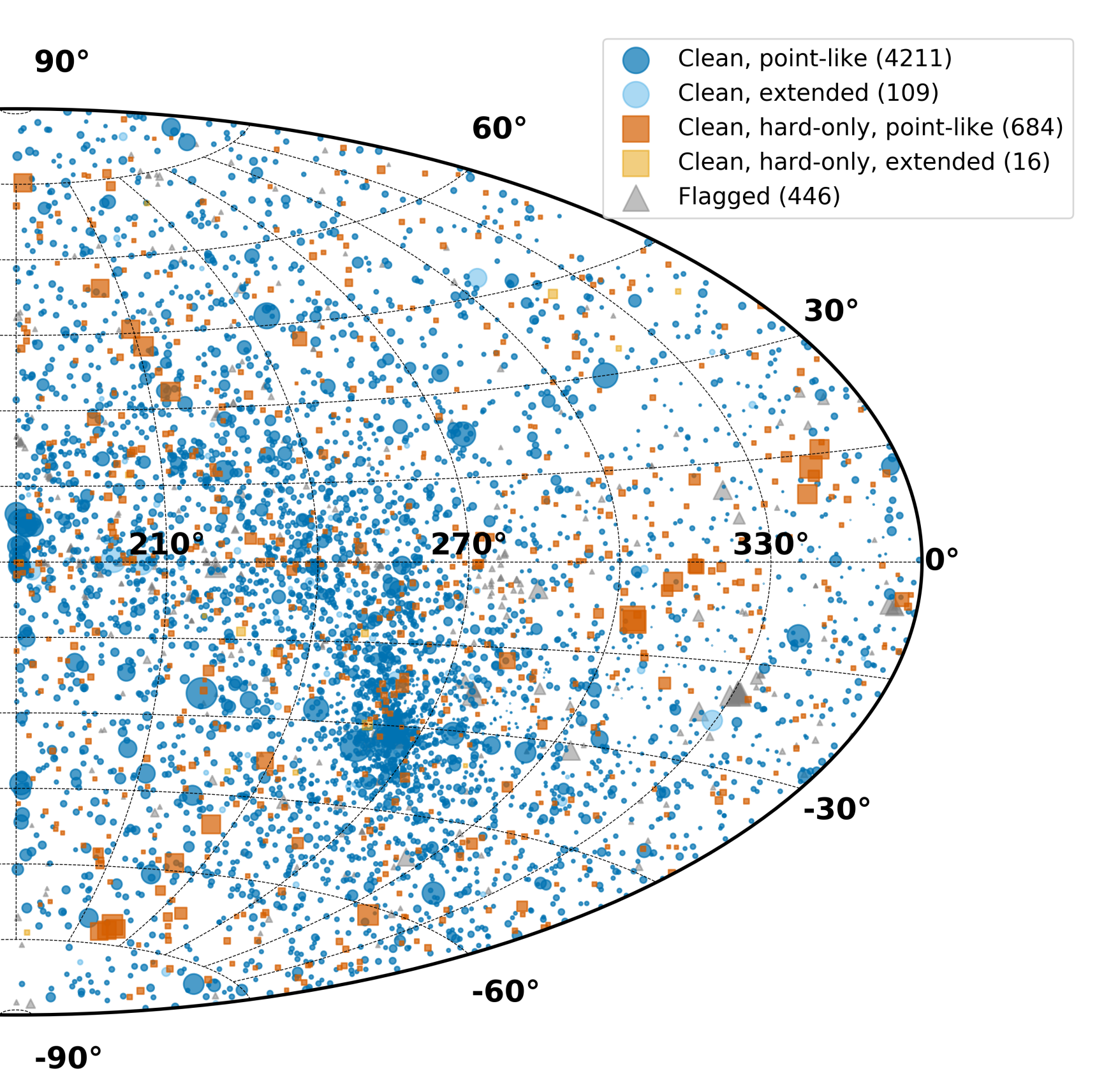
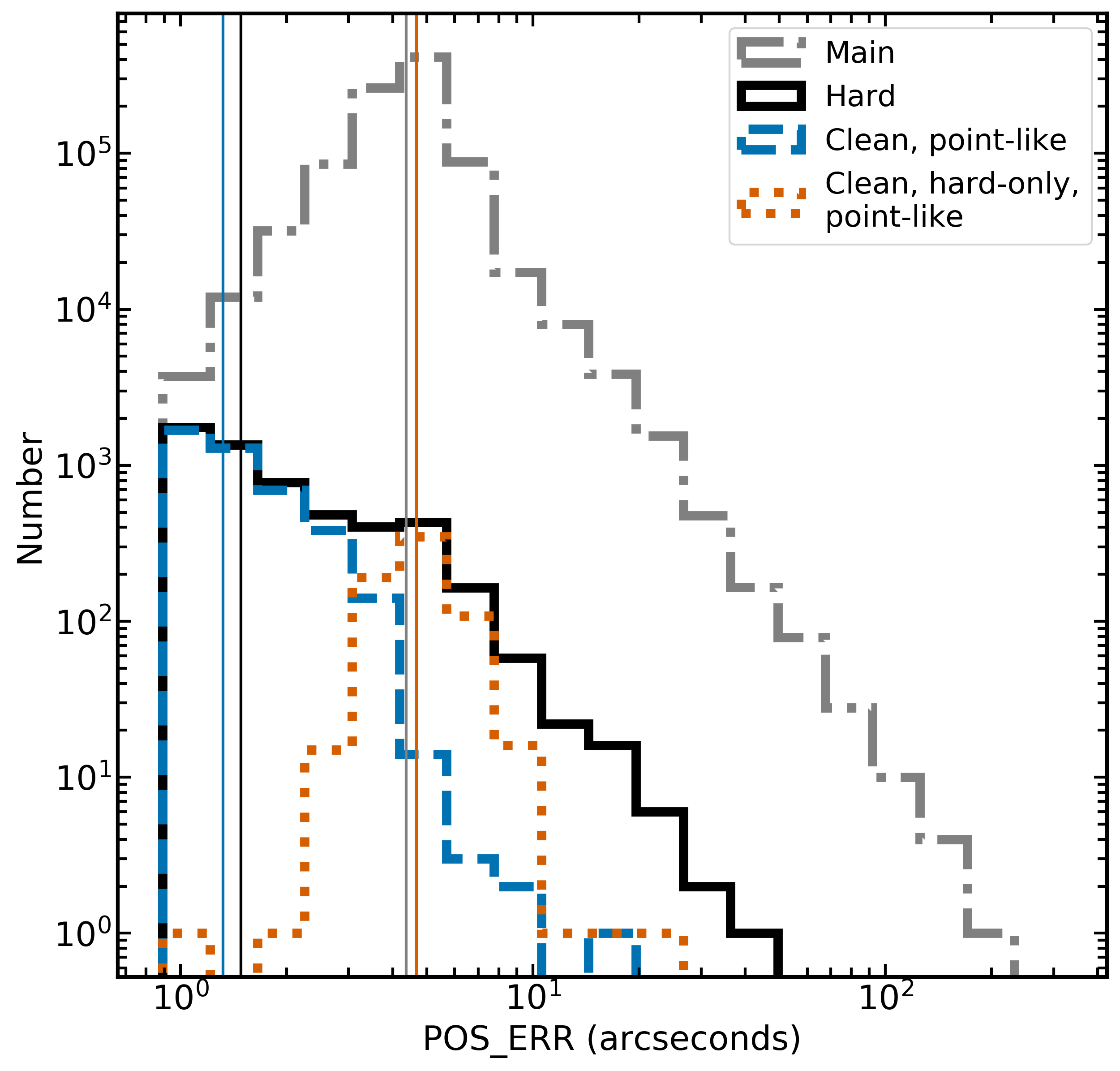
The eROSITA instrument aboard the Spectrum Roentgen Gamma (SRG) satellite has performed its first all-sky survey between December 2019 and June 2020. This paper presents the resulting hard X-ray (2.3-5 keV) sample, the first created from an all-sky imaging survey in the 2-8 keV band, for sources within western galactic sky. The 5466 hard X-ray selected sources detected with eROSITA are presented and discussed. The Bayesian statistics-based code NWAY is used to identify the counterparts for the X-ray sources. These sources are classified based on their multiwavelength properties, and the literature is searched to identify spectroscopic redshifts, which further inform the source classification. A total of 2547 sources are found to have good-quality counterparts, and 111 of these are detected only in the hard band. Comparing with other hard X-ray selected surveys, the eROSITA hard sample covers a larger redshift range and probes dimmer sources, providing a complementary and expanded sample as compared to Swift-BAT. Examining the column density distribution of missed and detected eROSITA sources present in the follow-up catalog of Swift BAT 70 month sources, it is demonstrated that eROSITA can detect obscured sources with column densities $>10^{24}$ cm$^{-2}$, but that the completeness drops rapidly after $10^{23}$ cm$^{-2}$. A sample of hard-only sources, many of which are likely to be heavily obscured AGN, is also presented and discussed. X-ray spectral fitting reveals that these sources have extremely faint soft X-ray emission and their optical images suggest that they are found in more edge-on galaxies with lower b/a. The resulting X-ray catalog is demonstrated to be a powerful tool for understanding AGN, in particular heavily obscured AGN found in the hard-only sample.
研究动机与目标
- 创建首个基于全天成像巡天的2–8 keV波段硬X射线选AGN大而均匀的样本。
- 利用遗产巡天和档案数据中的天体测量、测光和光谱数据,表征这些AGN的多波段性质。
- 评估eROSITA对遮蔽AGN的敏感性,特别是对柱密度 >10^23 cm⁻² 的源,并与Swift-BAT和HEAO-1进行比较。
- 识别并分析一个‘仅硬X射线’AGN样本——仅在硬X射线波段被探测到的源,表明其存在极端遮蔽。
- 评估巡天在不同柱密度区间内的完备性,并理解在探测最严重遮蔽AGN时的局限性。
提出的方法
- eROSITA全天巡天(2019年12月至2020年6月)提供了2.3–5 keV波段的主要X射线数据,构成了硬X射线选样本的基础。
- 使用贝叶斯对应源寻找代码NWAY,将X射线源与多波段星表(包括Legacy Survey DR10)中的光学/红外对应体进行匹配。
- 源的分类基于多波段测光和形态学特性,文献中的光谱红移用于优化分类结果。
- 对仅硬X射线探测的源进行X射线谱拟合,以约束其本征性质,包括软X射线通量和柱密度。
- 将eROSITA与Swift-BAT 70个月星表中漏检和检测源的柱密度分布进行比较,以评估完备性。
- 统计分析量化了eROSITA对康普顿厚AGN的敏感性,特别是在N_H > 10^24 cm⁻²的区间。
实验结果
研究问题
- RQ1eROSITA在探测高柱密度AGN方面,特别是N_H > 10^24 cm⁻²的源,其完备性如何?
- RQ2eROSITA的硬X射线样本在深度和红移范围上与以往硬X射线巡天(如Swift-BAT和HEAO-1)相比如何?
- RQ3硬X射线选AGN中,有多少比例仅在硬波段被探测到?这对其遮蔽程度和宿主星系性质有何含义?
- RQ4‘仅硬X射线’AGN的光谱和形态特征是什么?它们与典型AGN有何不同?
- RQ5eROSITA对遮蔽AGN的敏感性相比以往全天巡天提升了多少?
主要发现
- eROSITA在2.3–5 keV波段探测到5,466个硬X射线源,构成了首个在2 keV以上的全天成像巡天。
- 其中2,547个源具有高质量的多波段对应体,其中111个仅在硬波段被探测到,表明存在极端遮蔽。
- 与Swift-BAT相比,该巡天探测到更宽的红移范围和更暗的通量,提供了更完整的宇宙时空中AGN的普查。
- eROSITA能够探测柱密度 >10^24 cm⁻² 的AGN,但当N_H ~ 10^23 cm⁻²以上时,完备性急剧下降,表明对高度遮蔽源存在检测阈值。
- ‘仅硬X射线’AGN样本表现出极弱的软X射线辐射,且主要分布在轴比(b/a < 0.7)较低的侧向星系中,支持其高遮蔽特性。
- X射线谱拟合证实,这些仅硬X射线探测的源与康普顿厚吸收一致,许多源的N_H值超过10^24 cm⁻²。
阅读本论文
在 Nubint 阅读器中打开原文,边读边就任意段落提问。
在 Nubint 中阅读本论文本解读由 AI 根据论文原文生成,引用前请核对原文。