
[论文解读] Thermal Conductivity Predictions with Foundation Atomistic Models
本文提出一个框架,将基础机器学习势(foundation ML potentials)与Wigner热传导公式结合起来,在多种固体中以从第一性原理的精度在较低成本下预测非简谐振动与热导率,并包含用于提高精度的微调。它对 mp-fMLPs 与 DFT 数据进行了基准测试,并展示在何时以及如何使用 WTE 对获得准确的导热预测至关重要。
Advances in machine learning have led to the development of foundation models for atomistic materials chemistry, enabling quantum-accurate descriptions of interatomic forces across chemically diverse compounds at reduced computational cost. Hitherto, the accuracy and utility of these models have been assessed relying on descriptors based on formation energies or idealized harmonic atomic vibrations. Yet, the rigorous and physically interpretable quantification of their capability to describe both realistic anharmonic atomic dynamics and technologically relevant observables remains a pressing problem. Here, we address this problem, leveraging the Wigner formulation of heat transport and the Grüneisen approach to thermal expansion to connect the atomic-physics awareness of foundation models to their utility in predicting experimentally observable thermomechanical properties, presenting standards and fine-tuning protocols needed to achieve first-principles accuracy. We apply our framework to a database of 103 solids with diverse compositions and structures, demonstrating that it overcomes the major bottlenecks of current methods for designing heat-management materials -- high cost, limited transferability, or lack of physics awareness -- and its potential to discover materials for next-gen technologies ranging from thermal insulation to neuromorphic computing.
研究动机与目标
- 以基础 ML 势(fMLPs)为基础,推动并实现对非简谐振动和热特性的从第一性原理出发的精确预测。
- 制定基准测试和度量标准,以评估导热预测的精度与成本权衡。
- 提供微调协议,在零-shot fMLP 预测表现不足时实现更高精度。
- 在多样化固体数据库上展示该框架,说明热管理材料的发现潜力。
提出的方法
- 使用在近乎通用化学空间上训练的 fMLPs 来获得谐振和三阶非简谐振动性质。
- 通过 Wigner 传输方程(WTE)计算热导率,该方程结合粒子型和波动型贡献。
- 将零-shot fMLP 预测与来自 phononDB-PBE 数据库的 103 个化合物的 DFT-PBE 参考数据进行基准对比。
- 引入诸如对称相对误差(SRE)和对称相对均值误差(SRME)等精确度指标,以量化微观和宏观的精度。
- 应用带有 DFT-PBE 框架集的微调协议,使 fMLP 预测达到从第一性原理的精度,以 LiBr 为例进行演示。
实验结果
研究问题
- RQ1基础 ML 势是否能够在多样材料中提供对非简谐振动性质和热导率的量子级别精确预测?
- RQ2哪些基准和度量能准确反映来自 fMLPs 的物理驱动导热预测的精度?
- RQ3在波动性贡献显著的材料中,Wigner 热传输框架与 Boltzmann 传输有何比较?
- RQ4对 mp-fMLPs 的微调是否能在仅需适量额外数据和成本的情况下实现从第一性原理的精度?
- RQ5哪些材料表现出半经典 BTE 的失效,且更适合由 WTE 框架描述?
主要发现
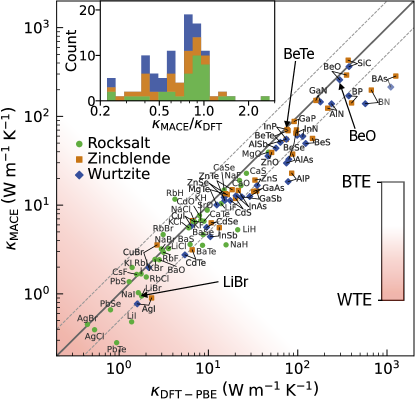
- 零-shot mp-fMLPs(MACE-MP-0、SevenNet、CHGNet、M3GNet)在 300 K 的导热率预测大约是 DFT-PBE 的两倍范围内,覆盖 phononDB-PBE 的约 69% 的 103 种化合物。
- 导热率的差异可能来自对高频声子低估,且可通过材料相关的误差抵消来缓解或补偿。
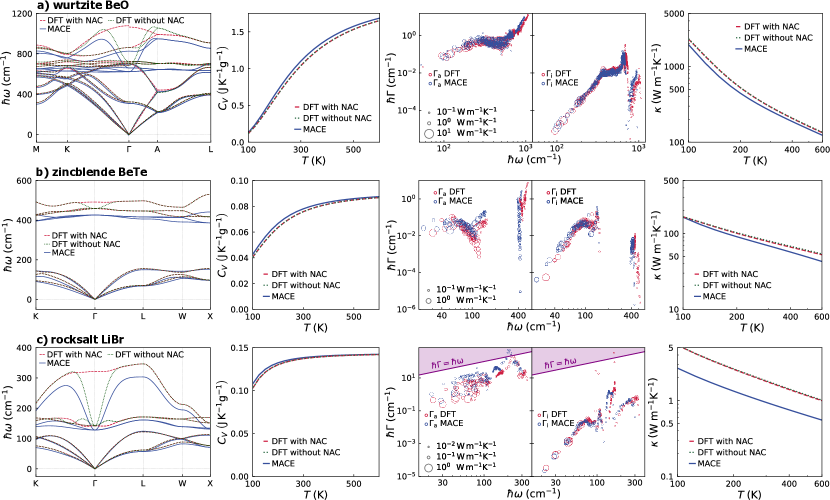
- WTE 框架同时捕捉粒子型和波动型传导,对于 BTE 低估或无法描述热传导、尤其是在低导热材料中尤为重要。
- 用一个小规模、定向的 DFT-PBE 框架集(3 帧)对 LiBr 进行微调,可在 300 K 时将导热率预测精度提高到接近 DFT-PBE 的 2%之内,同时提升声子和线宽预测。
- 使用微调模型在 100–800 K 的预测再现了实验趋势并与 aiMD 基准一致,验证了面向物理的做法。
阅读本论文
在 Nubint 阅读器中打开原文,边读边就任意段落提问。
在 Nubint 中阅读本论文本解读由 AI 根据论文原文生成,引用前请核对原文。