
[论文解读] Thought Cloning: Learning to Think while Acting by Imitating Human Thinking
思想克隆通过在行动时模仿人类思维来训练代理以语言思考,相较于行为克隆可实现更快的学习、更好的泛化、以及改进的安全性与可解释性。
Language is often considered a key aspect of human thinking, providing us with exceptional abilities to generalize, explore, plan, replan, and adapt to new situations. However, Reinforcement Learning (RL) agents are far from human-level performance in any of these abilities. We hypothesize one reason for such cognitive deficiencies is that they lack the benefits of thinking in language and that we can improve AI agents by training them to think like humans do. We introduce a novel Imitation Learning framework, Thought Cloning, where the idea is to not just clone the behaviors of human demonstrators, but also the thoughts humans have as they perform these behaviors. While we expect Thought Cloning to truly shine at scale on internet-sized datasets of humans thinking out loud while acting (e.g. online videos with transcripts), here we conduct experiments in a domain where the thinking and action data are synthetically generated. Results reveal that Thought Cloning learns much faster than Behavioral Cloning and its performance advantage grows the further out of distribution test tasks are, highlighting its ability to better handle novel situations. Thought Cloning also provides important benefits for AI Safety and Interpretability, and makes it easier to debug and improve AI. Because we can observe the agent's thoughts, we can (1) more easily diagnose why things are going wrong, making it easier to fix the problem, (2) steer the agent by correcting its thinking, or (3) prevent it from doing unsafe things it plans to do. Overall, by training agents how to think as well as behave, Thought Cloning creates safer, more powerful agents.
研究动机与目标
- 推动在强化学习代理中使用类语言的思维,以提升样本效率、泛化能力、规划与重新规划。
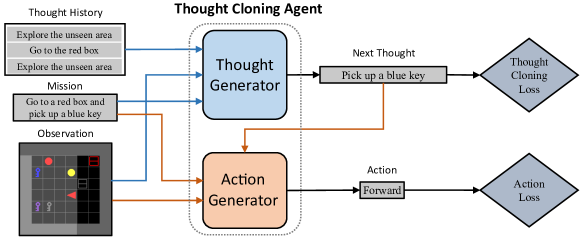
- 提出思想克隆,一种模仿学习框架,能够从同步的思考-行动演示中联合学习思考(以自然语言表示)和行动。
- 证明思想克隆在 BabyAI 的合成思维数据集上优于行为克隆,具有更强的分布外泛化和安全性收益。
提出的方法
- 引入一个双层次的思考生成器与行动生成器架构。
- 使用联合损失进行训练:思想克隆损失预测思维,行动损失预测行动,条件包括任务、观测和思维历史。
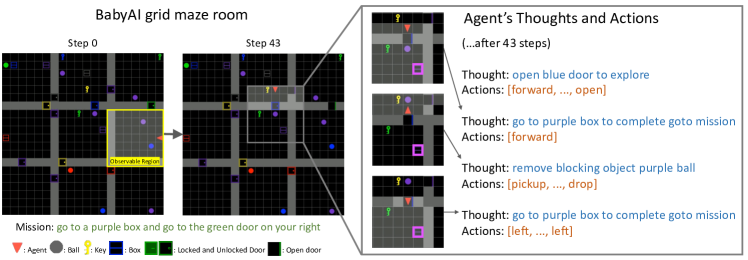
- 使用源自 BabyAI 的合成思维数据集,其中思维转录与行动和任务对齐,并加入噪声以模拟真实数据。
- 使用记忆增强的 LSTM 以及 FiLM 融合实现思考生成器;如有需要,可利用预训练的视觉-语言模型进行扩展。
- 将思想克隆与行为克隆以及没有思考模仿损失的 TC 变体进行比较,以分离思考监督的益处。
- 在 1M 条轨迹的 BabyAI 数据上评估,采用 8 次训练轮次和教师翻译计划,逐步迁移到自回归思考生成。
实验结果
研究问题
- RQ1一个从人类思维演示中学习思考与行动的双模型模仿框架是否能超越传统的行为克隆?
- RQ2使用思想克隆训练的代理是否能更好地泛化到分布外环境,并且能否通过微调进行适应?
- RQ3可解释性与安全性收益(例如干预思维的能力)在实际中是否成立?
- RQ4将人类般的思考融入是否能在具有挑战性、部分可观测的领域中实现更快的学习与规划/重新规划?
主要发现
- 思想克隆比行为克隆学习更快,并在训练过程中保持优越的性能。
- 思想克隆在没有思考模仿损失的 TC 变体上也表现更好,表明好处不仅来自更多参数。
- 思想克隆在零-shot 与微调情境下对分布外环境的泛化能力更强。
- 该方法提供了可解释性度量(未来行动声明分数)并实现了 Precrime 干预以防止不安全计划。
- 在拥有 oracle 高层次思维的条件下,思想克隆在大多数环境中实现了近乎最优的性能。
- 结果表明,使用大规模人类思维数据扩展思想克隆,可能显著提升能力与安全性。
阅读本论文
在 Nubint 阅读器中打开原文,边读边就任意段落提问。
在 Nubint 中阅读本论文本解读由 AI 根据论文原文生成,引用前请核对原文。