
[论文解读] Tight Auditing of Differentially Private Machine Learning
该论文提出了一个针对 DP-SGD 的紧致审计方案,利用 f-DP/GDP 和机制特定尾部推理,在自然数据集上仅通过两次训练即可获得接近理论隐私保证。它还展示了该方法如何揭示私有机器学习代码实现中的错误。
Auditing mechanisms for differential privacy use probabilistic means to empirically estimate the privacy level of an algorithm. For private machine learning, existing auditing mechanisms are tight: the empirical privacy estimate (nearly) matches the algorithm's provable privacy guarantee. But these auditing techniques suffer from two limitations. First, they only give tight estimates under implausible worst-case assumptions (e.g., a fully adversarial dataset). Second, they require thousands or millions of training runs to produce non-trivial statistical estimates of the privacy leakage. This work addresses both issues. We design an improved auditing scheme that yields tight privacy estimates for natural (not adversarially crafted) datasets -- if the adversary can see all model updates during training. Prior auditing works rely on the same assumption, which is permitted under the standard differential privacy threat model. This threat model is also applicable, e.g., in federated learning settings. Moreover, our auditing scheme requires only two training runs (instead of thousands) to produce tight privacy estimates, by adapting recent advances in tight composition theorems for differential privacy. We demonstrate the utility of our improved auditing schemes by surfacing implementation bugs in private machine learning code that eluded prior auditing techniques.
研究动机与目标
- 激发需要更紧凑、更加实用的经验隐私估计,超越最坏情况审计。
- 开发一种审计方案,在 DP-SGD 下为自然数据集产生紧凑的隐私估计。
- 将审计的计算负担从成千上万次训练降低到一个小而可行的数量。
- 实现对 DP-SGD 实现的直接检查,以检测与隐私相关的错误。
提出的方法
- 在 f-DP/GDP 设置中框定审计,以捕捉机制真正的隐私权衡。
- 改编隐私损失分布(PLD)和高斯 DP,以获得对隐私参数的紧下界。
- 使用 Clopper-Pearson 和贝叶斯技术,从观察到的假阳性/假阴性率中界定隐私参数。
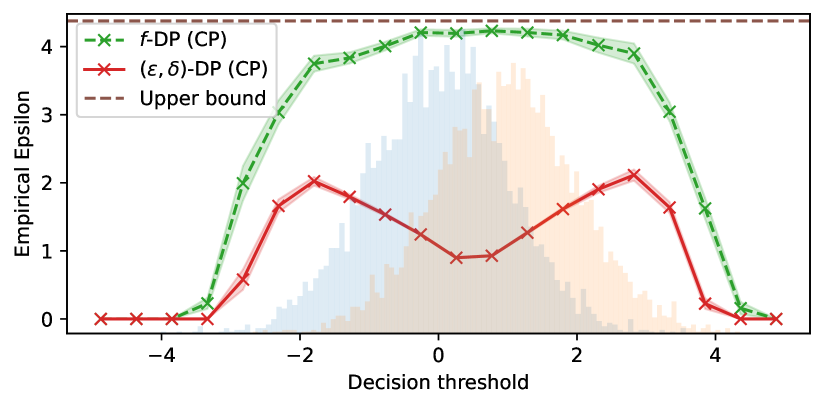
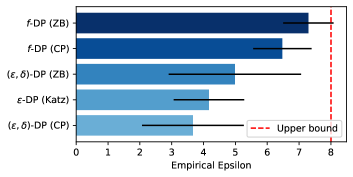
- 将基于 GDP 的审计与标准的 (epsilon, delta)-DP 审计进行比较,并在更少观测下呈现更紧的界限。
- 检验从白盒到黑盒的威胁模型,在现实攻击者能力下评估审计效果。
实验结果
研究问题
- RQ1DP-SGD 的经验隐私泄漏是否可以在自然数据集上被紧致估计,而不仅仅是最坏情况下?
- RQ2需要多少次训练才能获得 DP-SGD 的紧致经验隐私界限?
- RQ3将审计定制为特定隐私机制(通过 f-DP/GDP)是否优于通用的 DP 审计方法?
- RQ4审计是否能揭露先前方法错过的 DP-SGD 实现中的错误?
- RQ5不同攻击者威胁模型如何影响隐私审计的紧致性和可操作性?
主要发现
- 使用 GDP 的审计比传统的 epsilon-delta 审计给出更紧的经验隐私界限,在观测显著更少的情况下达到接近理论值。
- 所提出的方案在自然数据集上仅需两次训练即可产生 DP-SGD 的紧凑隐私估计。
- 将审计定制到高斯/函数字 DP 框架并使用 PLD,使得在组合和下采样下对 DP-SGD 的隐私损失能得到准确界限。
- 审计可以暴露先前审计技术遗漏的 DP-SGD 实现中的错误。
- 对威胁模型敏感的审计(包括白盒和黑盒设置)展示了对更新或数据的访问如何影响经验隐私估计的紧致性。
阅读本论文
在 Nubint 阅读器中打开原文,边读边就任意段落提问。
在 Nubint 中阅读本论文本解读由 AI 根据论文原文生成,引用前请核对原文。