
[论文解读] TimelyFL: Heterogeneity-aware Asynchronous Federated Learning with Adaptive Partial Training
TimelyFL 提出了一种对异构性敏感的异步联邦学习框架,能够根据客户端的实时能力动态调整本地训练工作量,从而实现更及时、更包容的全局模型更新。通过用时间约束的聚合间隔替代固定的缓冲区大小,并引入自适应部分训练,TimelyFL 相较于 FedBuff 将收敛速度提升 1.28×–2.89×,测试准确率提升 6.25%,同时参与率提高 21.13%。
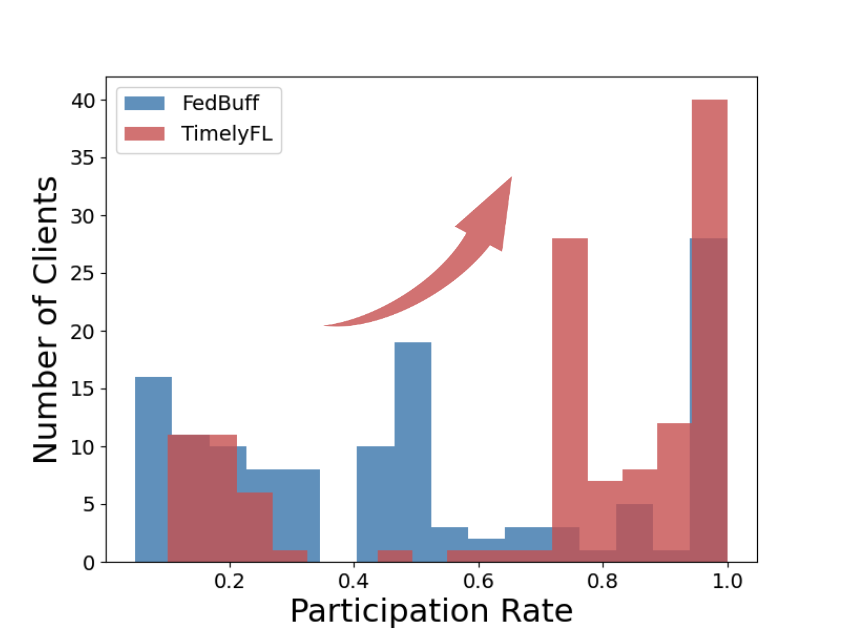
In cross-device Federated Learning (FL) environments, scaling synchronous FL methods is challenging as stragglers hinder the training process. Moreover, the availability of each client to join the training is highly variable over time due to system heterogeneities and intermittent connectivity. Recent asynchronous FL methods (e.g., FedBuff) have been proposed to overcome these issues by allowing slower users to continue their work on local training based on stale models and to contribute to aggregation when ready. However, we show empirically that this method can lead to a substantial drop in training accuracy as well as a slower convergence rate. The primary reason is that fast-speed devices contribute to many more rounds of aggregation while others join more intermittently or not at all, and with stale model updates. To overcome this barrier, we propose TimelyFL, a heterogeneity-aware asynchronous FL framework with adaptive partial training. During the training, TimelyFL adjusts the local training workload based on the real-time resource capabilities of each client, aiming to allow more available clients to join in the global update without staleness. We demonstrate the performance benefits of TimelyFL by conducting extensive experiments on various datasets (e.g., CIFAR-10, Google Speech, and Reddit) and models (e.g., ResNet20, VGG11, and ALBERT). In comparison with the state-of-the-art (i.e., FedBuff), our evaluations reveal that TimelyFL improves participation rate by 21.13%, harvests 1.28x - 2.89x more efficiency on convergence rate, and provides a 6.25% increment on test accuracy.
研究动机与目标
- 解决因慢速客户端和设备可用性差异导致的同步联邦学习可扩展性限制。
- 克服现有异步联邦学习方法(如 FedBuff)因延迟和参与偏差导致的准确率下降与收敛缓慢问题。
- 通过使更多设备——尤其是低容量或间歇性连接的设备——能够及时贡献更新,提升全局模型聚合的包容性。
- 通过根据实时客户端资源可用性动态调整本地训练工作量,设计对系统异构性具有鲁棒性的系统。
- 在非独立同分布(non-iid)数据分布下,实现更快的收敛速度和更高的测试准确率,同时不牺牲模型质量。
提出的方法
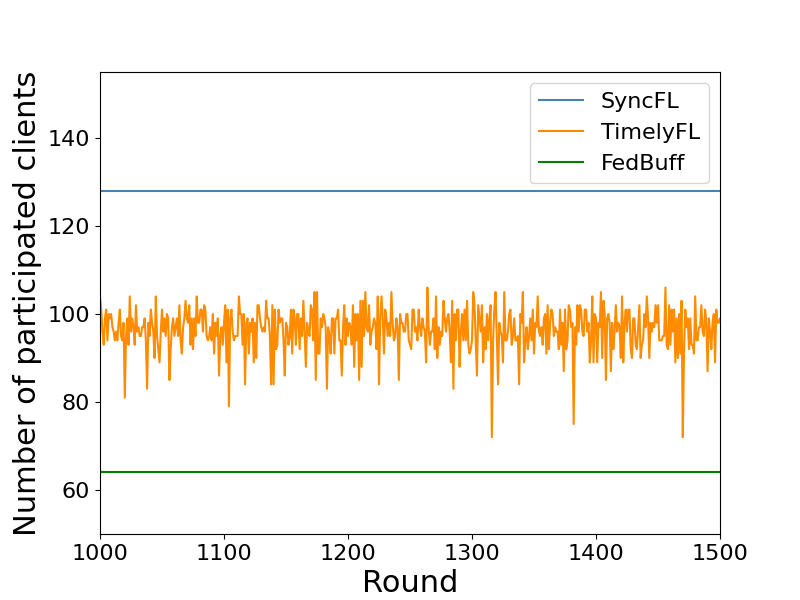
- 将 FedBuff 中固定的缓冲区大小替换为每轮聚合间隔的时间限制,使在该时间窗口内完成训练的任意客户端均可参与贡献。
- 将聚合间隔定义为第 k 个最快完成本地更新的时间,其中 k 为可调参数,确保及时纳入可用客户端。
- 为低容量设备引入自适应部分训练,即每轮仅基于实时设备能力训练完整模型的一部分。
- 根据实时设备性能动态调度训练工作量(如部分训练比例和本地训练轮次),以保持效率并减少延迟。
- 采用灵活的聚合机制,每轮可接受不同数量的更新,避免固定缓冲区大小带来的瓶颈。
- 与标准联邦学习优化器(如 FedOpt、FedAvg)集成,并在多种数据集和模型架构上进行评估。
实验结果
研究问题
- RQ1时间约束的聚合机制是否能改善异步联邦学习中的客户端参与度并减少延迟?
- RQ2为低容量设备引入自适应部分训练,在异构联邦学习环境中对收敛速度和最终模型准确率有何影响?
- RQ3在非独立同分布(non-iid)数据分布下,TimelyFL 相较于 FedBuff 在收敛速率和测试准确率方面提升程度如何?
- RQ4实时工作量自适应如何增强系统对设备异构性和间歇性连接的鲁棒性?
- RQ5TimelyFL 是否能在包括轻量化模型在内的多种模型架构和数据集上保持高性能?
主要发现
- 与 FedBuff 相比,TimelyFL 将参与率提高了 21.13%,显著提升了全局模型更新的包容性。
- 在多个数据集和模型上,TimelyFL 相较于 FedBuff 实现了 1.28× 至 2.89× 的收敛速度提升。
- 测试准确率相较 FedBuff 提升 6.25%,尤其得益于更及时且多样化的客户端贡献。
- 通过自适应工作量调度,TimelyFL 将收敛至 50% 准确率的时间缩短为 4.09×,在 CIFAR-10 上测试准确率提升 10.89%。
- 在轻量级的 Google Speech Commands 数据集上,TimelyFL 的收敛速度优于同步联邦学习(SyncFL)和 FedBuff,证实其在小型模型上的有效性。
- 在非独立同分布(non-iid)数据设置下,TimelyFL 与 FedBuff 的性能差距进一步扩大,表明其对数据异构性的更强鲁棒性。
阅读本论文
在 Nubint 阅读器中打开原文,边读边就任意段落提问。
在 Nubint 中阅读本论文本解读由 AI 根据论文原文生成,引用前请核对原文。